Gallery run 22nd June

1191
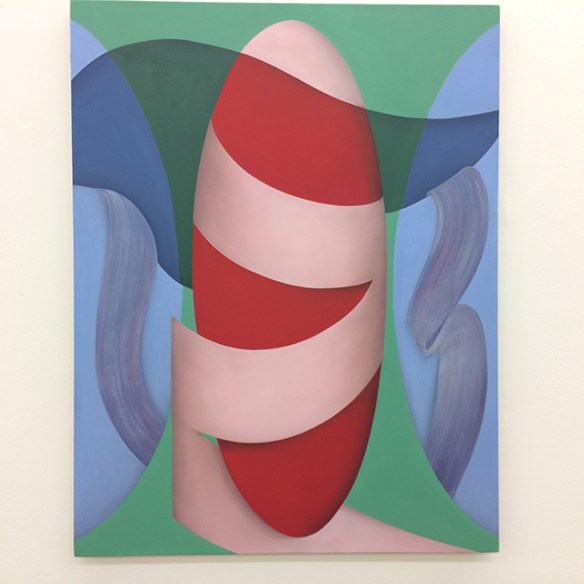
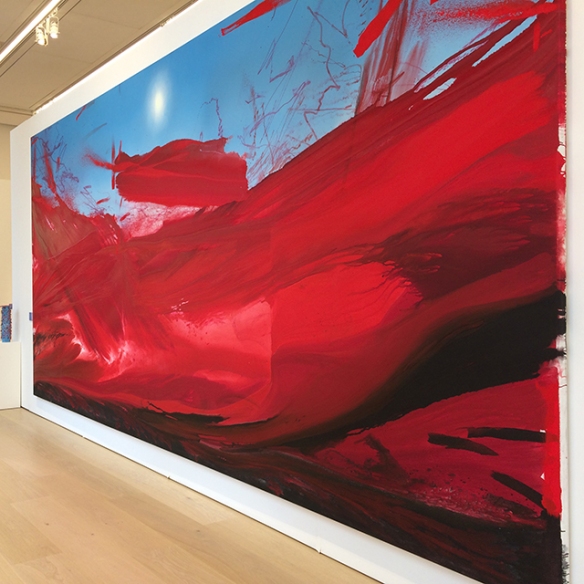
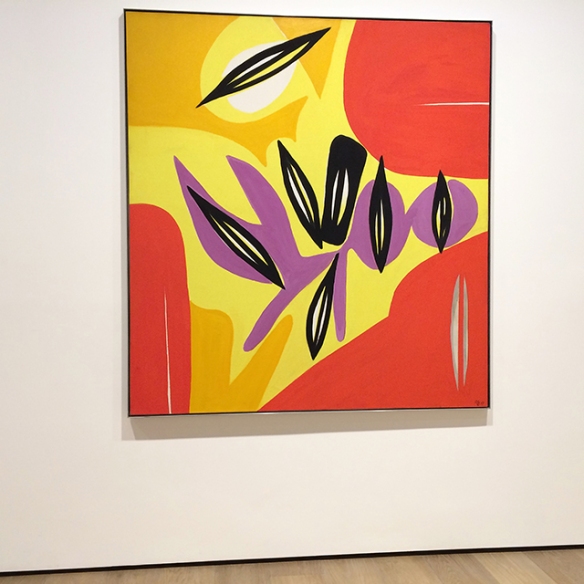
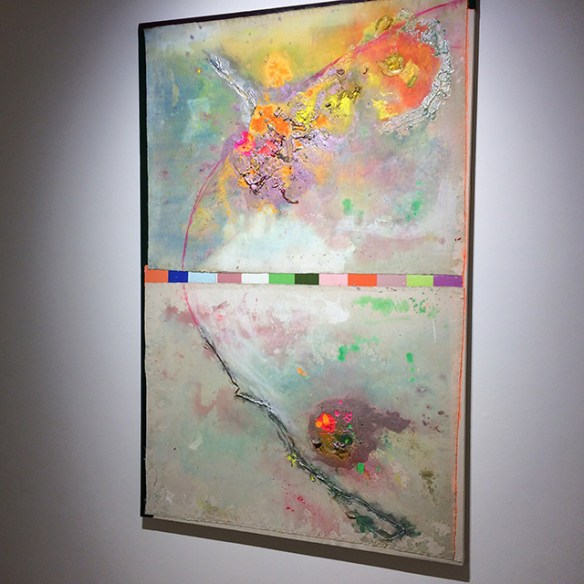
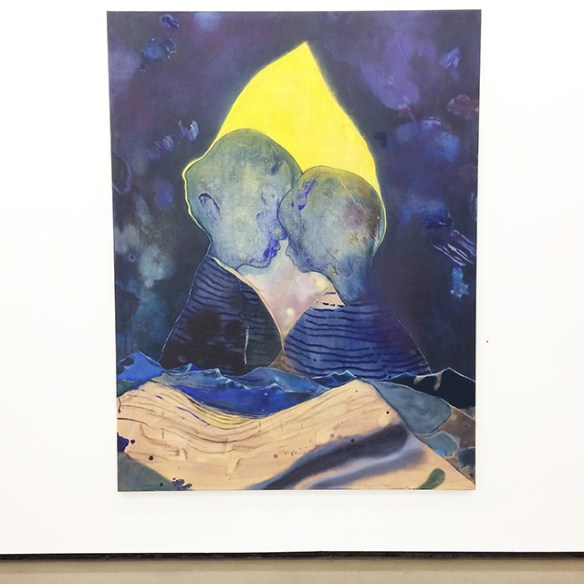
Lesley Vance of Herald Street with beautiful formal compositions that use a range of styles including a nice gestural brushstroke stylie.

1192
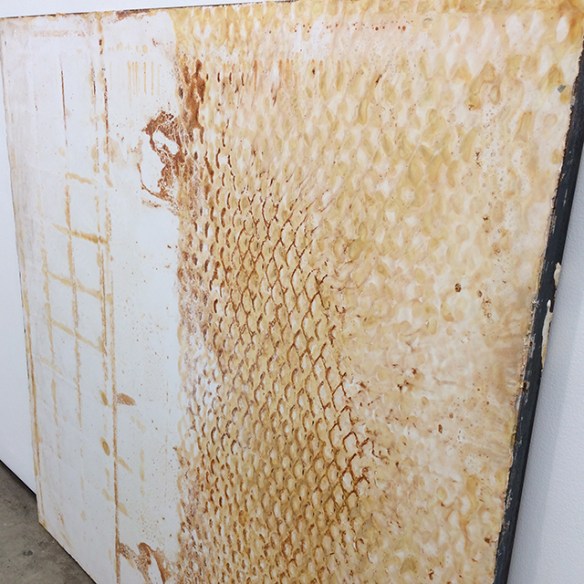
Oscar Tuazon at Maureen Paley with work that references major projects in the US. These involve live-in spaces as well as political agitation for communities to keep access to dwindling water resources as it gets syphoned off by industry. We are presented with the basic elements in the gallery of fire, water and earth, or in this case rust.

1193
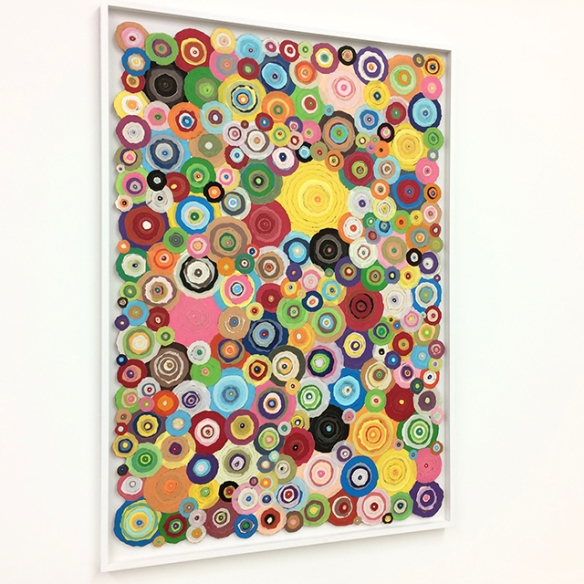
Anwar Jalal Shemza at Hales Gallery exploring the vast possibilities of composition using just circles, squares and, of course, colour.

1194
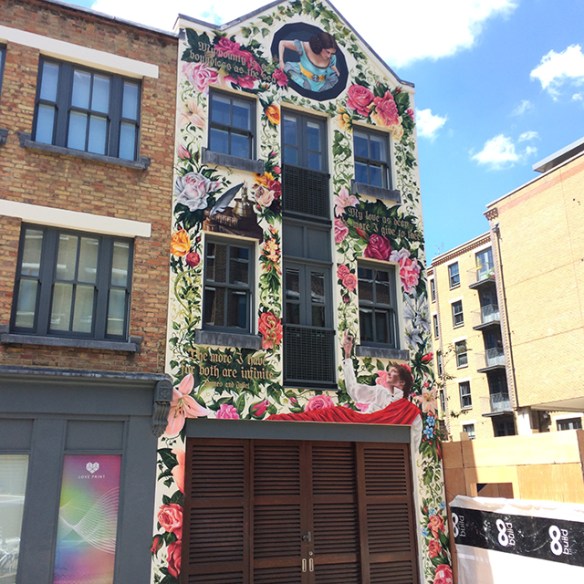
The star-crossed lovers are featured in a great mural near Hoxton.

1195
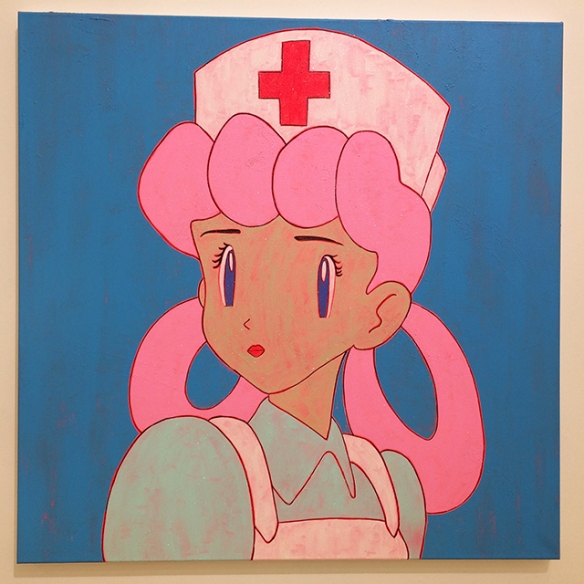
Kathryn MacNaughton at Beers London with carefully rendered re-workings of computer and mouse-generated images.

1196
Sarah Sze of Victoria Miro with great photo and paint collages. They are shown alongside lots of torn images attached to the gallery’s walls with blue tape. It is as though the artist has recreated the laboratory of visual associations from which the formally mounted works derived, as an installation in the gallery.

1197
Katharina Grosse of Gagosian with giant spray paint and stencil works, executed as high art abstraction.

1198
Eline McGeorge of Hollybush Gardens who creates pixilated images by weaving emergency foil blankets into natural imagery. The juxtaposition of the two materials creates an extra pathos suggesting that nature maybe in the position of the injured patient.

1199
Footie-England flags casting their red-crossed shadow onto a pavement somewhere near the end of today’s run in Peckham.

Gallery run 3rd May

1121
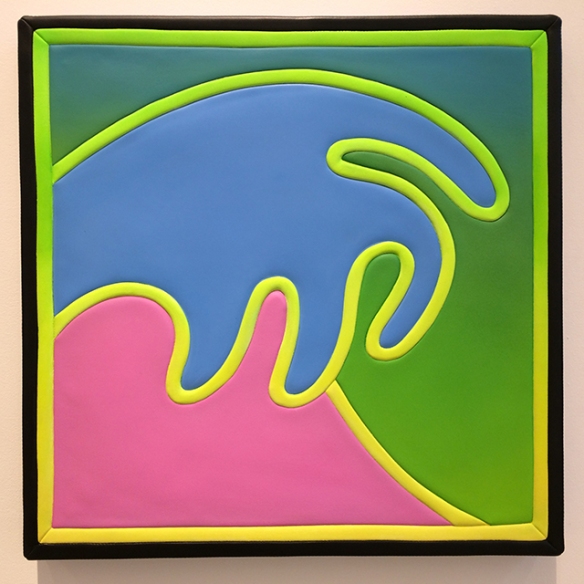
Julian Opie at Alan Cristea Gallery with the ubiquitous vinyl support now raised to the level of very good, high art.

1122
Helen Frankenthaler at Victoria Miro.

1123
Richard Serra of Gagosian with thickly covered sheets of paper, revealing uncovered edges built into the composition.

1124
Matthias Bitzer of Almine Rech Gallery with faces, mediating mathematical forms and his characteristic alternating light and dark bands of paint.

1125
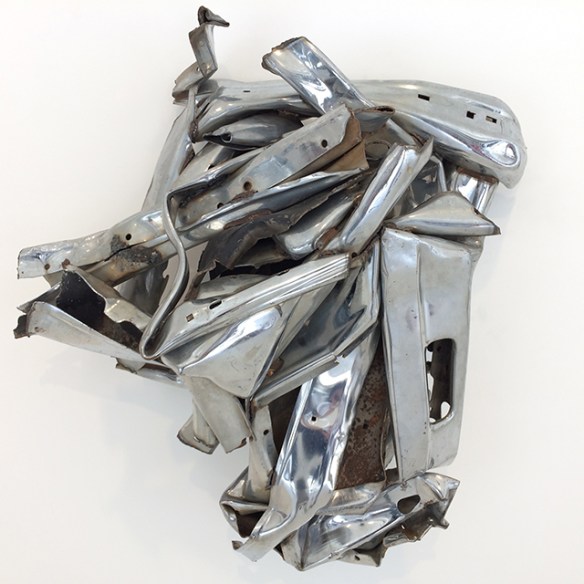
John Chamberlain of Gagosian with posthumous artwork of crushed car parts shown in conjunction with his estate.

1126
Urs Fischer of Sadie Coles HQ with an emerging nude figure.

1127
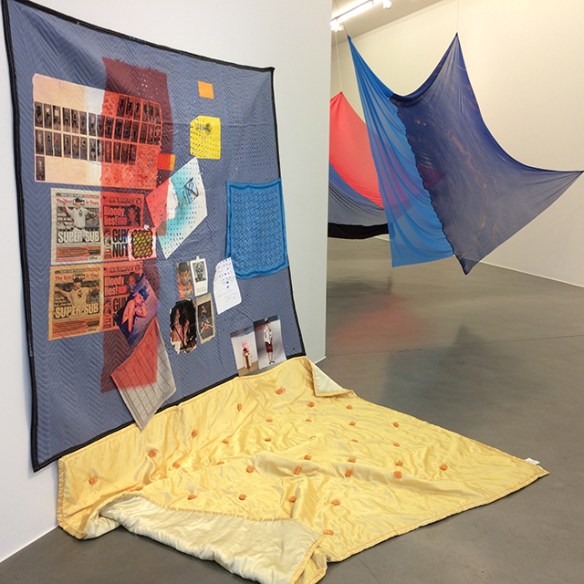
Eric N Mack at Simon Lee Gallery with multi-media images and spaces.

1128
Karen Kilimnik of Sprueth Magers with small, vivid paintings. The effect of her imagination is clear from the explosion and bullet traces that have been frozen for the single moment of the composition.

1129
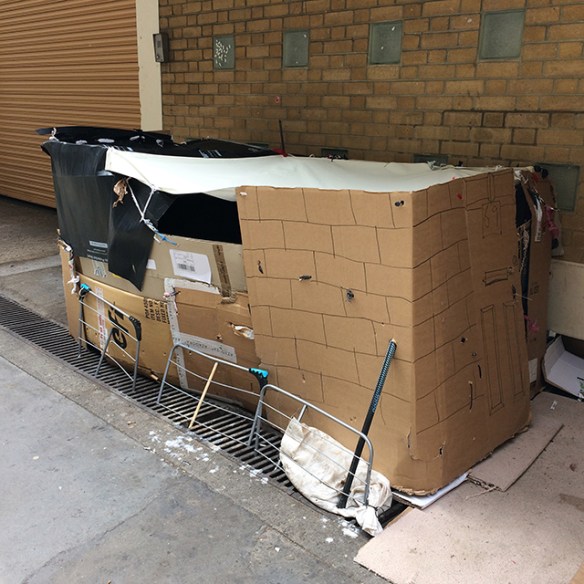
Spot the front door with letter box and street number 69, drawn onto this shelter along with the more obvious added brickwork.

Gallery run 9th March

The day begins with a jog up to White Cube Gallery in Mason’s Yard. Minjung Kim has used traditional Korean craft techniques to lay down layers of ultra-thin mulberry tree paper into rhythmic compositions. The paper has many uses outside of art in the artist’s native country including as window panes, due to its strength even in thin layers allowing light to diffuse between the various natural fibres. Downstairs, the artworks are vividly coloured. The paper has been dyed and applied in layers, with each piece burnt along one edge in a ritualistic gesture by the artist, one that we are told is accompanied by the smell of incense and a discipline of complete silence. The overall effect on the artworks is to create textured regions of intense colour reminiscent of flowers and natural vegetation.

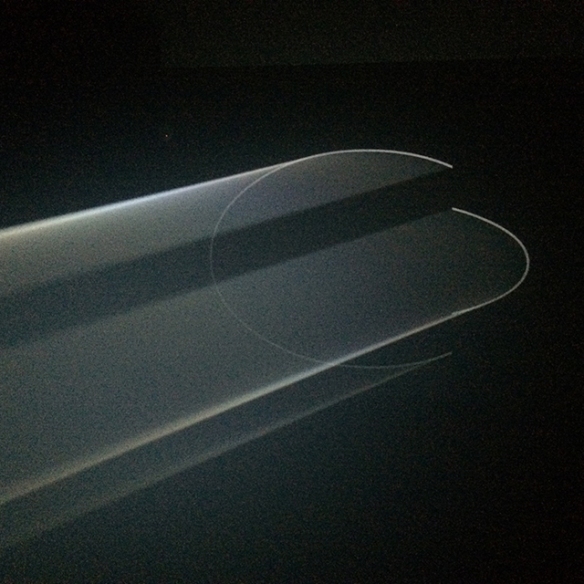
In Sprueth and Magers just across Piccadilly, Anthony McCall is displaying a light installation. His use of a smoke-like mist in these light-works, allows the experience to be a 3D one rather than just the conveyance of an image from one flat medium, a digital Jpeg in a projector, to a screen on the far wall. Yes, the screen is still present as the final destination for the image, but the light wends its way through wisps of smoke, like in those cigarette-friendly cinemas of one’s youth, catching the little eddies of particles on the way, creating straight shimmering beams of light across the room. The image itself is simple enough, a single line that is curved into an ellipse, sometimes perfectly rounded, sometimes dislocated into a stepped join between end and beginning, but the transition between the two is captivating as the digital projector slowly cycles from the one to the other.

At Grosvenor Hill a few hundred metres further on, is the Gagosian Gallery. A burst of applause echoes from within the furthest room. Glenn Brown had given me a great tutorial twenty years ago and he is instantly recognisable as the same chap. With his address to a group of visitors in the background and my own sketchy knowledge of some of his main artistic concerns gleaned during that generous four hour tutorial, the work on display takes on an extra depth. The painting is ultra flat as many of us would be familiar with, whilst the waxy trails of paint from the historical canon he explores, are simulated with intricate brushwork. These labour intensive works used to net the artist just a couple of pounds an hour, a fact which he presented as a footnote to the precarious business of being an artist, during the aforementioned tutorial. It was interesting to hear from this address that whilst the paintings are still labour intensive, twenty years later, the intricate sketching style of some of the accompanying drawings is actually very quick to execute. Here, expertise of his medium appears to have allowed the artist to bend some of those time constraints of the beautiful painted works, and create an image that takes on the same rapid fluidity as those very lines he has imitated.

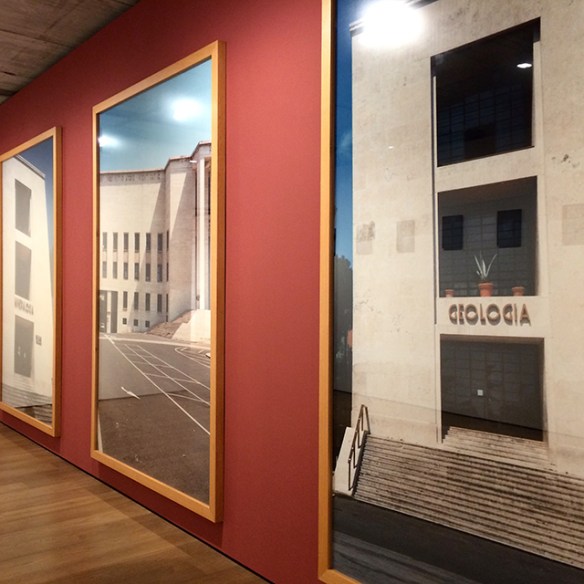
A second major gallery sits just round the corner and is the home of Almine Rech. Gunther Forg has several large photographs on display of variously imposing buildings. These are neo-classical in style and each is emblazoned with a title depicting the particular institution it houses. Whilst the titles such as GEOLOGIA and MUSICA are true to the original photographs, rendered in various block capitals in concrete or metal, and sitting above the grand entranceways, they nevertheless form a more extended and general index of knowledge, one which is familiar to us from library shelves and TV documentaries. Meanwhile, the buildings have a grand scale themselves, both in their photographic representation and in their actual physical size. Presented together along one wall, the images appear monumental and we get that rare sense of an illusionistic space that is actually bigger than the expansive gallery it has been presented in.

1041
Minjung Kim at White Cube who makes images from thin layers of mulberry tree paper.

1042
Tonico Lemos Auad of Stephen Friedman.

1043
Bjarne Melgaard of Galerie Thaddaeus Ropac with recently finished work that fills the room with an aroma of linseed oil and paint from their drying surfaces.

1044
Sturtevant at Galerie Thaddaeus Ropac.

1045
Anthony McCall at Sprueth Magers with slowly moving light projections, which uses a smoke-like substance in addition to a screen, to capture the image. The public are encouraged to move through the space and disrupt the image.

1046
Bosco Sodi of Blain Southern with a piece at Philips.

1047
Glenn Brown of Gagosian showing paintings where the brush marks of oil paint are simulated with a flat almost photographic surface.

1048
Gunther Forg of Almine Rech.

1049
Sculptures on Grosvenor Hill.

Gallery run 15th February

Gallery runs by artist, jogger and London explorer Julian.

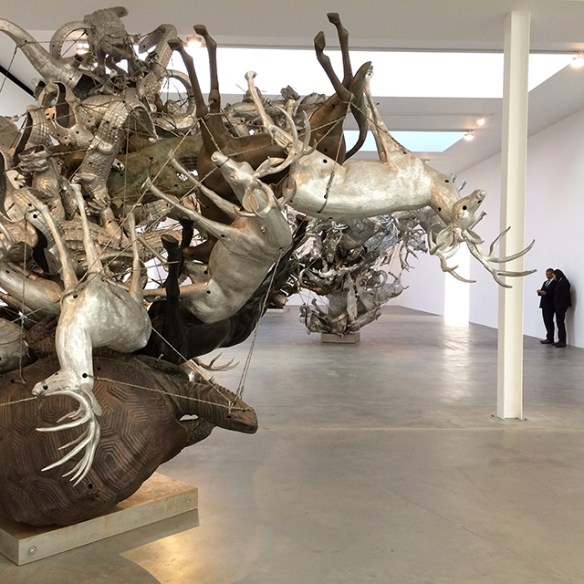
Gagosian Gallery, which is on Brittania Street near Kings Cross, has been between exhibitions for several weeks and the two present shows by Nancy Rubins and Vera Lutter are therefore much awaited. They don’t disappoint! The scale of work by both artists is stunning. For Nancy Rubins the scale requires engineering solutions to hold her sculptures together. Assembled metal objects originating from scrap yards and fairgrounds are secured to a network of cross linking metal cables. These cables allow the sculptures to project way beyond the relatively small plinths that they sit upon. Furthermore, the placement of these cables forms an elaborate system of cantilevers which incorporate the various objects on display into their design. The art objects then, rather like Calder’s mobiles, serve both as surface for contemplation as well as physical mass within this larger system.

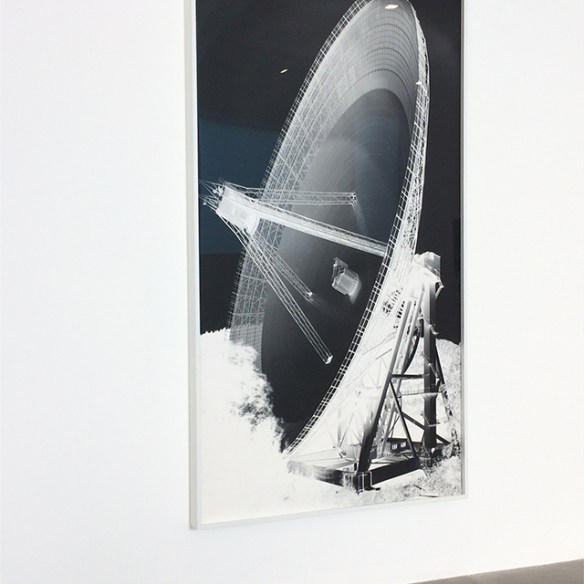
In contrast Vera Lutter’s works, whilst being physically large, draw their true impact from the scale of the machinery that underpins them. Her works are giant negatives which are about 3.5 metres high, roughly 100 times the height of old fashioned film negatives. It is of no surprise, therefore, that the object she has used for a camera carries a similar multiplication of scale. It’s a shipping container no less. The various expanses of photographic negative before us in the gallery are a sort of physical trace of the walls of this container that they would have been stuck against during their exposure and on this account they bring with them a sense of the magnitude of the container itself, its steel plate and enormous mass. If this double reading were not enough, though, the artist has then presented yet another level of engagement with the images. For they are of the world’s largest radio telescope and this creates a powerful metaphor of observation through use of only the faintest of signals. The faint traces of energy from outer space would be equivalent in some way to the almost imperceptible light reaching the pieces of film inside the container.

The next section of the run is over the hill at Angel. This means leaving the canal behind as it disappears into a very long tunnel and hot-footing it across to the other side. Back by the water, another lock serves to drop its level, before a spur of water branches out sideways past Victoria Miro gallery. A great show by David Altmejd at Stuart Shave Modern Art, a gallery slightly further on, is followed by a return to the canal and a visit to Stuart Shave’s second gallery space in Hackney. Paul Lee has produced several combinations of canvas and tambourines, the latter being a familiar trope for the artist, and they have an interesting sensuous quality due to a sort of exchange of physical properties from their close proximity. The tightly stretched skins of both objects, both sitting about 2 inches away from the wall, unite to produce a sort of extended space across their combined surfaces.

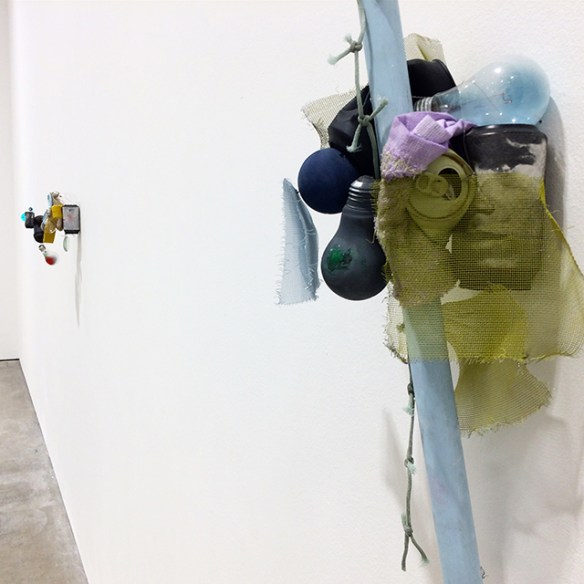
In contrast to these, the artist has produced four wall-mounted objects that appear, at first sight, to be no more than a cluster of recyclables, fabrics and bits of wire. However, they have a great sense of freedom to their forms, something that would require either chance processes for their assembly or else the application of sound artistic principles to block any unwanted rational processes of repetition, use of pre-established pattern or over reliance on an external narrative. None of these deficiencies here and what’s more for good measure, the central core of each object, which may well have been fashioned from a fizzy drink can, offers the one-off surprise to a viewer taking a closer look, that they are actually portraits of a male face rendered in black screen print style ink. Though small, this figurative element offers a strong contrast to their constructivist style.

1011
Antonio Calderara at Lisson Gallery.

1012
On the Regent’s Canal. A new layer of image just added with the yellow sign.

1013
Nancy Rubins of Gagosian Gallery.

1014
Vera Lutter of Gagosian Gallery with images of one of the world’s largest radio telescopes made using a giant pinhole camera constructed from a shipping container.

1015
David Altmejd of Stuart Shave, Modern Art with plaster reliefs inspired by the complex biological evolutions of organisms.

1016
Paul Lee of Stuart Shave, Modern Art.

1017
Eddie Peake of White Cube with an immersive installation.

1018
He Xiangyu of White Cube with small clusters of wire and pieces of metal that had benn smuggled out of North Korea to China for a pitifully small cash price.

1019
Andrea G Artz has produced novel photographic origami pieces at Crol And Co.

Gallery run 11th January

The run to Trinity Buoy Wharf has been an attractive activity ever since a speaker at an event there, Ian Sinclair, notable for walking round the entirety of the M25 and writing a book about it, declared that this wharf, with its location next to the River Lee, marked an historic site. From here the Saxons would check out the Vikings, whilst the latter would return their reconnaissance in this direction from across the barrier of the River Lee. It is right on this junction that this smaller tributary departs the Thames as it takes its waters from the North. With a bacon roll consumed, it is time to head to the first gallery of the day via a series of waterways.

The River Lee provides quite a formidable barrier to the foot traveller even today and unlike the fairly tortuous route of a few weeks ago which required a four lane highway as travelling companion to cross the river, today’s route wends its way north past the giant docks of Canary Wharf and onwards up the Regent’s Canal, escorting me to Hackney, and indeed, arriving fifteen minutes early at one of the midday openers. PeerUK is hosting Catherine Story from nearby Carl Freedman gallery and in its window are clues to the nature of the show. Clay maquettes are the artist’s starting point and these have then been transposed to canvas as a series of Surreal looking paintings populated by chunky figures with shear planes suggestive of both limbs and machinery. They are in fact reminiscent of Cubism and with the clay being a plastic medium, the artist appears to have worked out in advance, the various folds, bobbles, distortions and protrusions, distinctive of that style, before then transposing them to the two dimensional world of paint.

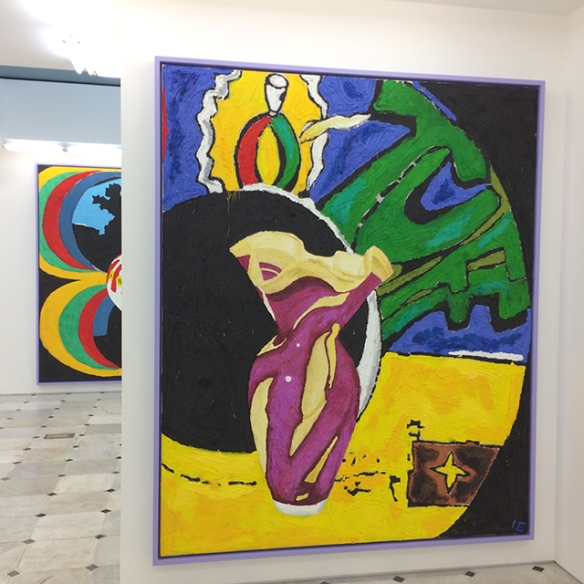
Herald Street Gallery has opened a new space in Museum Street just near the British Museum and Ida Ekblad is on show. Her rather stunning, bright paintings are actually made with plastic, a fact gleaned whilst reading her press release off the phone in those last few minutes of waiting outside the previous space. The plastic has been melted and smeared with a palette knife and yet none of its intensity of colour, whether it be derived from a previous state as coloured carrier bag or plastic household object, a specific origin that the artist doesn’t actually divulge, has been lost. Rather this detritus of daily life lives on in a strange afterlife as material of a painting, depicting the simple forms of pots that are themselves reminiscent of Greek urns, along with a whole host of other types of ornamentation ranging from flowers to simple coloured planes.

After seeing yet more good quality work up for auction at Phillips, with a couple of stand out pieces by Alex Israel and Barnaby Furnas, the next destination is south of the River at Vauxhall where Cabinet Gallery sits proudly in the middle of the aptly named, Pleasure Garden. Henrik Olesen’s musings on the nature of an object lead to an unusual, though confident display of tacked, nailed and propped materials that sit and hang against the various white-walled nooks that this gallery has made available with its slightly unusual polygon-styled floor plan. On many of the box-sections of brushed aluminium, which feature as rectangular frames or stand-alone girders, there are small inscriptions presented on clear plastic rather as one might find accompanying cooking instructions on a ready-meal, and these provide further philosophical reflections by the artist on object hood. Perhaps by giving us a general scene of peculiar part-objects to look at whilst openly questioning their validity, the artist is also trying to evoke an aspect of the human condition that has been put into words by the philosopher Heidegger, that since the Greek ages we have passed over the phenomena of the world, a general being, and instead focused our attention, to our detriment, on individual objects from which we try to extract meaning.

961
Catherine Story of Carl Freedman Gallery on show at Peer UK.

962
Ida Ekblad of Herald Street Gallery with vivid paintings made from melted plastic.

963
Barnaby Furnas of Victoria Miro provides the statement piece for auction at Phillips.

964
Alex Israel on auction at Phillips and adorning the front cover of the catalogue as befits a top ranking artist shown by Gagosian Gallery amongst others.

965
Michael Pybus on auction at Phillips.

966
Clever use of stickers on this bike.

967
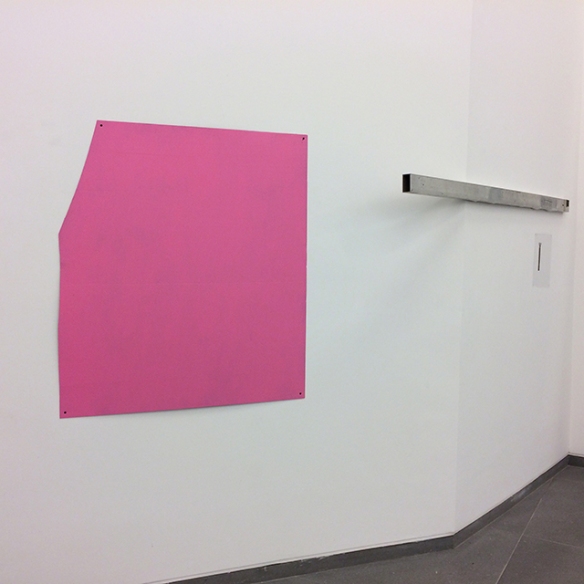
Henrik Olesen presents a show at Cabinet Gallery of what could perhaps be described as partial objects, many of which are casually stapled or pinned to the wall. The show itself seems to question what an object actually is.

968
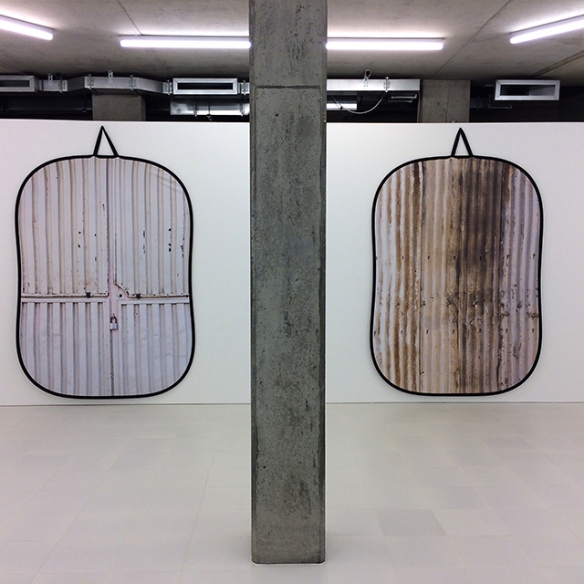
Simon Thompson of Cabinet Gallery, an artist I’ve wanted to visit for a while, has done prints of objects on rather fab rug-like objects with a hanging tag.

969
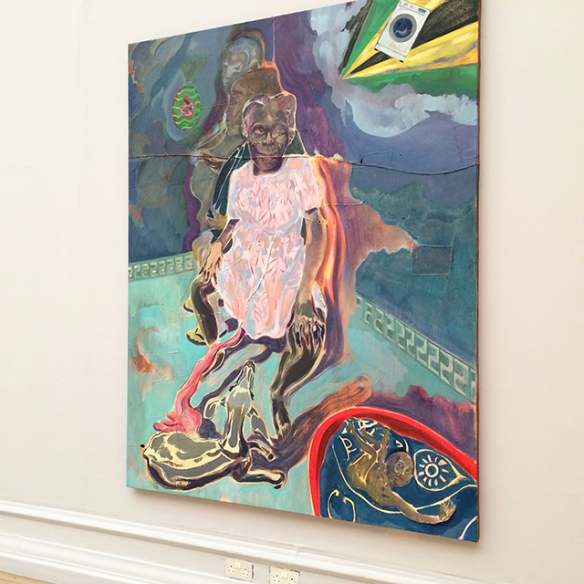
Michael Armitage of White Cube showing at South London Gallery. An allegorical piece as a mother gives birth to a goat. Not a good thing! and dreams of a better life symbolised by washing machine top right, are back on hold.

Gallery run 27th October

The main feature of today’s run is the exceptionally long and attractive stretch between Camden Arts Centre in the west and The Approach Gallery in the east of London. Over half of this journey is off-road.

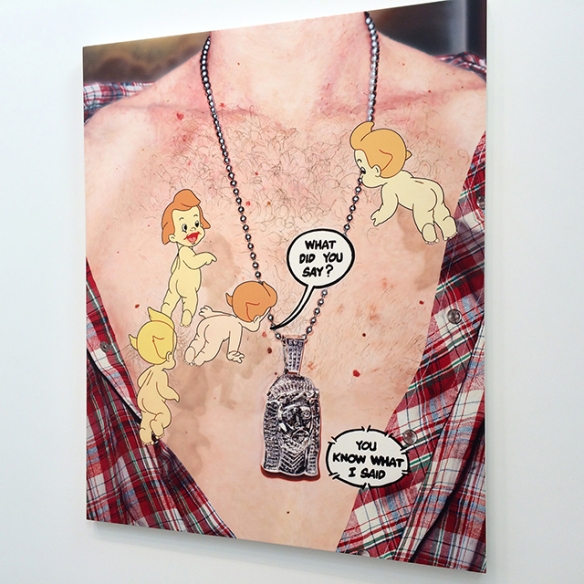
Rewind two hours and I am in Newport Street Gallery at Damien Hirst’s fifth show since opening the showcase space for his own collection. Like Jeff Koons from an earlier show Dan Colen, along with Hirst himself, are all on the books of Gagosian. Without really following the logic of an argument, this simple association suggests maybe there is some swapping of priceless art pieces between these giants of the contemporary scene. Colen is included in this accolade because he is a rising star and his limited edition of glass bottle and glass cig butts on sale at the entrance for £1600 looks good value on this account. Colen’s works are summarised as essentially self-portraits, by the blurb, and that seems right. For as well as the photo-realist self portrait with its cartoon-like addition, featured, the sculptural works all involve an activity by the artist, be it sticking chewing gum to a canvas or collecting rubbish from New York’s streets and then turning it into improvised paint brushes.

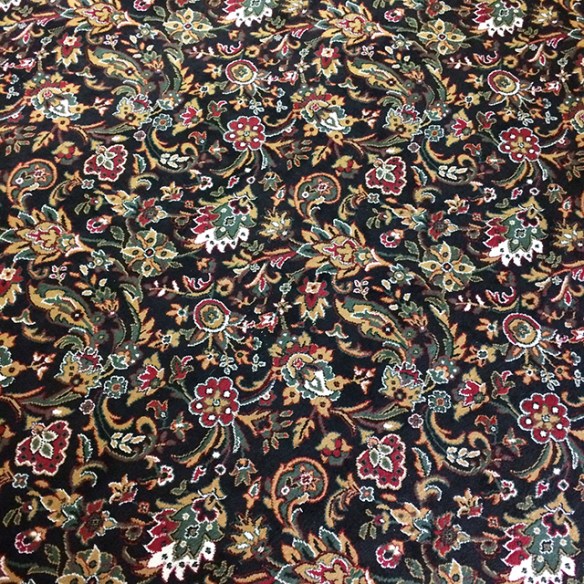
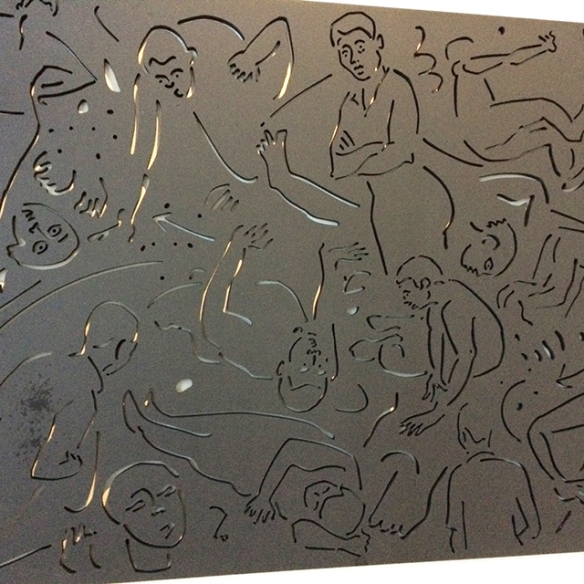
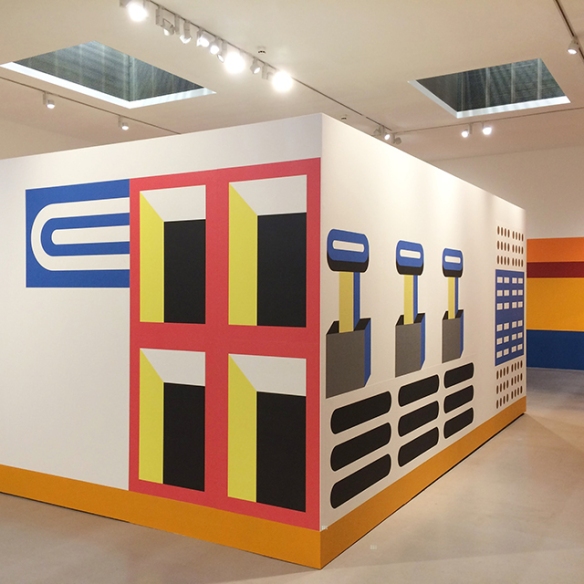
The run north is a long one and features the Zabludowicz collection and the elegant pub-style carpet by Rebecca Ackroyd, before arriving at Camden Arts Centre. Language is a feature of Christian Nyampeta’s show. Some words, he argues, such as philosophy cannot be translated easily into his native tongue of Rwanda. Far from being a deficiency of his country’s languages it is almost the opposite. Western thought has ignored an important concept, which he refers to as “Being”, or more specifically “good will to fellow humans”. In contrast, words from his own culture, he argues, carry these additional connotations as part of their overall meanings. In the other gallery Nathelie Du Pasquier continues her foray into the London consciousness after having recently shown at Pace, and in this gallery she has made a brightly coloured installation suggestive of industrialisation through the tripling of her motifs which is reminiscent of the three phase power supply that remains segregated from generator to power line to factory.

The intermission referred to at the beginning, the long run between west and east, begins with Hampstead Heath. The hard-won altitude gained at Hampstead is quickly surrendered as one approaches the three ponds and with Highgate church now looming above, it is this ascent that will then provide the fantastic views across London before one enters the trees and scrubland of Parkland walk. As mentioned in previous runs, Parkland Walk is a disused railway line and thankfully today it is on a downwards gradient and, with its array of bridges over low roads and ornate arches under the higher ones, one that is remarkably constant in its gradual descent.

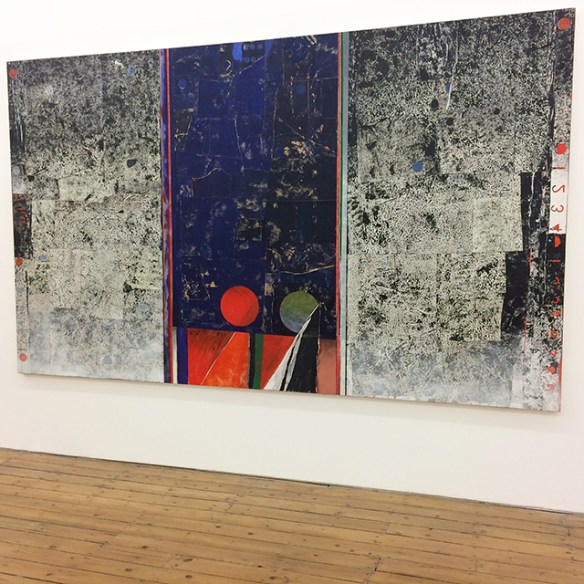
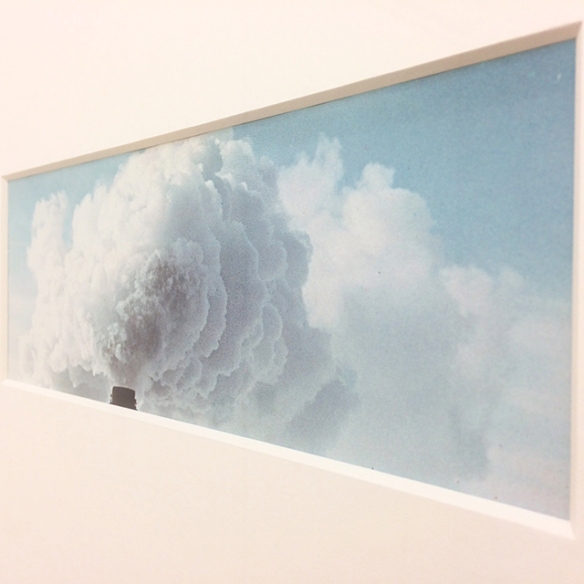
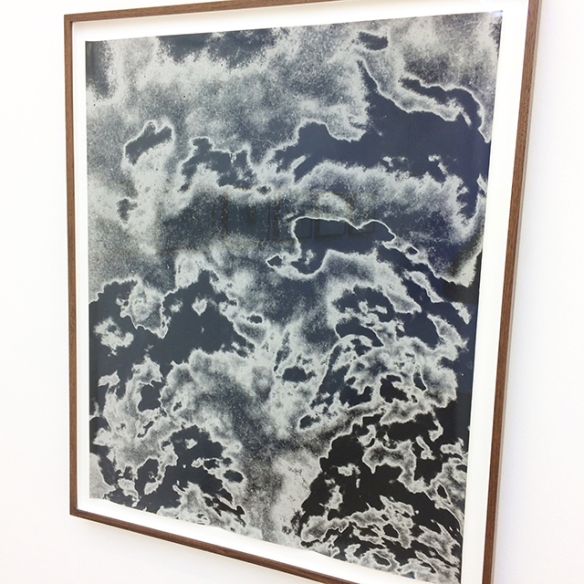
In the east, three artists are showing at The Approach gallery, whilst outside the downstairs pub police-style tape causes momentary alarm as it surrounds the railings of the outer seating space, before revealing its joke on closer inspection, as a Halloween prop and not the site of major incident. Artworks feature motorways and smoke from three of the gallery’s strong list of regulars.

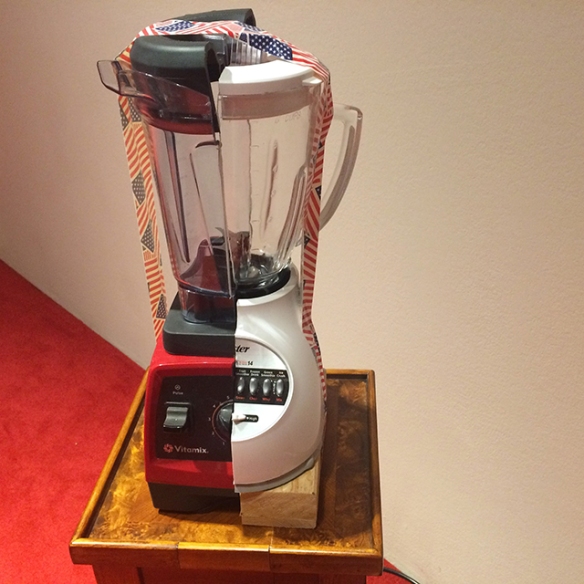
Nearby, the building formally inhabited by Wilkinson gallery has been taken over by Stuart Shave. Josh Kline has cast familiar objects in concrete and then smashed them up slightly, whilst other objects have been cut in half with some extremely effective cutting tool. Having achieved the precision of a smooth cut through the variety of materials making up consumer objects, the plastic of a knob and the steel of a fascia, the artist has then taped together two incongruous halves. A twin of different shape but similar function ensures that this part of the process looks impromptu and scruffy like some final ironic comment about the objects and perhaps also about the process of making art.
871
Dan Colen represented by Gagosian showing at Newport Street Gallery. Beautifully painted and a witty dialogue between cherub and a rather austere looking silver medallion.
872
Rebecca Ackroyd at Zabludowicz Collection with a carpet design that explores Britishness referencing, in particular, the pub carpet.
873
Christian Nyampeta at Camden Arts Centre with an installation and video work that explores the problem of translating western concepts such as philosophy into the language of the Rwandan people.
874
Nathalie Du Pasquier at Camden Arts Centre with bold images using isometric drawing, a graphic technique that doesn’t rely on perspective.
875
Sam Windett of The Approach with paintings incorporating collage based around the themes of roads and driving.
876
John Stezaker of The Approach with pictures of smoke without its cause, in other words heavily cropped chimneys.
877
Lisa Oppenheim of The Approach with solarised smoke photographs.
878
Josh Kline at Stuart Shave Modern Art with cut up and reassembled objects.
879
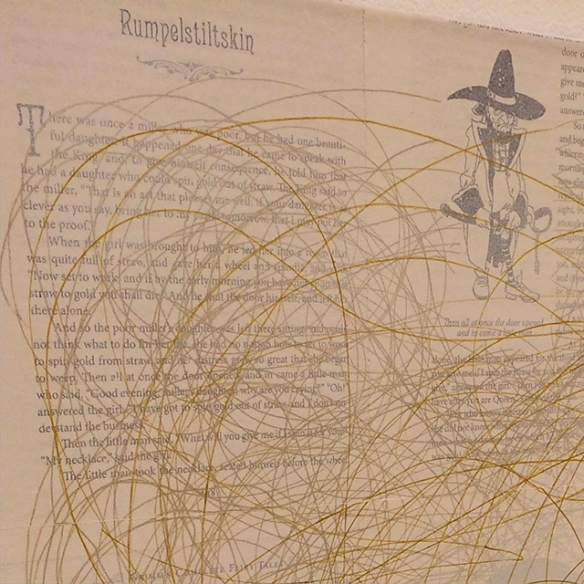
Tim Rollins and KOS of Maureen Paley with drawn-on texts.
Gallery run 20th October

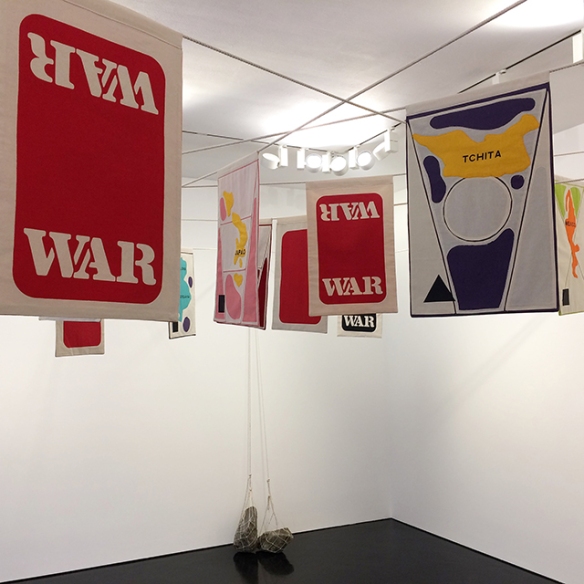
At Stephen Friedman Gallery Rivane Nauenschwander has produced an installation based on the Brazilian version of the board game known in the UK as risk. Flags represent the individual countries that the players would normally roll dice for in their pursuit of world domination. Long all-nighters with friends playing this game have imbued this artwork with a particular aura for me. Round the corner in Grafton Street Sprueth Magers have been doing a refit to their gallery. It looks very slick and the formerly creaking floorboards have now been lovingly preserved and firmly secured. Gary Hume has experimented with gloss paint on paper and the effect is very interesting. The painted surface takes on a mottled form due to the paper support yielding in some way to the gloss, yet it still looks as though it has the solidity of a worked and beaten metal support.

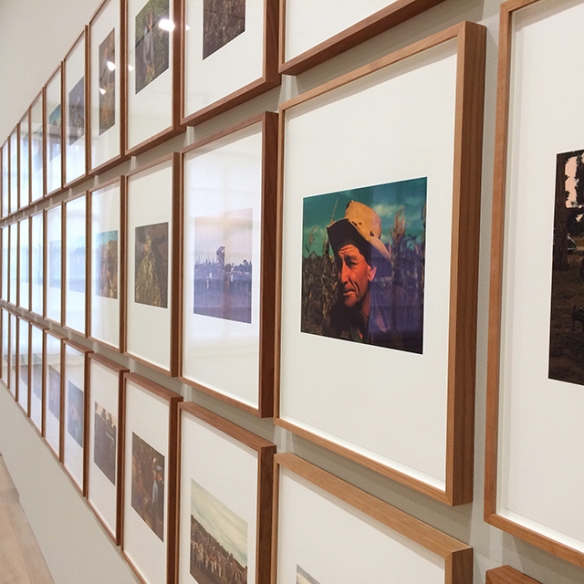
Further down Grafton Street at David Zwirner, Sherrie Levine is displaying work made by re-photographing some iconic images made in a 1940 project to document rural American life during The Great Depression. The display itself is striking with about 50 images hung in a perfect grid on the gallery wall. After visiting this hub of three closely placed galleries the next stop is Grosvenor Hill where Almine Rech and Gagosian have created a new hub comprising two expansive white spaces. The former gallery is showing Ernst Wilhelm Nay. The abstract paintings are reminiscent of seeds and foliage yet they are not restricted to this interpretation. This ambiguity lends them an additional magic which also complements their perfect balance of colour.

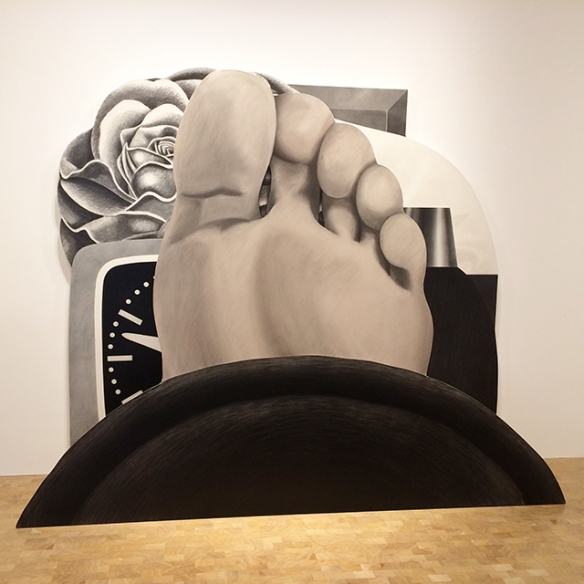
The word is out that Almine Rech and Gagosian have teamed up with the estate of Tom Wesselmann. Both galleries have produced identical press releases describing the artist’s shaped canvases that predominate in his series of bedroom paintings. Various bedside objects such as clocks and designer lamps interweave the limbs, feet and hands that the artist has sketched and then blown up into full size paintings. In the Gagosian on Davies Street a subtle black and white maquette of two painted boards placed in front of one another simulate the two ends of a bed. A large pair of elegant feet obscure the rest of a body whilst the lamp peers out from further behind. This completes the Mayfair region for today and now it is time to embark on the old favourite route along the Regent’s canal whereupon one arrives at the gas storage frameworks that offer a familiar landmark for Hackney.

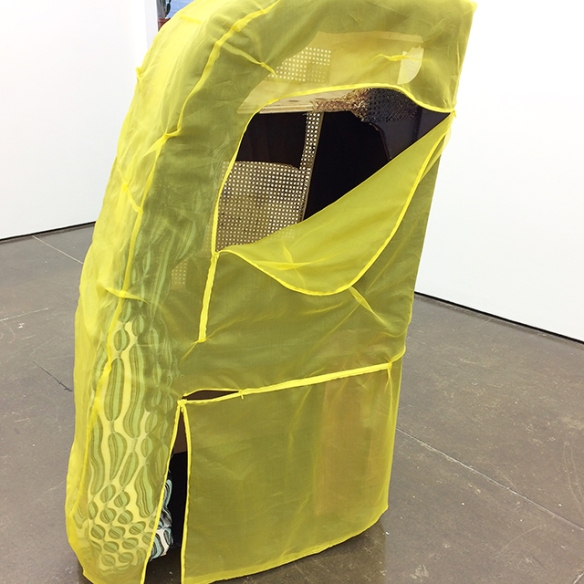
Two of the new galleries exhibiting at Frieze this year are Campoli Presti and Hales gallery, whilst a new artist has been taken on at Herald Street, called Jessi Reaves. These additions offer the chance to see three new artists in this region of the city which is really the birthing place for new talent and with its exceptionally high rate of Turner Prize nominations is also sustainable in its own right with no need to interact with or be fostered by the Mayfair galleries to the west. Jessi Reaves is an American artist and hence of international importance, who makes sculptures from old furniture. The assistant in the gallery invites me to sit down on the rebuilt comfy chairs and this highlights the critical space that the work operates in, being utilitarian in some respects but stripped of any designer chic. Concluding this exploration after a quick stop at Beigal Bake is a visit to Hales gallery. Since its early days on Deptford High Street as a well respected gallery cafe, it has now become important internationally. Frank Bowling is one of seventeen artists on their books and he is showing colourful abstract paintings incorporating small objects offered up by friends, as well as cutting and sewing, which all contribute to a complex and interesting surface.

861
Rivane Neuenschwander of Stephen Friedman Gallery with an installation based on the board game risk. Each flag represents a risk territory. On the back is written “war”. This would be “risk” in the Uk version.

862
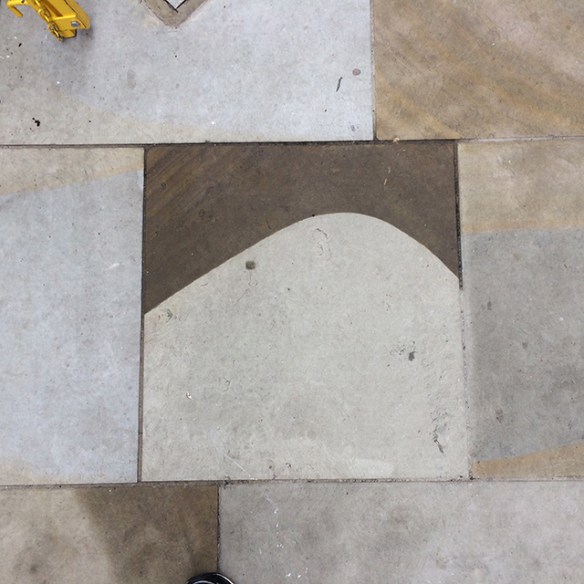
This paving slab on Grafton Street appears to be made up of two parts?

863
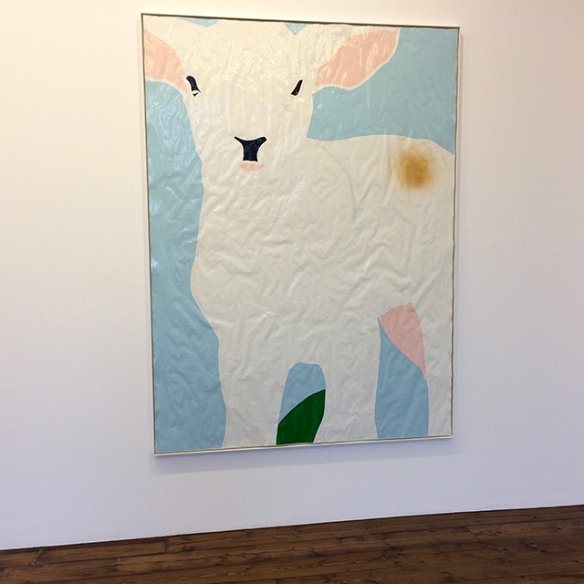
The gallery is open again! Gary Hume of Sprueth Magers uses his trademark gloss to produce a mottled finish on paper in his new works.

864
Sherrie Levine has rephotographed and appropriated American Depression photos of farmers by Russell Lee. What was once an attempt to boost morale when they were made in 1940 has now become historical document. Shown at David Zwirner gallery.

865
Ernst Wilhelm Nay at Almine Rech Gallery. Beautiful images with natural motifs but in bright colours.

866
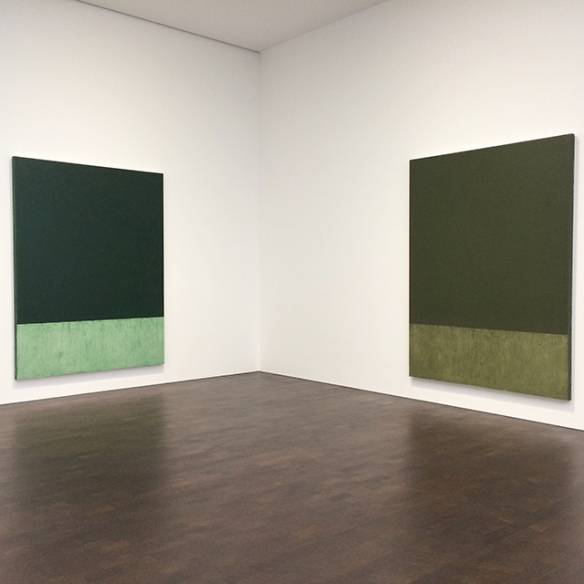
Brice Marden of Gagosian using terre verte, green earth pigment, from several well known paint suppliers, has produced 9 canvases of varying greenness.

867
Tom Wesselmann at Gagosian with Bedroom Paintings.

868
Jessi Reaves of Herald Street with sculpted furniture, cut up and reassembled.

869
Frank Bowling of Hales Gallery with abstract compositions on stitched canvases.

Gallery run 14th September

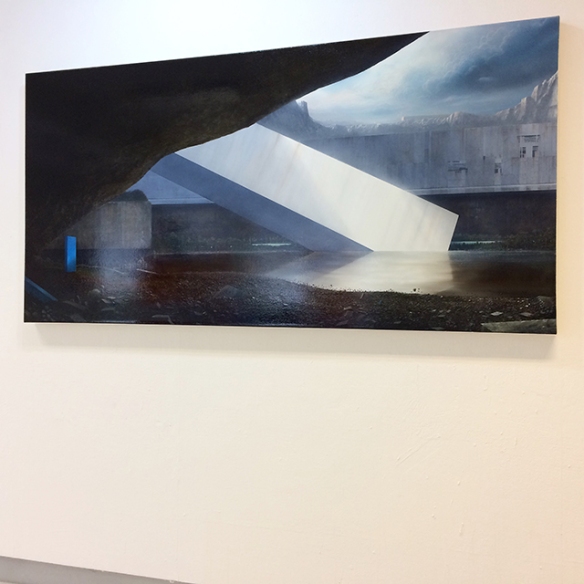
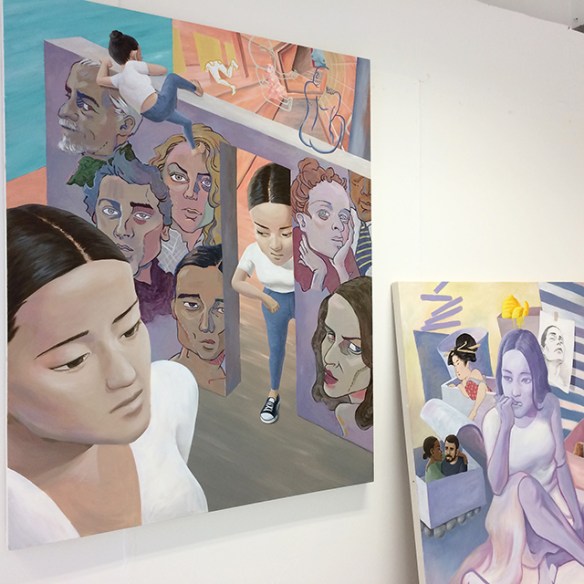
The day starts with a diversion to Clapham Junction. My partner is on a business trip abroad and has forgotten her phone. Having made the rendezvous and said a second farewell, it is only a short distance to Chelsea College. The college is located near Tate Britain and is hosting an MA fine art student show, the last of the season. Two painters on display are of particular note. Naoya Inose has produced fantastical landscapes incorporating architectural structures with enormous walls, bathed in the glow of a low sun which has simultaneously illuminated vast ranges of clouds. In contrast Mikolaos Panagiotopoulos has created a much more intimate space populated with variously wrought figures that are lifelike though suggesting in places a more cartoon-like idiom.

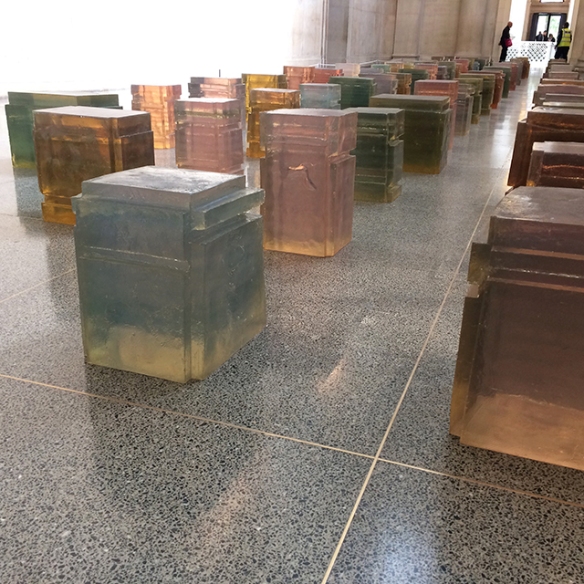
Next door the Tate has a grand retrospective of Rachel Whiteread and although it is a pay show, a large display has been installed in the Duveen Galleries, the enormous central space reserved primarily for sculpture. The pastel lozenges, which the sculptor has cast from coloured resin, bare the imprints of legs and chair bottoms and suggest that these are solid embodiments of the empty spaces beneath seats. A moment of reflection on the nature of chairs follows before noticing too, the glow of light that is trapped and preserved in the resin forms, the source being the sun of course, which is wending its way round the skylights above the gallery.
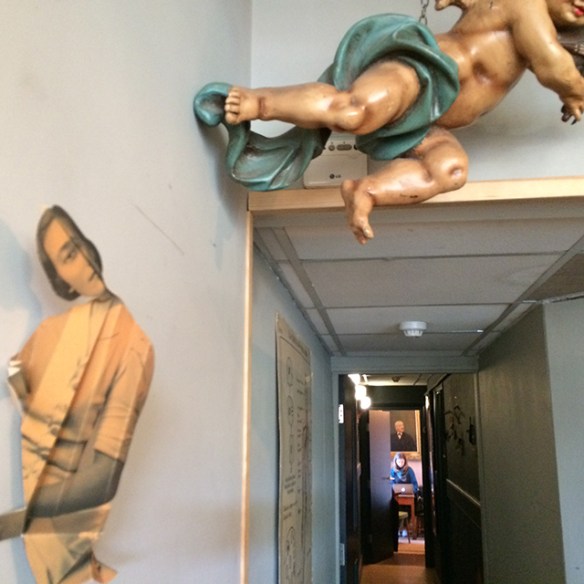
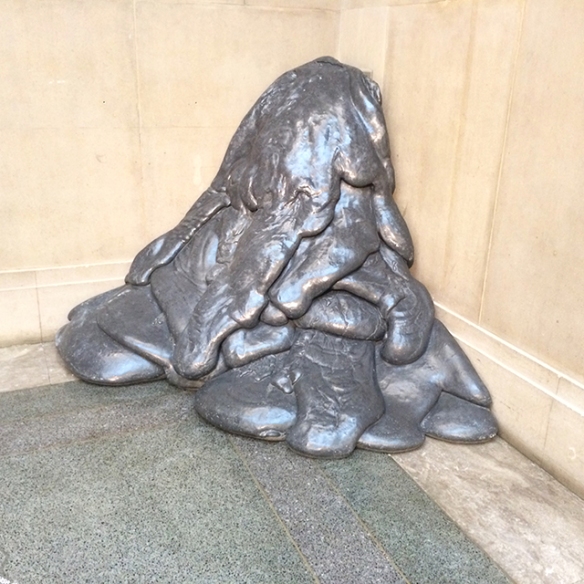
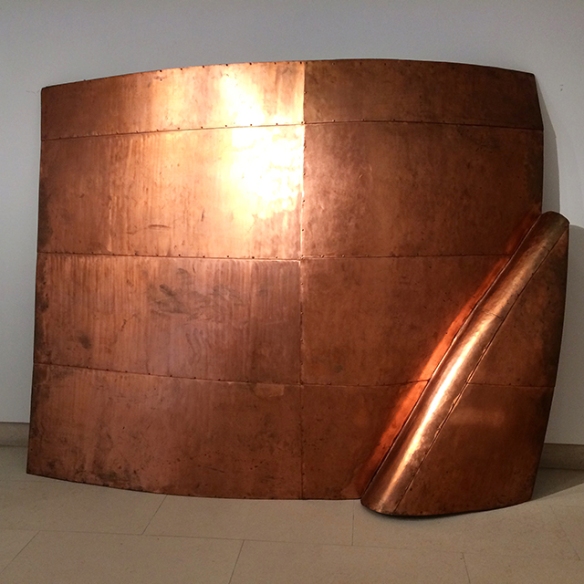
Close by in this central space, Lynda Benglis has produced what looks like a pile of molten metal cast into a generic corner. This pile finds its particular fit amongst the London stone of Tate Britain flanked by occasional classical columns.

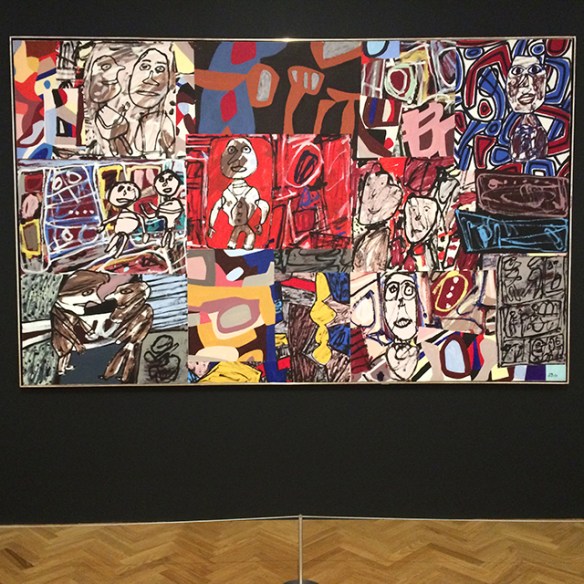
Then it is a short jog through St James’ Park to Pace Gallery where Jean Debuffet’s late collage works are on display from a private collection. They demonstrate a striking use of juxtaposition as hundreds of drawings appear to have sought each other out as though by a natural force and collected into several perfectly ordered groups. Each framed cluster is rich in narrative through its varied fragments, but yet is unified through similarities of colour, theme and other parameters far too subtle to even put into words.
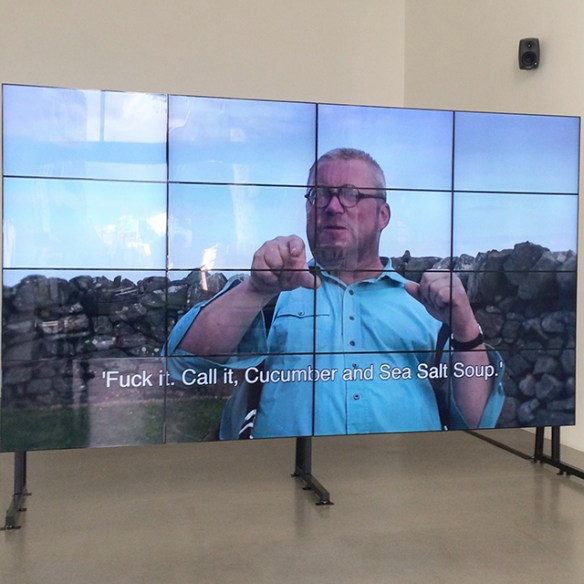
Finally at Sadie Coles HQ, TJ Wilcox has produced three films using an interview style done with great sensitivity. The restauranteur Fergus Henderson describes the joys of food with engaging anecdotes and slowly one becomes aware too, through the direct and honest replies, about the interviewee’s illness and treatment for Parkinson’s disease. Though the speech is sometimes hard to follow, necessitating subtitles, the interview is full of life. I stand there for a full twenty minutes simply enjoying the story, the images and the slow revelation of someone’s fascinating life.

821
Naoya Inose at Chelsea MA Fine Art, with great landscapes.

822
Mikolaos Panagiotopoulos at Chelsea MA Fine Art with elegantly combined images of figures.

823
Rachel Whiteread of Gagosian Gallery on show at Tate Britain.

824
Lynda Benglis of Thomas Dane Gallery with a piece on show at Tate Britain.

825
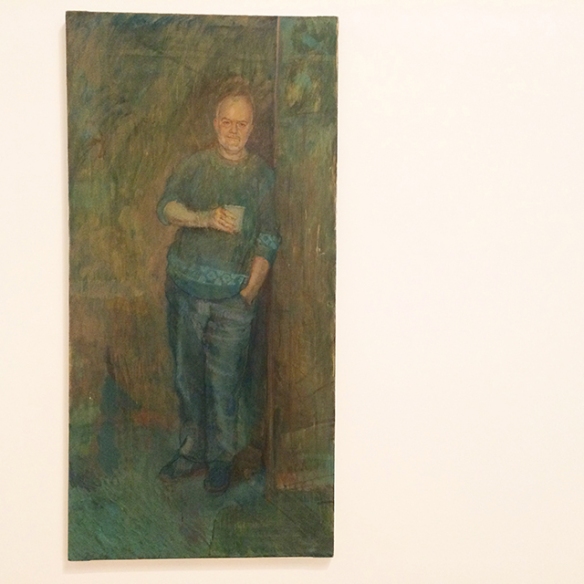
Michael Fullerton of Carl Freedman Gallery with a portrait of John Peel in Tate Britain.

826
Jean Dubuffet at Pace London with images built up from drawings collages onto the canvas.

827
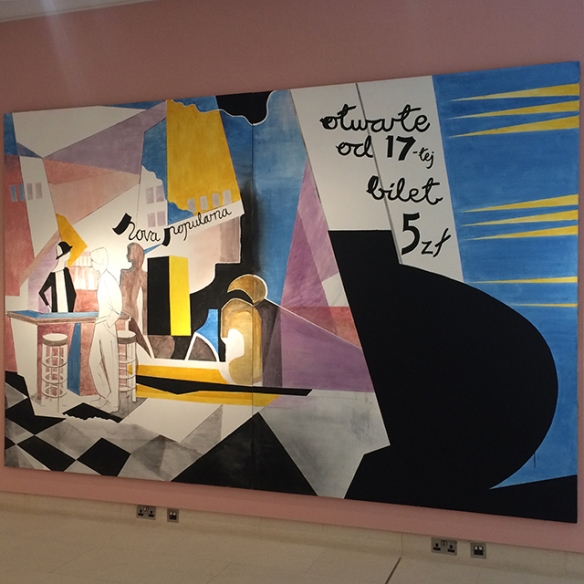
Lucy McKenzie and Paulina Olowska with a striking piece up for auction.

828
Danh Vo of Marian Goodman Gallery with a piece up for auction.

829
TJ Wilcox at Sadie Coles HQ interviewing charismatic restaurateur Fergus Henderson. There was too much salt in a friend’s batch of cucumber soup.

Gallery run 31st August

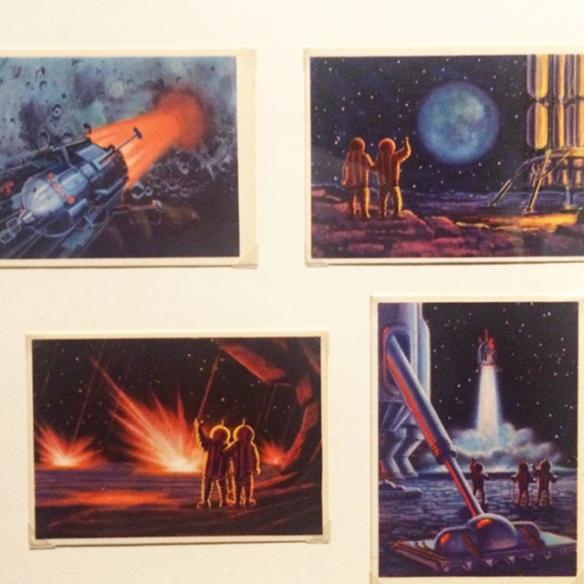
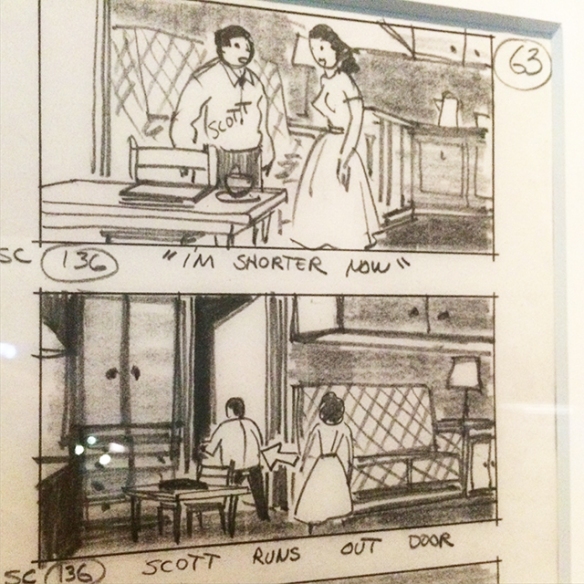
The first stop today is a Science Fiction Exhibition at the Barbican containing artwork from several artists at London galleries. On arrival, there is a sort of sensory overload of robots, clips from 60’s sci fi films and models of rockets destined for the moon. Many of these items are film props which were used in classics ranging from Star Wars to The Incredible Shrinking Man. The initial attraction for this show was the abundance of familiar gallery artists, but this is soon matched by the great postcard-sized paintings by Andrey Sokolov of moonscapes and yet more rockets.

At the Barbican a helpful attendant points the way up to Old Street after asking me If I was lost and what look likes a very pedestrian unfriendly car ramp turns out to be a short cut back to the main road. At Beers, Adam Lee is showing some evocative paintings inspired by the exotic location of his studio in an isolated region of Australia.

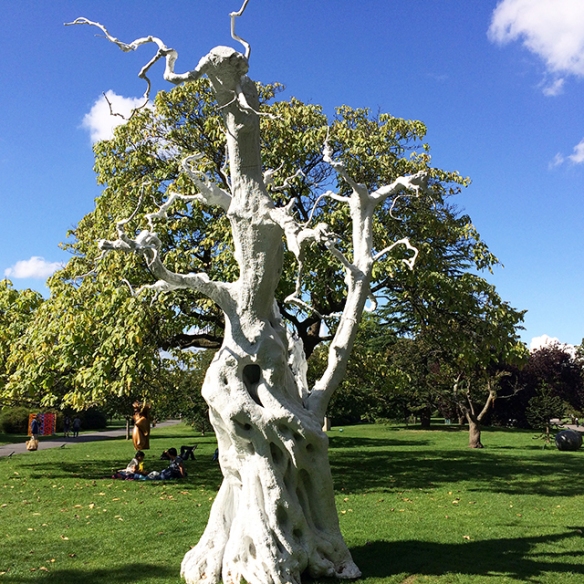
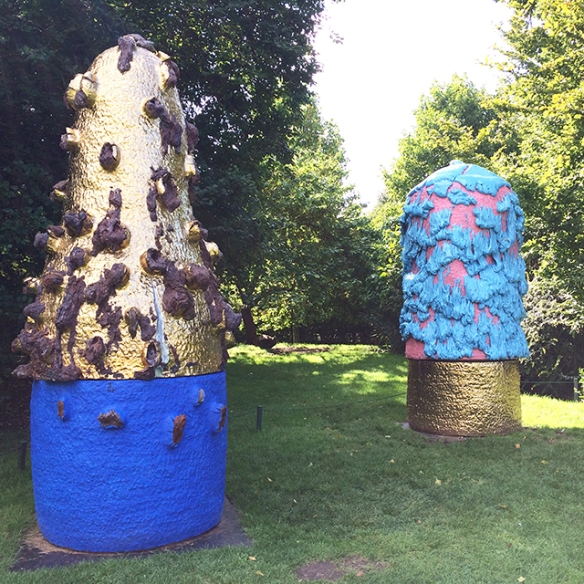
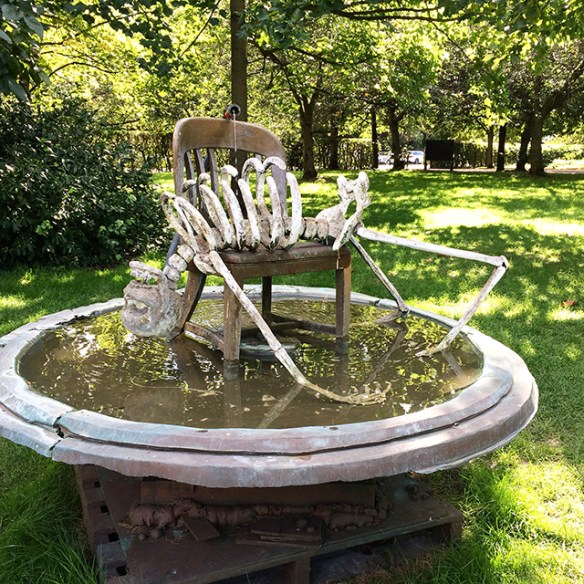
From here the Regent’s Canal provides a direct, though fairly long, route to Regent’s Park where there is a choice selection of sculptures. This is the Frieze Sculpture Park show and it is kicked off with a stunning sculpture by John Chamberlain set against a background of the park and some of the Regency properties on its periphery. Next Ugo Rondinone of Sadie Coles HQ presents an enormous white tree planted firmly into the grass. Tony Cragg has a sculpture with his stacked disc motif all assembled into a gold figure that has some similarities to the fantastical machines and figures on show earlier at the Barbican. Finally Takuro Kuwata of Alison Jacques Gallery has presented some brightly coloured cylindrical forms that look slightly organic like brightly coloured mushrooms, though of a different shape. Urs Fischer, meanwhile, has a skeleton placed in a fountain. It is being cooled, or watered in some way, with a garden hose. Then for me it’s back south with tired legs after having spent much of the last week with feet up on vacation.

801
Postcards by Andrey Sokolov shown at Into the Unknown: A Journey Through Science Fiction at The Barbican Centre.

802
Storyboard for The Incredible Shrinking Man shown in the exhibition Into the Unknown: A Journey Through Science Fiction at The Barbican Centre.

803
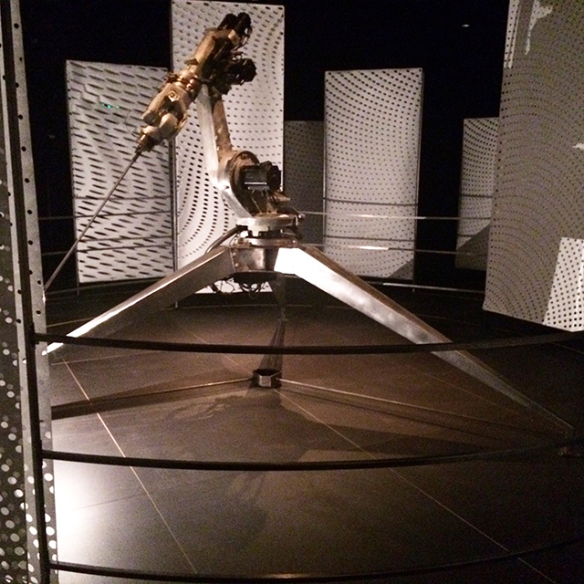
Robot figure with light stick. Conrad Shawcross showing at Into the Unknown: A Journey Through Science Fiction at The Barbican Centre.

804
Adam Lee at Beers London.

805
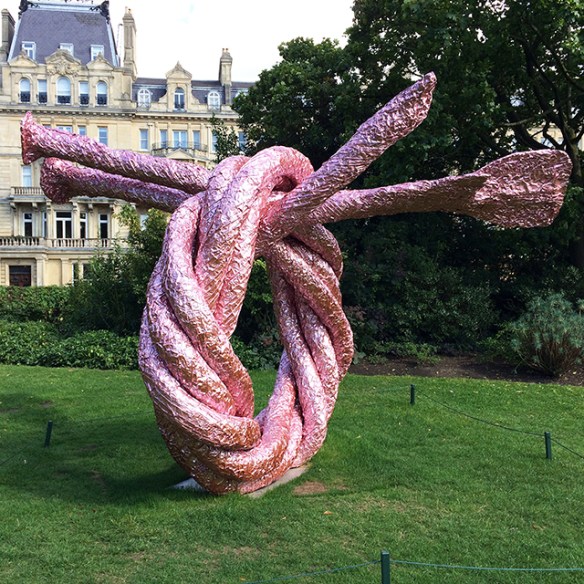
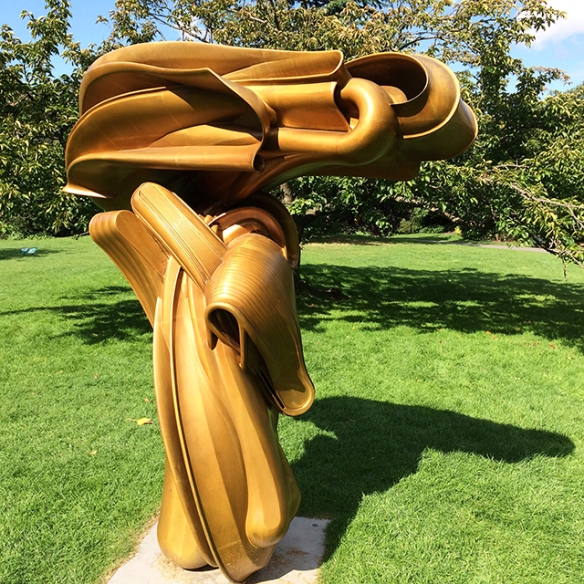
John Chamberlain of Gagosian showing at the Frieze Sculpture Park in Regents Park.

806
Ugo Rondinone at Frieze Sculpture Park in Regents Park.

807
Tony Cragg at Frieze Sculpture Park in Regents Park.

808
Takuro Kuwata of Alison Jacques Gallery at Frieze Sculpture Park in Regents Park.

809
Urs Fischer of Gagosian in the Frieze Sculpture Park in RegentsPark.

Gallery run 11th August

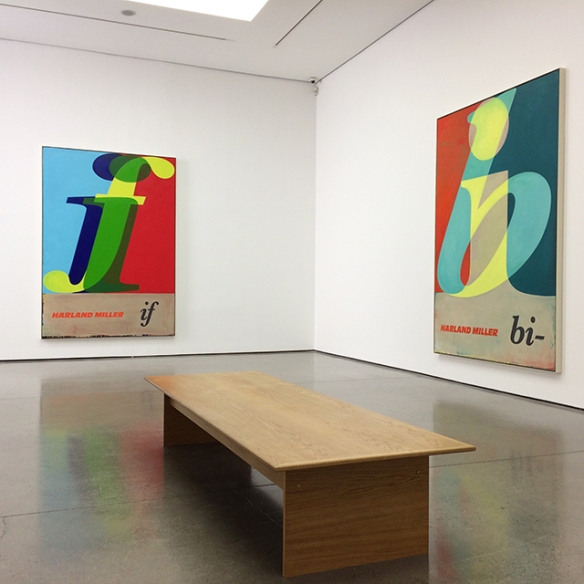
The day starts with a run up to White Cube Gallery near St James’ Park, followed by a visit to Gagosian just across Piccadilly and up past Berkeley Square. At White Cube, Harland Miller has painted more imaginary book covers using the 70’s style idiomatic of self-help manuals. He seems to look back at that era with affection and there is a suggestion in the blurb that it marked a time when such projects on oneself were seen as augmentative to an already ok self whereas now the self has become categorised by science as being afflicted by a range of disorders perhaps best left to the professionals to remedy. After these thought provoking issues, Peter Marino’s work consisting of several patinated bronze trunks, serves up a healthy serving of bling preventing any further circumspection of the soul. Above each of these floor-based works are priceless artworks by Bacon, Picasso and Warhol all hung on the wall. Taken from the Gagosian group of elite artists, these works provide a sort of imaginary setting which no doubt many rich collectors will identify with as home.

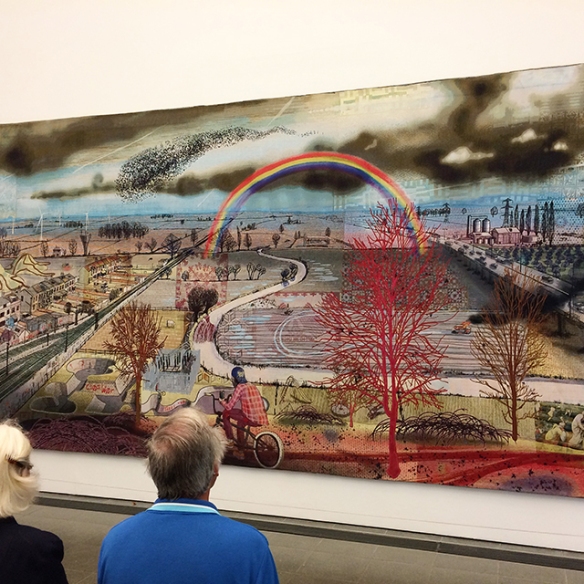
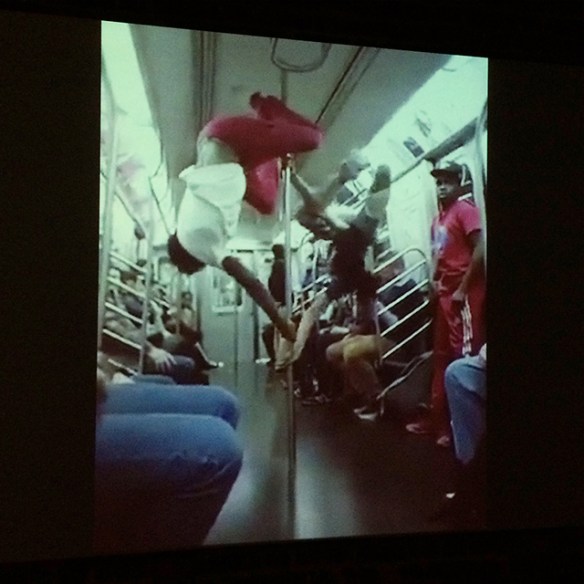
Initially when I then arrive at the Serpentine Gallery in Hyde Park and see the slogan “The most popular show ever” before being asked to queue, I wonder who might have written this in their revue. Then I realise it is the title of Grayson Perry’s new show. He is displaying vases and tapestries and some gloriously sumptuous bikes with cow horn handlebars, a motorbike and peddle bike. Judging by the crowds milling around these great exhibits, the show title rings true. Across the Serpentine lake in the Sackler gallery are more works by a black artist Arthur Jafa, exploring political and urban street life themes. My favourite work is a video showing a performance of two artists spontaneously taking over the central isle of a metro train and swirling around the central pole. As I snap the image and look at the photo, they are upside down with lights and seats receding into the distance creating a spectacle that looks like the astronauts on a space station. They are modern day “metronauts”.

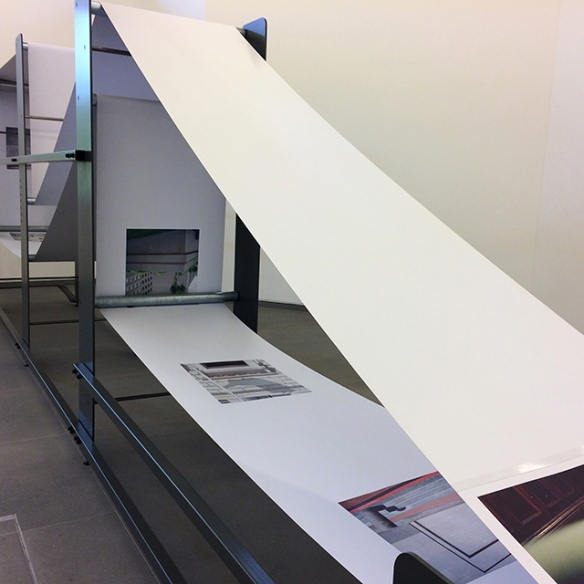
Finally the journey back south takes me to Vauxhall where Calla Henkel and Max Pitegoff are showing at Cabinet Gallery. In the middle of the gallery is a long one metre wide strip of vinyl which is being passed over motorised rollers in a complex system of zig-zags. Printed on this vinyl are occasional images of stonework lettering which, we are told, are addresses of American government organisations that have been carved onto their stone walls. Meanwhile in a sort of contra-punctual relation there are also images of the interior of an Irish bar in Berlin. Whilst the former is perhaps associated with military prowess, the latter still has associations of military exemption, a feature of Berlin life for many years. The structure of the present artwork in Cabinet alludes to a standard printing procedure of airing the vinyl strip to allow time for the inks to dry. But it is also suggestive of a much more poetical process whereby it is acting as a sort of collaging machine. Here the contrasting images from Berlin and Washington that have been printed onto the vinyl strip, whilst not actually drying together in a literal sense, are nevertheless settling together over time.

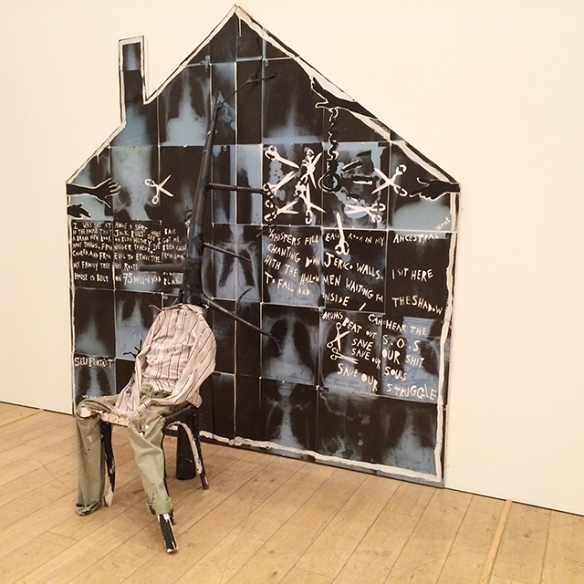
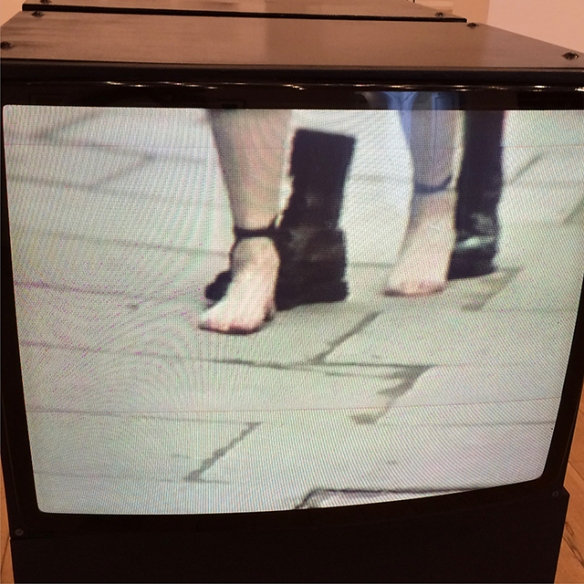
A short distance further south takes one to the South London gallery. Opposite is an important base camp for this final ascent, called Sophocles’ bakery which makes excellent cheese boreks. The placement of this bakery allows for a five minute walk, to consume the pastry, before arriving at the gallery. Inside Lubeina Himid has presented some collage-based works relating to her placement within a domestic and political culture and she carries an additional aura now as a Turner nominated artist. Meanwhile on a TV monitor is “roadworks” an early performance piece by Mona Hartoum. She walks barefoot through busy Brixton market and carefully drags DM boots attached by their laces behind each ankle seemingly oblivious to the constant chatter and comments. These video works under stressful situations, as they are described, perhaps helped to hone her abilities in making the powerful more static works she is known for today.

771
Harland Miller of White Cube with images based on imaginary book covers with very brief titles.

772
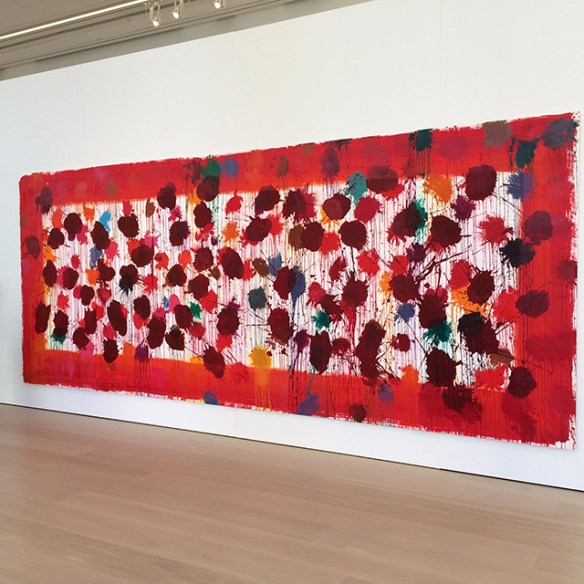
Howard Hodgkin large scale work.

773
Peter Marino at Gagosian Gallery in Davies Street with decorative bronze chests made in a classical style.

774
Grayson Perry of Victoria Miro Gallery at Serpentine Gallery.

775
Arthur Jafa at Serpentine Gallery with a performance of acrobatics in a metro train.

776
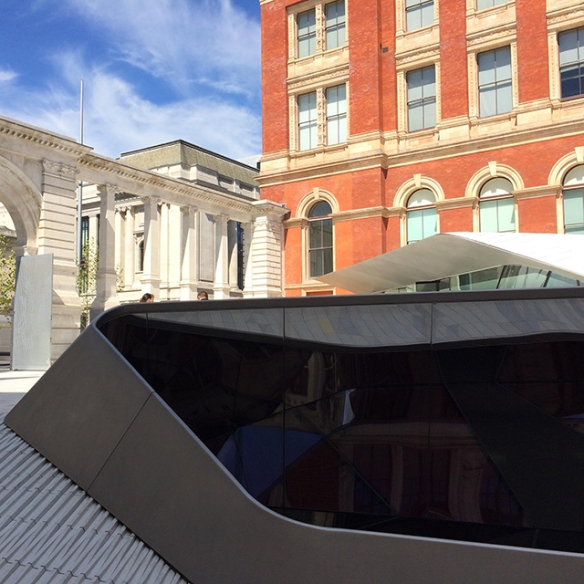
Victoria and Albert Museum have a new entrance and courtyard.

777
Calla Henkel and Max Pitegoff at Cabinet Gallery.

778
Lubaina Himid of Hollybush Gardens at South London Gallery.

779
Mona Hartoum of Lisson Gallery showing a performance by herself in South London Gallery.