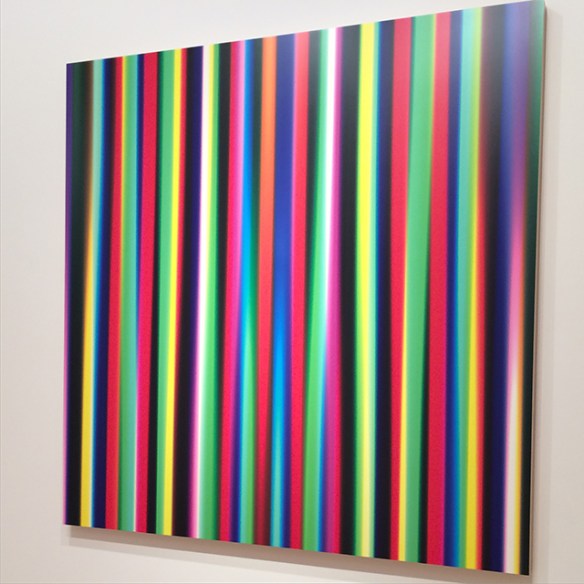
Gallery run 13th April

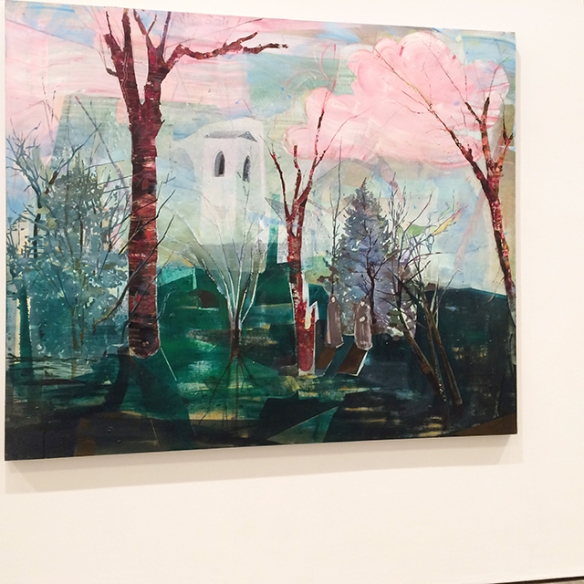
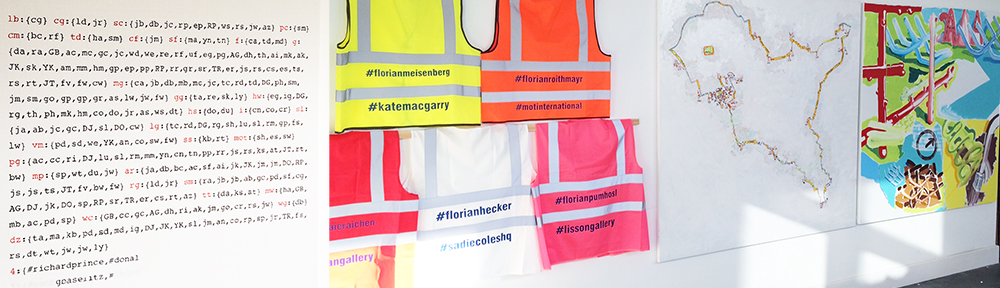
Like last week, this Gallery-Run-write-up has been reduced to the individual photo captions, shown further down the page, in order to make room for a temporary project called Plus 1 that now follows. Guests join me, hopefully, on a gallery run and will share ideas. Alas there are still no takers, though admittedly I still haven’t really asked anyone else yet, beyond the hopeful invitations shown last week. This week’s article features something entirely different, though still comprising a sort of plus 1, whilst also verging on the confessional! For two months I learnt the names of artists associated with London-Frieze-exhibiting galleries, from lists of paper whilst out jogging being careful not to run into lampposts or pedestrians. Each list could be hand-held and studied. Some even show the effects of rain or of being stuffed into a pocket. Along with a two word summary of something that each artist did, the process helped to create a stack of memory boxes that follows the sequence of the numbered lists shown in the photograph below. The memory boxes automatically bring forth the next in the stack, provided they are cycled through in recall about once every fortnight. The boxes also bring with them an essence of each artist, since they have gradually filled up with experiences of gallery visits. Memory is a strange thing and this sequential recall is probably born through the need to piece together consecutive events in time, something the philosopher David Hume considered to be the rather unphilosophical survival function that shapes the human brain.
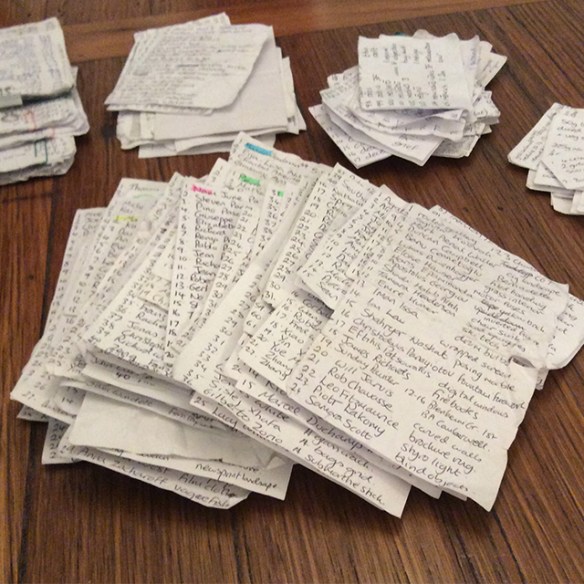
listsThe Lists Cycle. Gallery Runner lists in the foreground.

1091
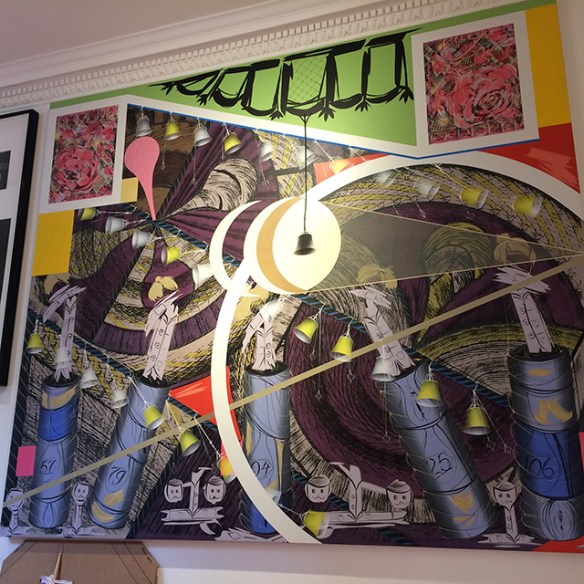
Pablo Bronstein of Herald Street Gallery with a film that crosses the glam game show format with some of the grand narratives of Greek mythology.
1092
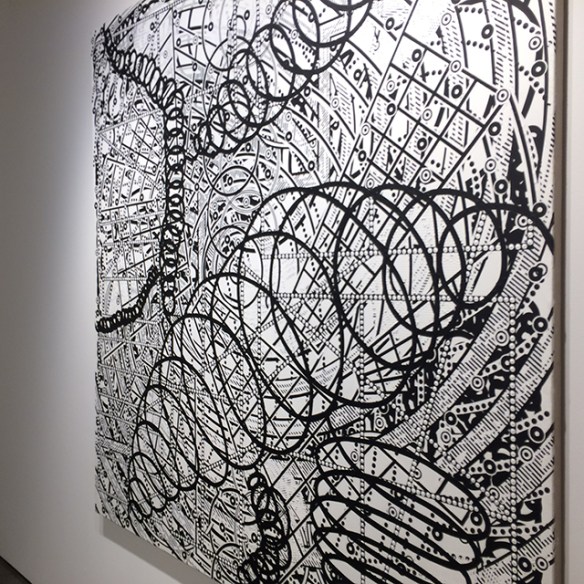
Bernard Cohen at Flowers Gallery.

1093
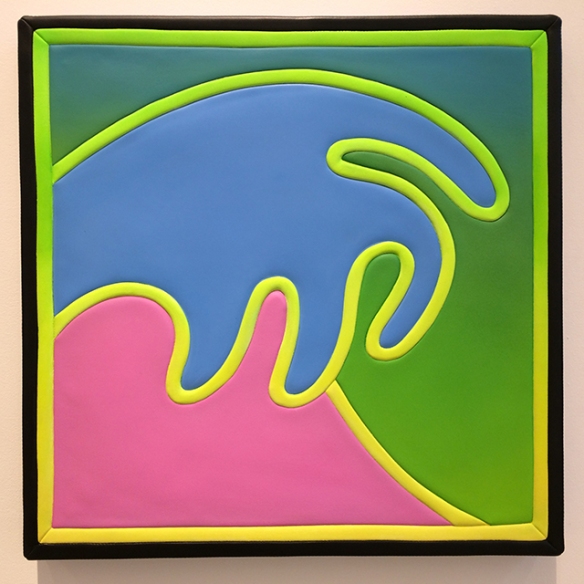
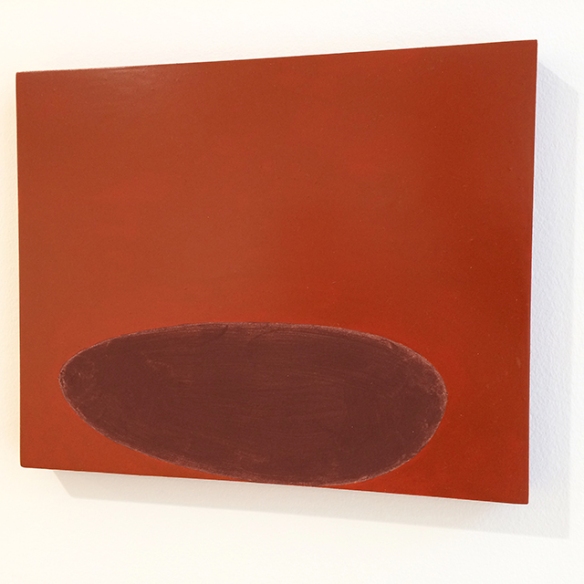
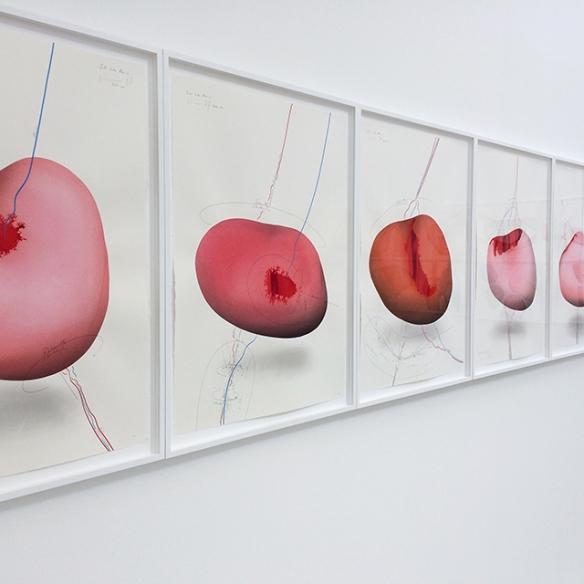
Elizabeth Murray of Pace Gallery showing at Victoria Miro with what looks like biological imagery on the shaped canvas.
1094
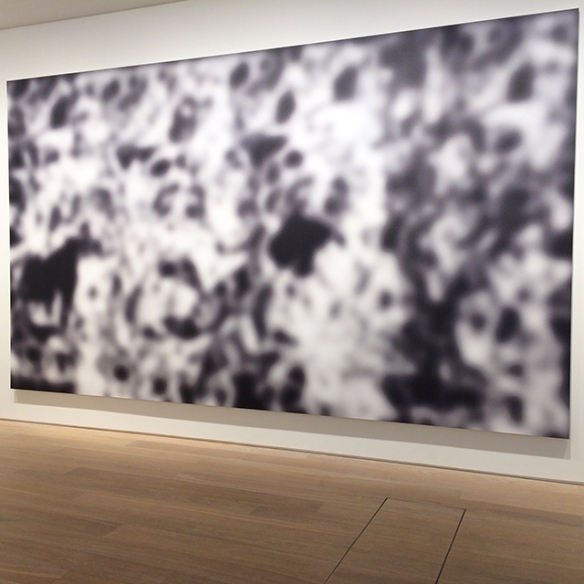
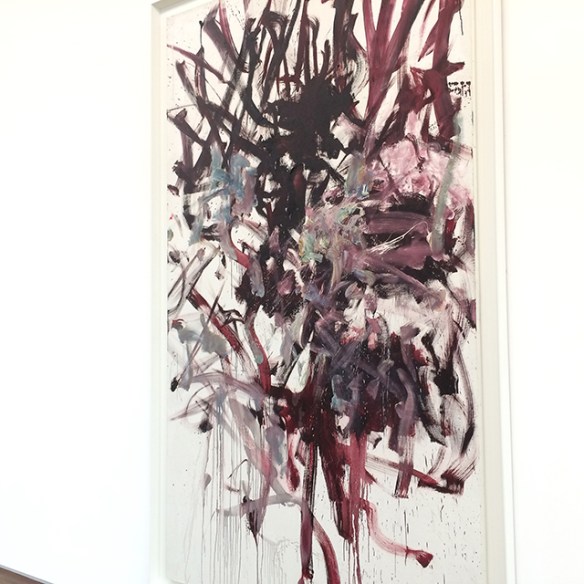
Joan Mitchell at Victoria Miro in a group show.
1095
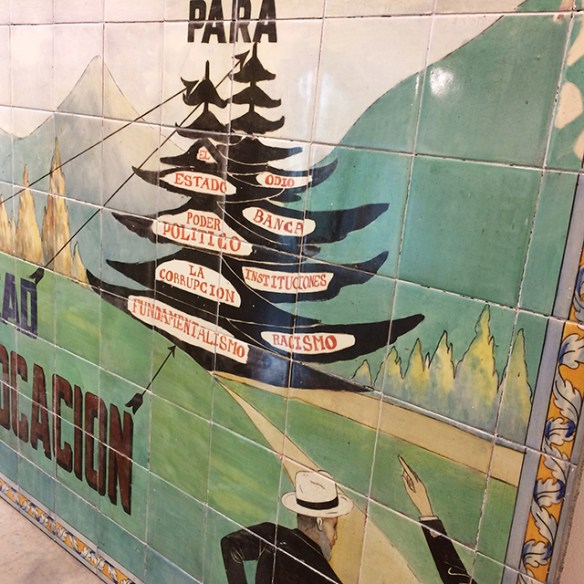
Carlos Garaicoa at Parasol Unit with reconstructions of tiled Cuban adverts, albeit with a few alterations.
1096
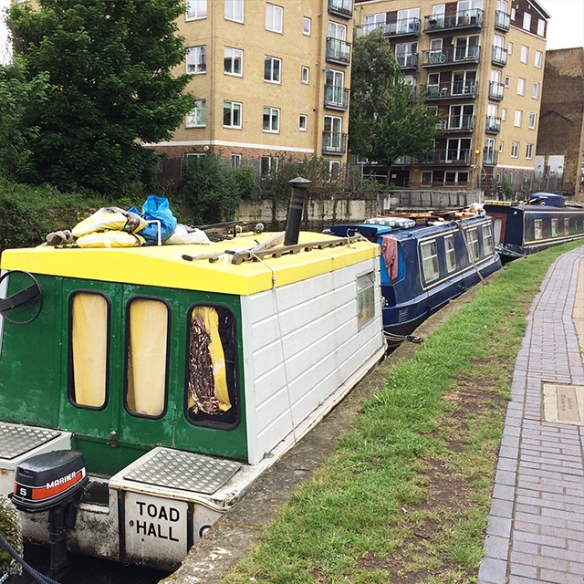
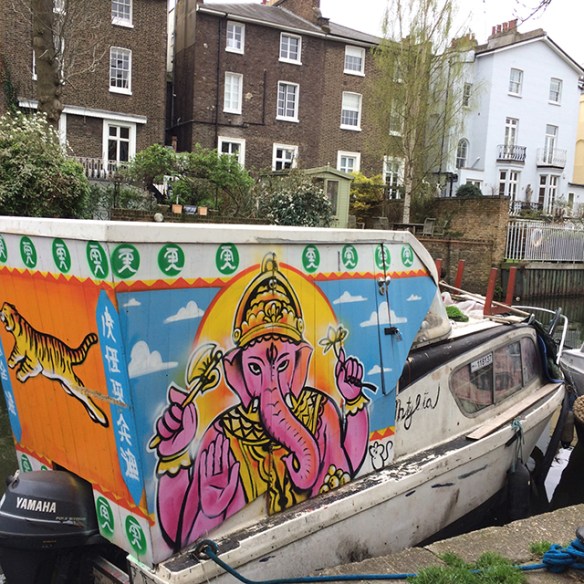
Fab boat in Camden.

1097
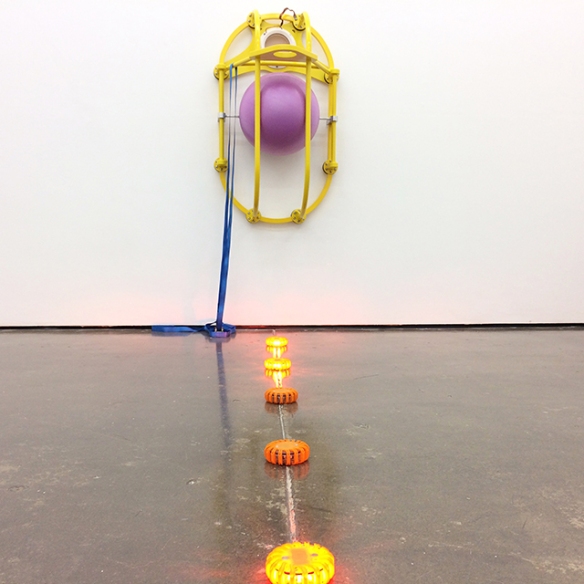
Ryan Gander of Lisson Gallery with carved shapes from an important mathematical blueprint. Meanwhile the black pile of sand steadily grows during the show from a thin stream of sand falling out of a hole in the ceiling.

1098
Pedro Reyes of Lisson Gallery with a room full of sculpture and wall tableaux forming a complete system of ideas, some executed and some pending.

1099
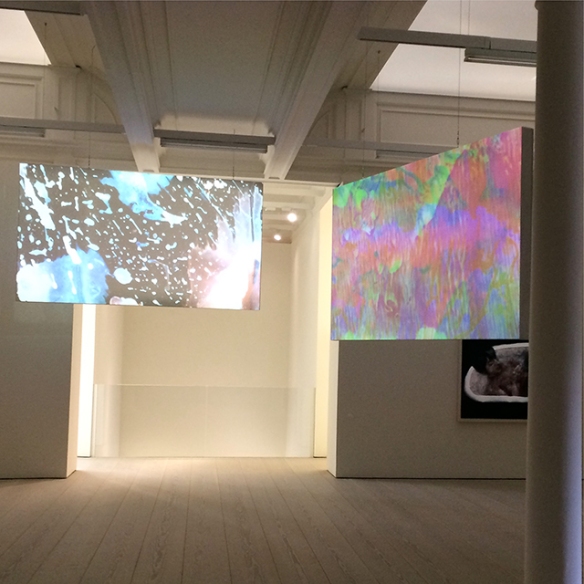
Ian Cheng of Pilar Corrias showing at Serpentine Galleries. We see what appears to be a simple animation but gradually learn that the creature is living in real time and using a sort of AI to try things out and get used to its rather unusual body.
Gallery run 7th February

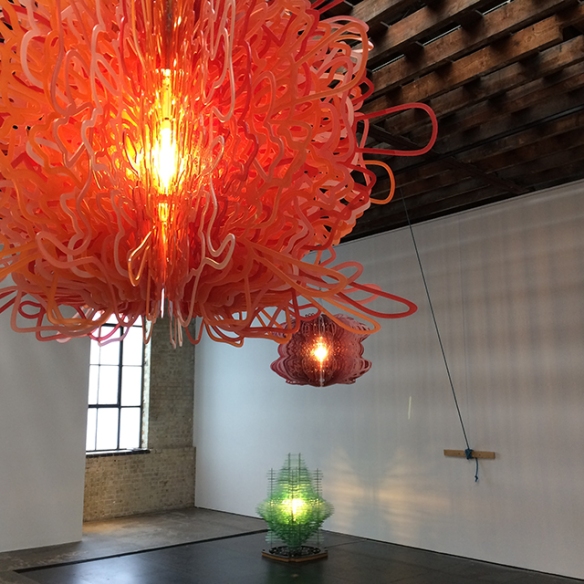
The Regent’s Canal highway describes a sort of subjective experience of running on the towpath between Hackney and Regent’s Park. Though not particularly fast in the physical sense the towpath seems quick in a kind of existential sense, namely that with several galleries dotted along its route a sensation of speed is produced by the sheer lack of things that need to be done or thought about during the journey. A few glances at boats, the occasional meandering daydream is all that separates one gallery on the canal from the next. Suddenly the finger is on the buzzer awaiting entry to Victoria Miro Gallery. Jorge Pardo, who is of Cuban American extraction and now living in Mexico, is showing wall-mounted structures that resemble beautifully coloured screens. They are painted, but not in a traditional sense, for the colour emerges from an interaction of minute speckles of paint which have either been created from abrasions into a surface of many layers or, and this seems the case here, have in fact been created completely intentionally by a programmed computer and application device. A thin hair’s-breadth groove around each speckle provides the clue that the speckles themselves have been applied with deliberate intent. On a larger scale, that is on the scale of the entire objects, we see rhythmic patterns running right across their surfaces. Waves and flow lines appear as the eye scans the intricately cut plastic and fibrous sheets. For the lamps this experience is enhanced further by the presence of the interior light source which provides a strong contrast between material and void. In addition this light source promotes a change of geometry in the object. Rather than being planar, as was the case with the wall mounted works, these lamp-like objects are radial. Intricately cut sheets of coloured plexi-glass fan out from the centre, like an elaborate array of coloured cooling fins, conveying their subtle glows to the object’s fragmented surface.

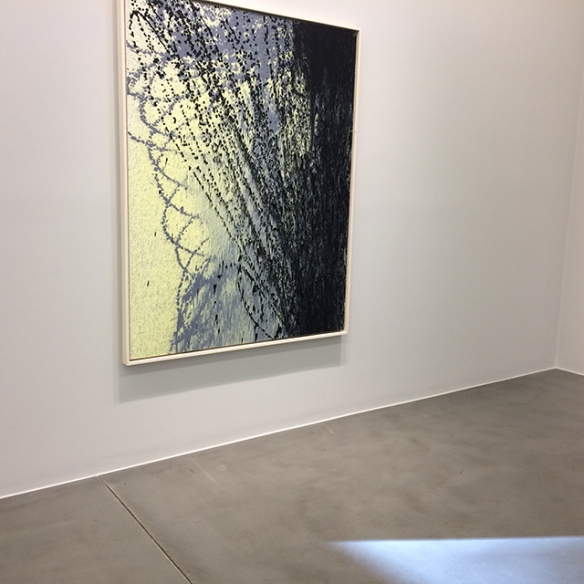
Back on the canal highway, Regent’s Park soon offers a route south to the West End. At Simon Lee Gallery, there is a display of the late works by Hans Hartung. Accompanying this display is a film that shows the artist in a wheel chair, since he is an old man, spraying and flicking paint across large expanses of canvas. Known for his gestural abstraction, the artist is now using a prosthetic device comprising a stick wand and spray nozzle. In the gallery we see the result and how the artist succeeds in his express intention of mimicking the forces of nature. Partly these forces reside within the paint itself causing the drops to cling to one another or else suddenly break free as though they were a shower of ejecting particles, but there is a deeper connection to nature too, manifest most clearly when the work has taken on more complex forms such as a spiral motif in one outstanding example. Here it is as though the artist has attuned himself to the various rhythms that define the universe itself allowing him to represent the more complex forces that create the various spinning and oscillating systems around us.

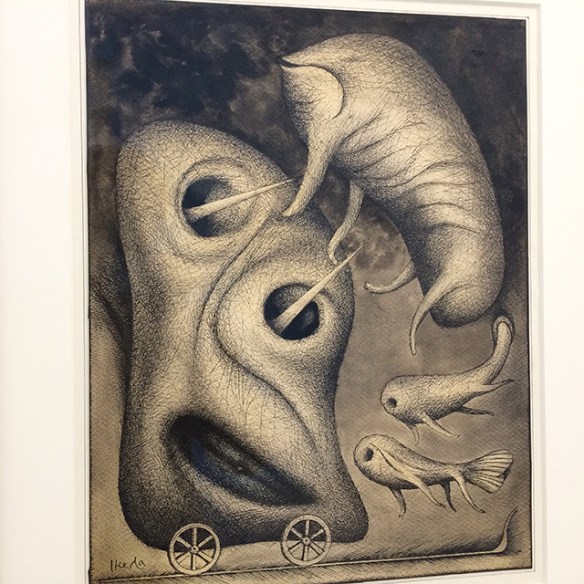
With Corvi Mora and Greengrassi galleries pairing up this month, several artists are on display in the main viewing space and it requires careful checking of the paperwork to determine which gallery is associated with which artist. Tatsuo Ikeda who as it turns out is with Greengrassi, though in previous years has also exhibited with the blue-chip giant Gagosian, has produced surreal drawings of figures sporting various limbs for locomotion, as well as prosthetic cones. The artwork is very proficient, which allows us not only to enjoy the images, but also to engage with the various distortions of nature without rejecting them on the grounds of incredulity. The images are therefore accepted on account of their near photographic-like appearance. As a passing observation it seems that the two dominant features of these works, namely their Surrealism and their Realism of execution, turn out to be unlikely bedfellows, despite the apparent contradiction of these two terms.

1001
Jorge Pardo at Victoria Miro with laser cut plastic in exotic lamps that nevertheless look very traditional.

1002
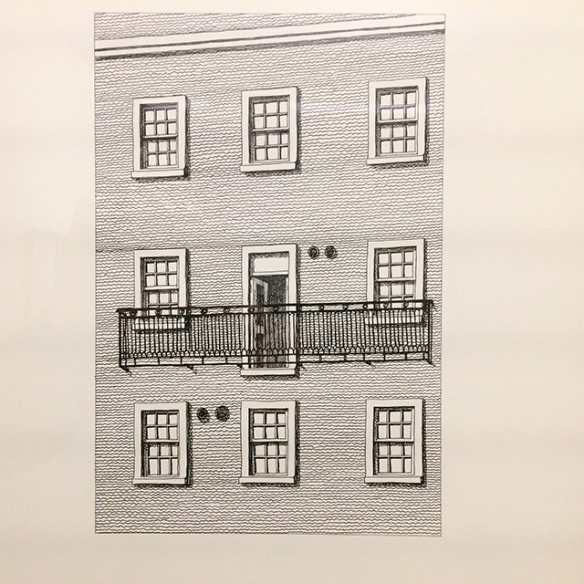
Pablo Bronstein of Herald Street Gallery showing drawings at RIBA of pseudo-Georgian architecture.

1003
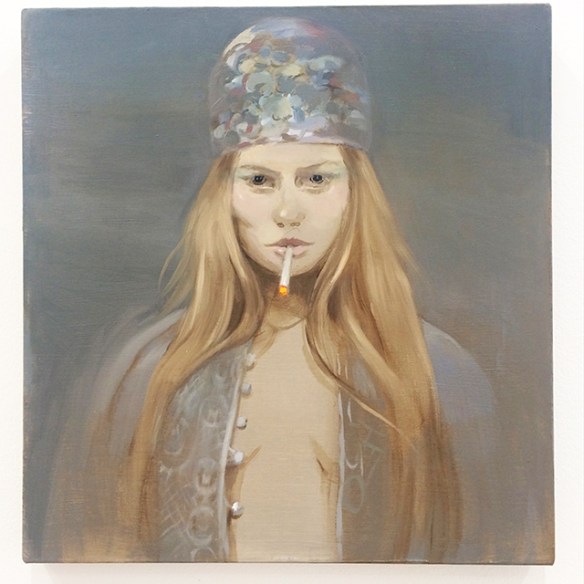
Matt Saunders of Marian Goodman Gallery.

1004
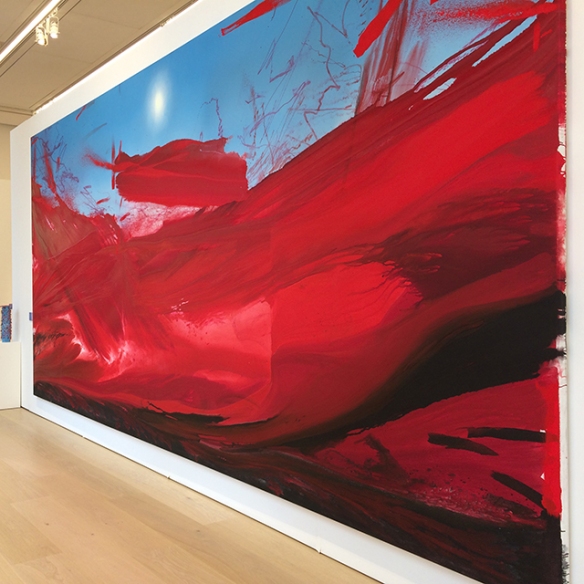
Hans Hartung at Simon Lee Gallery with paintings from late in his career made using spray nozzles and paint-covered olive branches that he could manipulate from his wheelchair.

1005
Estate near Greengrassi and Corv iMora galleries looking resplendent against a blue sky this afternoon.

1006
Tatsuo Ikeda at Greengrassi group show for Condo 2018.

1007
Kye Christensen Knowles at Corvi Mora and Greengrassi group show as part of Condo 2018.

1008
John Lindell at Corvi Mora for Condo 2018.

1009
Sable E Smith at Greengrassi and Corvi Mora group show as part of Condo 2018.

Gallery run 11th January

The run to Trinity Buoy Wharf has been an attractive activity ever since a speaker at an event there, Ian Sinclair, notable for walking round the entirety of the M25 and writing a book about it, declared that this wharf, with its location next to the River Lee, marked an historic site. From here the Saxons would check out the Vikings, whilst the latter would return their reconnaissance in this direction from across the barrier of the River Lee. It is right on this junction that this smaller tributary departs the Thames as it takes its waters from the North. With a bacon roll consumed, it is time to head to the first gallery of the day via a series of waterways.

The River Lee provides quite a formidable barrier to the foot traveller even today and unlike the fairly tortuous route of a few weeks ago which required a four lane highway as travelling companion to cross the river, today’s route wends its way north past the giant docks of Canary Wharf and onwards up the Regent’s Canal, escorting me to Hackney, and indeed, arriving fifteen minutes early at one of the midday openers. PeerUK is hosting Catherine Story from nearby Carl Freedman gallery and in its window are clues to the nature of the show. Clay maquettes are the artist’s starting point and these have then been transposed to canvas as a series of Surreal looking paintings populated by chunky figures with shear planes suggestive of both limbs and machinery. They are in fact reminiscent of Cubism and with the clay being a plastic medium, the artist appears to have worked out in advance, the various folds, bobbles, distortions and protrusions, distinctive of that style, before then transposing them to the two dimensional world of paint.

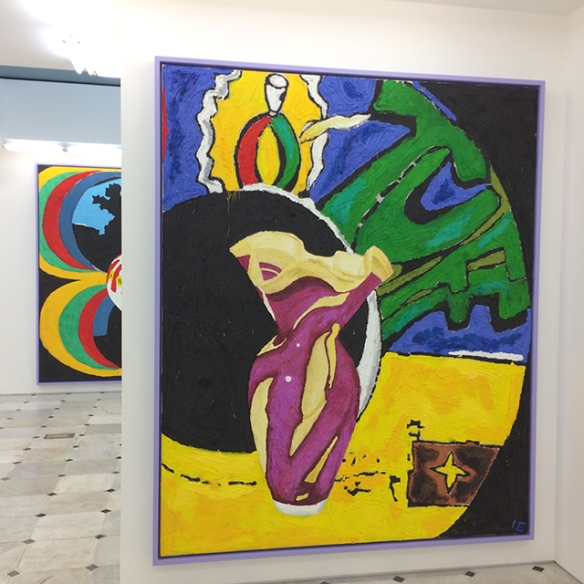
Herald Street Gallery has opened a new space in Museum Street just near the British Museum and Ida Ekblad is on show. Her rather stunning, bright paintings are actually made with plastic, a fact gleaned whilst reading her press release off the phone in those last few minutes of waiting outside the previous space. The plastic has been melted and smeared with a palette knife and yet none of its intensity of colour, whether it be derived from a previous state as coloured carrier bag or plastic household object, a specific origin that the artist doesn’t actually divulge, has been lost. Rather this detritus of daily life lives on in a strange afterlife as material of a painting, depicting the simple forms of pots that are themselves reminiscent of Greek urns, along with a whole host of other types of ornamentation ranging from flowers to simple coloured planes.

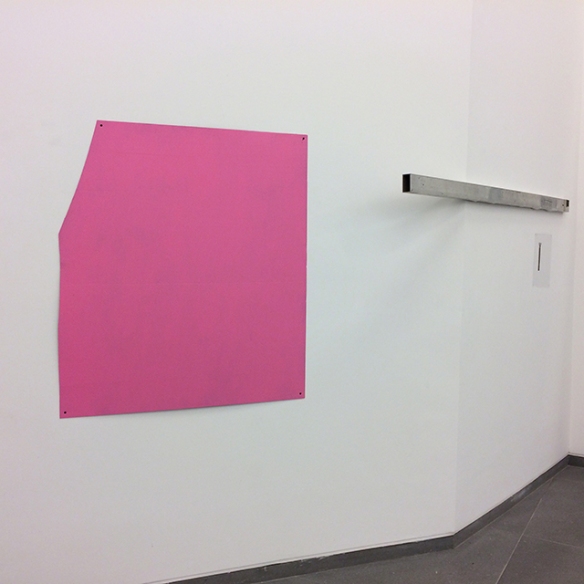
After seeing yet more good quality work up for auction at Phillips, with a couple of stand out pieces by Alex Israel and Barnaby Furnas, the next destination is south of the River at Vauxhall where Cabinet Gallery sits proudly in the middle of the aptly named, Pleasure Garden. Henrik Olesen’s musings on the nature of an object lead to an unusual, though confident display of tacked, nailed and propped materials that sit and hang against the various white-walled nooks that this gallery has made available with its slightly unusual polygon-styled floor plan. On many of the box-sections of brushed aluminium, which feature as rectangular frames or stand-alone girders, there are small inscriptions presented on clear plastic rather as one might find accompanying cooking instructions on a ready-meal, and these provide further philosophical reflections by the artist on object hood. Perhaps by giving us a general scene of peculiar part-objects to look at whilst openly questioning their validity, the artist is also trying to evoke an aspect of the human condition that has been put into words by the philosopher Heidegger, that since the Greek ages we have passed over the phenomena of the world, a general being, and instead focused our attention, to our detriment, on individual objects from which we try to extract meaning.

961
Catherine Story of Carl Freedman Gallery on show at Peer UK.

962
Ida Ekblad of Herald Street Gallery with vivid paintings made from melted plastic.

963
Barnaby Furnas of Victoria Miro provides the statement piece for auction at Phillips.

964
Alex Israel on auction at Phillips and adorning the front cover of the catalogue as befits a top ranking artist shown by Gagosian Gallery amongst others.

965
Michael Pybus on auction at Phillips.

966
Clever use of stickers on this bike.

967
Henrik Olesen presents a show at Cabinet Gallery of what could perhaps be described as partial objects, many of which are casually stapled or pinned to the wall. The show itself seems to question what an object actually is.

968
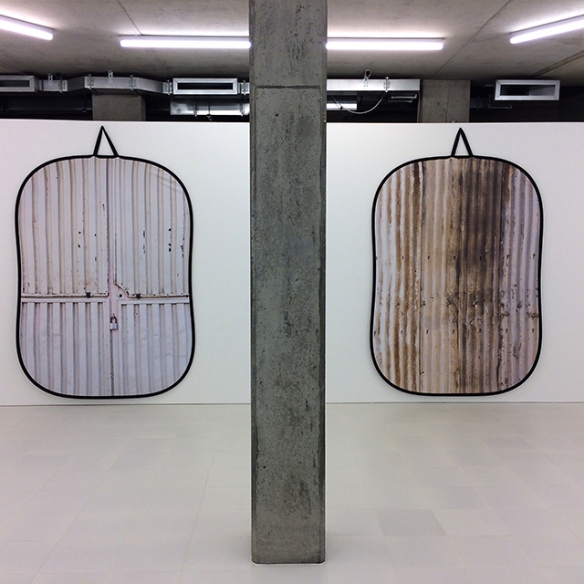
Simon Thompson of Cabinet Gallery, an artist I’ve wanted to visit for a while, has done prints of objects on rather fab rug-like objects with a hanging tag.

969
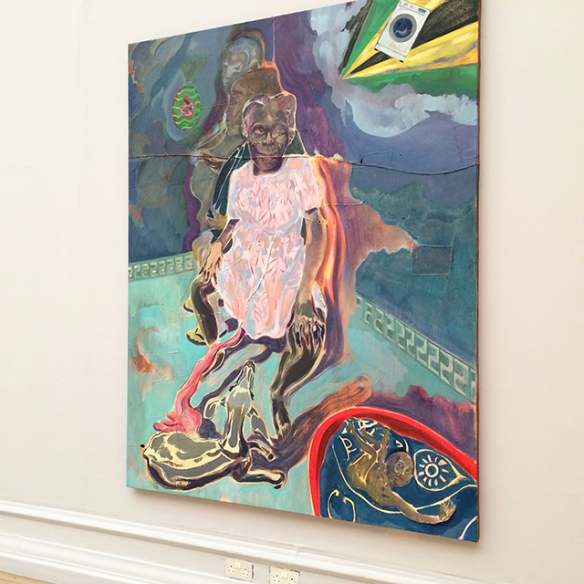
Michael Armitage of White Cube showing at South London Gallery. An allegorical piece as a mother gives birth to a goat. Not a good thing! and dreams of a better life symbolised by washing machine top right, are back on hold.

Gallery run 15th November

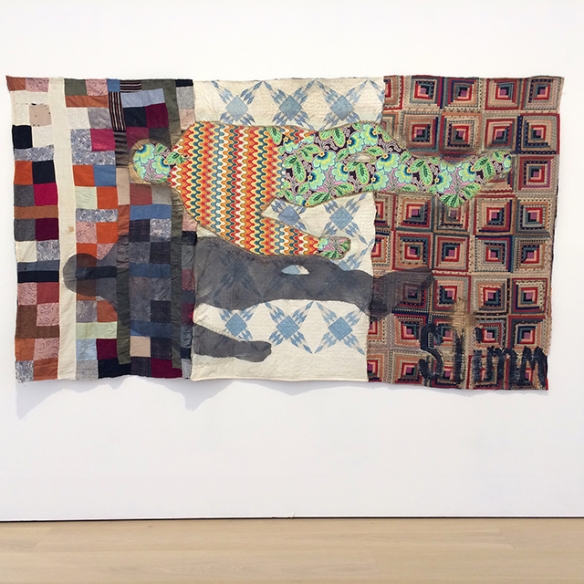
With a lap round The Serpentine in Hyde Park taking the time up to ten o’clock, the first gallery of today’s run should now be open. But alas, my check of opening times on the internet last night was not done accurately enough and it turns out the gallery is in fact closed today for refurbishments. Fortunately one of their artists, Sanford Biggers, is showing just a few hundred metres away at Phillips auction house. The good fortune of spotting the gallery artist in this alternative venue is further enhanced by the quality of the work. It comprises a delicately stitched, embroidered quilt cover with a back story that it was donated to the artist along with many others from families whose ancestors were effected by slavery. This has become part of the rich historical narrative of the artwork itself.

A few blocks along in Victoria Miro, Stan Douglas is displaying photographic-based work. Although primarily the show focuses on high-resolution photographic reconstructions of the London riots of 2011, there are also two abstract works. These additional abstract works are fascinating because they are actually based on simple jpeg images of geometric shapes but where the information of the original digital files has been altered in a systematic way. The resulting rhythmic patterns, we are told, reveal the wave patterns that make up the structure of all jpeg files.

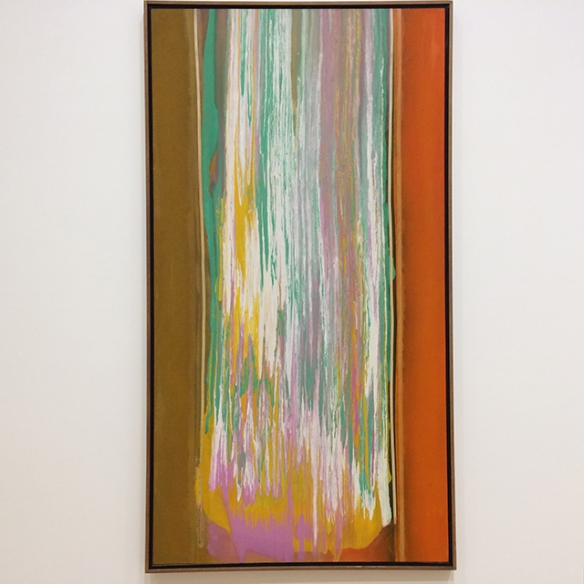
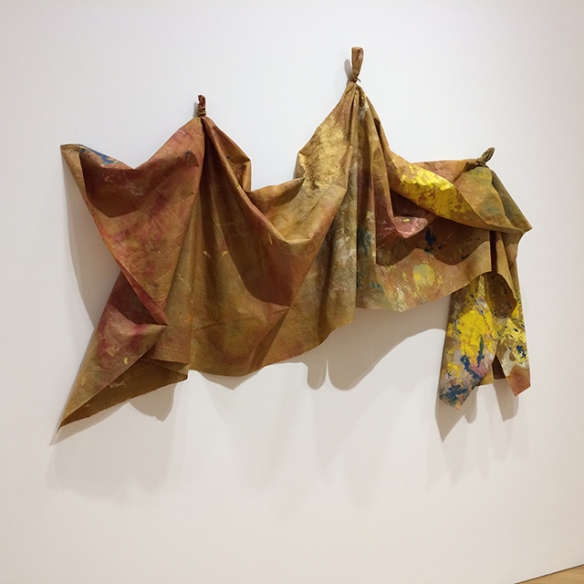
Nearby in the hub of galleries close to the Royal Academy, Pace Gallery is showing some of the American Abstract Expressionists. The dominant figure in this group, at least from an historic perspective, is Kenneth Noland, and the show builds on this popularity by also including works from other important artists from that movement including Frank Bowling and Sam Gilliam. The former has poured paint down the canvas and despite the absence of a brush, has created an elegant and ordered painted surface, evidenced by the clean boarders on either side of a main channel that comprises a complex multi-layered surface of paint. Meanwhile, the latter artist has removed his canvases from their stretchers altogether. They have been bunched up into a few hanging points and suspended from the gallery walls.

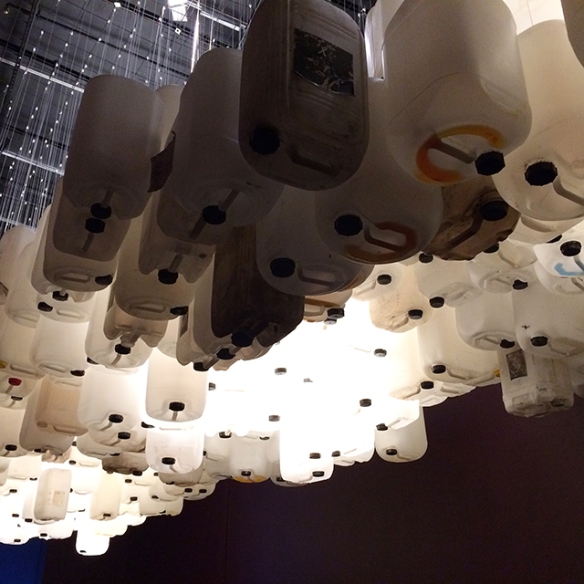
The London art scene is buzzing right now with the Basquiet show at the Barbican. Today’s run actually takes in a concurrent show in the building’s second gallery, known as The Curve. John Akomfrah has collected a multitude of chemical containers with their coloured residues still visible in white plastic grooves. He has then suspended them from the ceiling where they mingle with the lighting to create a stunning spectacle of glowing white plastic. The artwork actually references the anthropocene, an emerging name for Earth’s most recent age, and one that is characterised by human influence rather than geological change. On this account, the artwork draws more attention, in fact, to the pollution of these chemical containers than to their sublime beauty. Perhaps also on this solemn note, it is where today’s blog comes to a close, though the run itself would take in David Blandy at Seventeen, Omar Ba at Hales Gallery, Alan Belcher at Greengrassi and Abel Auer at Corvi Mora, all offering great exhibitions over the rest of the day.

901
Sanford Biggers of Massimo De Carlo on show, and for auction, at Phillips.

902
Stan Douglas at Victoria Miro with a manipulation of a jpeg file. These familiar digital files, used for storing images, use clever techniques to compress them and the artist has intervened in some way to produce an image that reveals this underlying technique as an image of its own.

903
Frank Bowling often represented in London by Hales Gallery on show here at Pace Gallery.

904
Sam Gilliam at Pace Gallery with a detached canvas.

905
John Akomfrah represented by Lisson Gallery showing at Barbican. These are chemical containers that the artist has used to represent, with some beauty, the Anthropocene, our current geological time period by some accounts.

906
David Blandy of Seventeen Gallery with a digital reconstruction of the solar system.

907
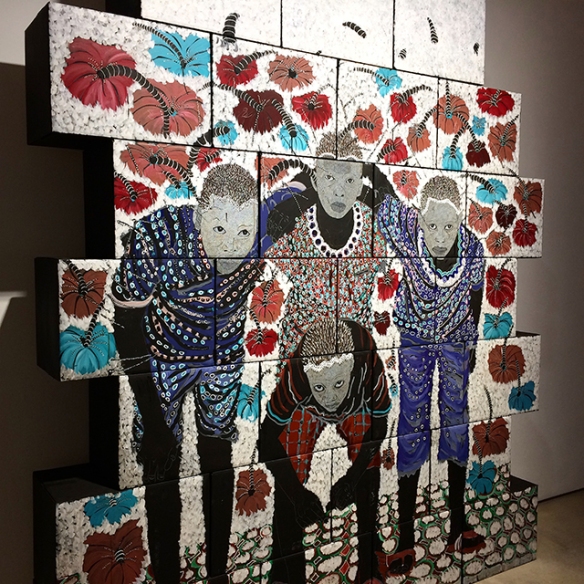
Omar Ba of Hales Gallery draws on the experiences of his native Senegal to develop his rich symbolic language in paintings.

908
Alan Belcher at Greengrassi with paintings of geometric objects that accompany, in his show, paintings of ducks, fish and shellfish each having a surreal quality.

909
Abel Auer of Corvi Mora.

Gallery run 12th October

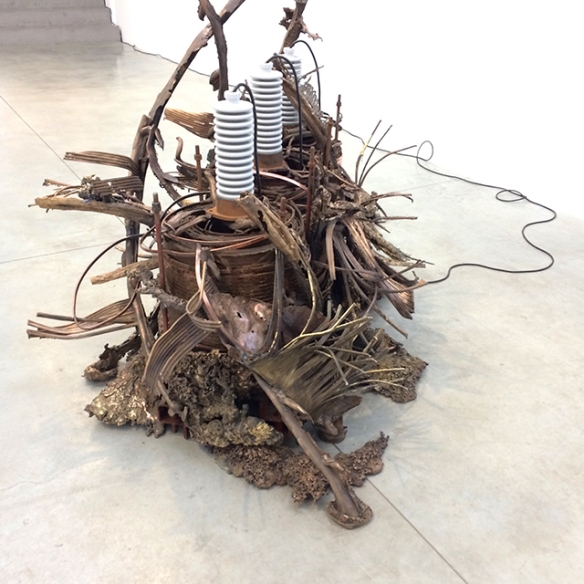
One of the most enjoyable runs is along the Regent’s Canal from Lisson Gallery to Wharf Road, where Victoria Miro and Parasol Unit are situated. Having been to neither gallery for a while there are new shows to see at each and with the addition of an exceptionally fair autumn day the planets are aligned for a good run. At Lisson Gallery, Allora and Calzadilla have installed a display that very obliquely criticises America’s policy towards Puerto Rico and other affiliated states. These states don’t get a star on the US flag and furthermore, according to the artists, suffer from the ambiguity of their legal status of being “Foreign in a Domestic Sense”. They are foreign in some respects and domestic in others but in a way that gives them generally a bad deal, as the critique continues. How could this critique be presented as an artwork?, one might wonder. Partly through drawing attention to the phrase above in its use as the show title and partly also through arguing that the work itself by a sort of mimetic response, embodies contradictory aspects in its own form. On display is a transformer plugged into a domestic power socket making a surprisingly large humming sound off what is presumably a 13 amp plug. With various bits of foliage and earth surrounding it, the electrical equipment does indeed seem to deliver this contradictory response to the viewer that the artists had hoped for. The artwork is actually rather scary to get close up to for the photograph.

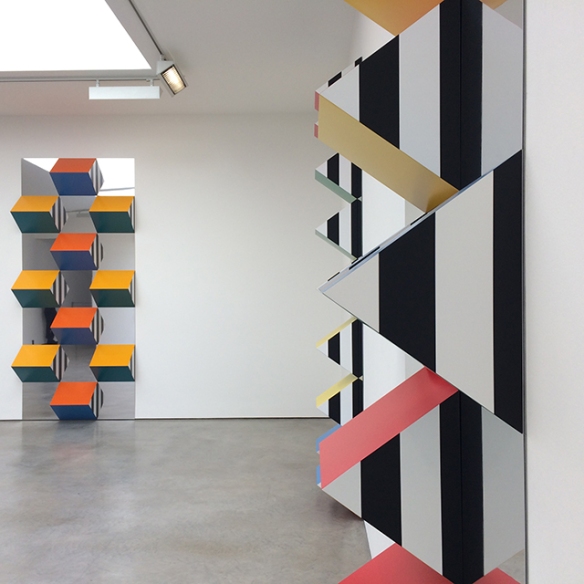
At the other gallery Daniel Buren has installed beautifully finished powder-coated, coloured modules against a mirror background. This encourages the simple conceit on my part of trying to pick up reflections from across the gallery and uniting the different modules in single camera shots. Buren’s characteristic 8.7cm vertical stripes unite all the modules together and this is a geometric feature which the press release diligently draws attention to.

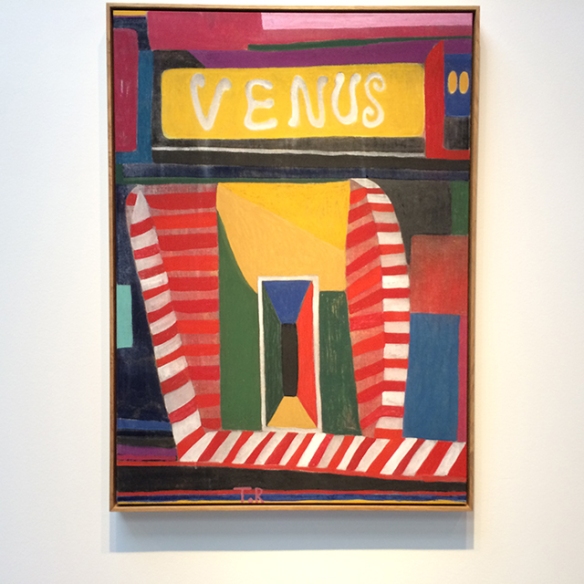
The canal is looking good today adorned by the sparkling sun and the towpath is full of walkers and cyclists. Though the canal is not a short cut, it allows the mind to switch off and soon enough one arrives at Wharf Road, 5 miles away. Tal R is showing his sex shop paintings which are a lot less explicit than they sound. Indeed it is the very barrier of the front door and plain facade of the shop that the artist likens to a physical barrier of the painted canvas. The critique continues that the canvas obscures various desires forever hinted at but unrealised through the medium of paint. The images are painted from photographs but rather than this being a negative feature in the sense that the images are only copies, the photographs add a performative aspect to the artwork. For these photographs are collected randomly by the artist’s friends and thereby remove some sense of the artist’s own taste and instead allow the subject matter to be presented as a simple phenomenon.

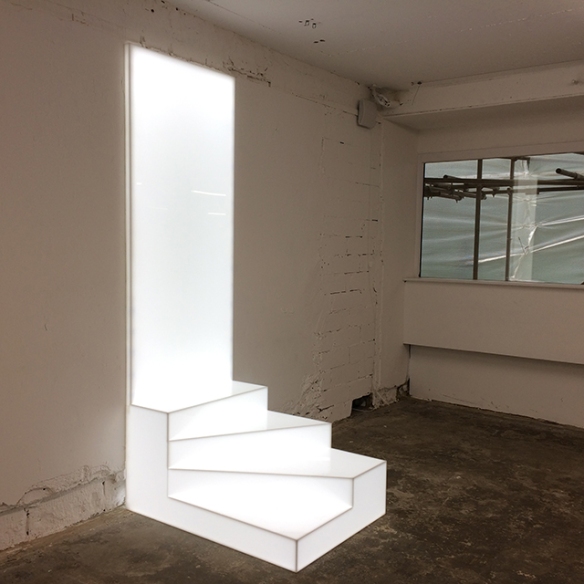
Having also seen some more great artwork at Parasol unit, the last destination is The Strand where Lisson Gallery have taken over a building. The building is scheduled for demolition and has temporarily assumed the name of Store Studios. Here the Lisson artists have executed some of their installations in this new setting and of particular note is Ryan Gander’s sculpture depicting glowing steps ascending to a rectangular doorway, which is actually a sheet of back-lit plexiglass. The effect is to suggest some transcendental ascent to those climbing those steps (but as they number only three and are built of plexiglass too, cannot be walked on) set within the shabby walls of the condemned building. With the index of Lisson artists largely addressed in this show and the earlier works from the morning further drawing from that index, the day has finished with a decidedly minimalist Lisson-like feel.

851
Daniel Buren of Lisson Gallery with wall mounted pieces based on his characteristic 8.7cm wide black and white stripes.

852
Allora and Calzadilla of Lisson Gallery. Foreign in a Domestic Sense is a legal American phrase which the artists feel is unfair to certain of its allies.

853
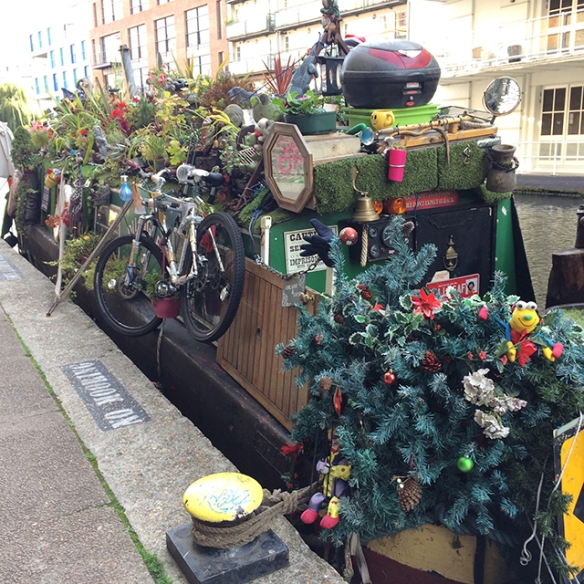
Regent’s Canal.

854
Tal R of Victoria Miro with his new series of paintings based on photos of sex shops, many of which were sent to him from around the world.

855
Martin Puryear at Parasol Unit with beautifully crafted sculptures.

856
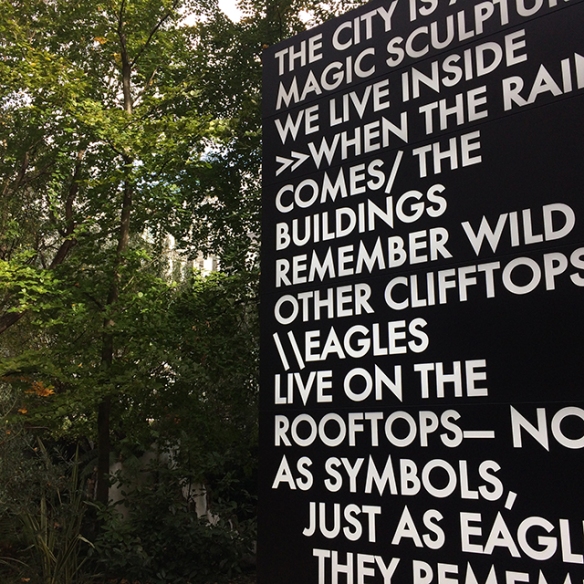
Robert Montgomery at the Parasol Unit with a large outdoor text piece.

857
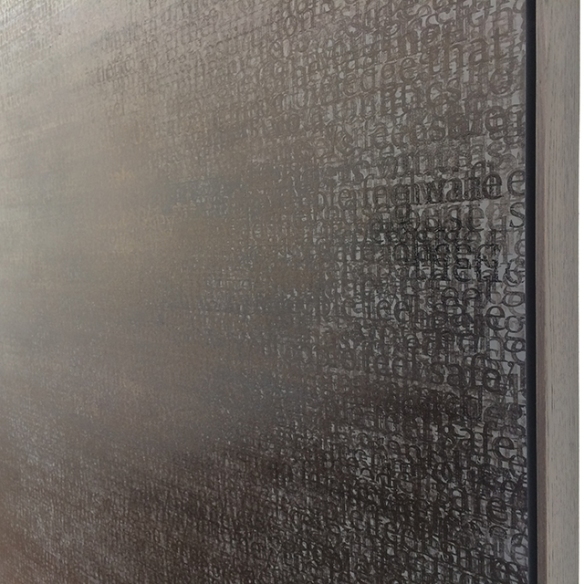
Idris Kahn of Victoria Miro with delicate text-based paintings.

858
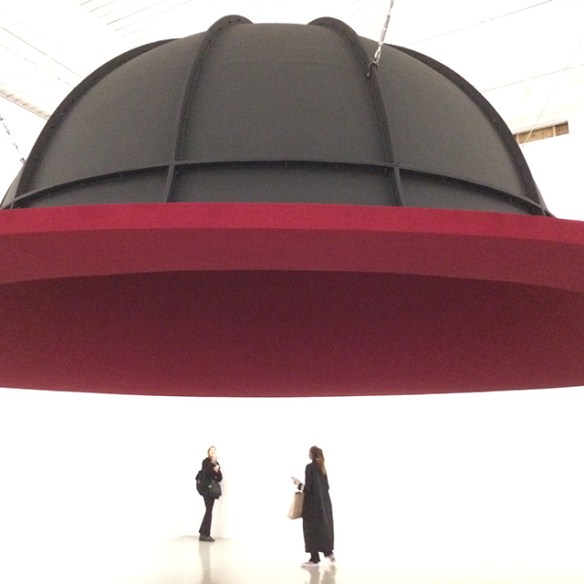
Anish Kapoor of Lisson Gallery showing at Store Studios on The Strand.

859
Ryan Gander of Lisson Gallery at Store Studios on The Strand.

Gallery run 8th September

Today is wet and with the forecast suggesting continuous rain all day apart from a two hour window in the late morning, it is fortunate that all the galleries lie close together in the West End. The Photographer’s Museum is free before 12 and this morning slot also fits well with the gap in clouds overhead. Gregory Crewdson is showing photographs in which a small town and surrounding forrest have played host to several tableaux created by the artist and his team of assistants. Human figures are captured in the images perfectly lit behind windows or amongst landscapes. The effect is to reveal simultaneously both the details of a facial feature and those of a receding landscape. Technically this probably means an astonishingly deep depth of field and what the blurb described as a film crew whose size is normally associated with a movie.

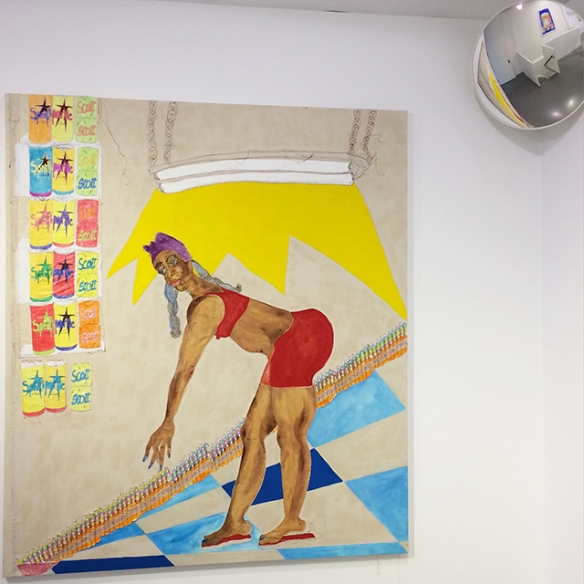
Having marvelled at these works the next destination is Pilar Corrias Gallery. Tshcabalala Self has themed her first show here around the Bodega, the US equivalent of the corner shop. Lots of bottles of pop line the shelves. They seem to stand as a sort of cypher for the artist’s own memories of these shops. In addition to paint, the images use collage and stitched fabric. Even the gallery itself plays a role in the artwork. Three neon signs hang in the window and anti-theft mirrors are installed in each corner of the gallery, like the type the shop keeper glances up at from behind the till.

The rain has now started and after arriving at David Zwirner Gallery it is necessary to dry off in a porch opposite for a few minutes to remove any obvious signs of a soaking. Downstairs Lucas Arruda has displayed delicate landscapes and upstairs Suzan Frecon is displaying the studies for large abstract paintings she would go on to produce, though they themselves are not on display here.

Finally there are two further excursions from under the rain protection of overhanging facades. First at Simon Lee Gallery, Jeff Elrod has exhibited paintings composed chiefly of spray paint. The effect is to create an abstract surface and is exemplified by a fantastic large scale work upstairs that resists any attempt for the eyes to focus upon it. In that sense the painting offers an experience to the viewer that is almost physical. The last excursion, which is to Thomas Dane Gallery reveals an interesting twist to the standard summer group show format. Here the works are given 9 hours of individual air time in the empty gallery before returning to the packing cases, which themselves are all on display. Eventually, though, a sort of climax is scheduled to take place wherein all the individually displayed works will go up in the gallery at the same time. As the curator explains, this should have an interesting effect as each piece re-appropriates its piece of wall in a packed display, perhaps displacing others sideways in the process.

Now with the weather unexpectedly clearing up and only a short distance covered up to this point, I head west to build up the miles and attempt to convert these fragmented visits to the galleries into something more resembling an actual gallery run.

811
Spot the loo roll!
Gregory Crewdson at The Photographers Gallery with a body of work depicting life in an American town and surrounding forrest. The photos are carefully staged tableaux.

812
Tschabalala Self of Pilar Corrias with paintings of a type of corner shop called a #Bodega. Spot the anti theft mirror you would find in the corner shop.

813
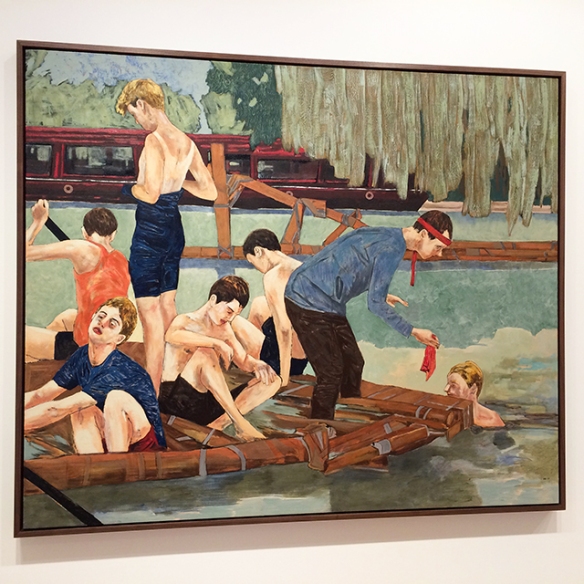
Hernan Bas at Victoria Miro Gallery with paintings of revellers and rebels in Cambridge.

814
Mark Hagen uses a gloss white surface on a canvas-like support in this composition shown at Sotheby’s St George St.

815
Aaron Young at Sotheby’s.

816
Lucas Arruda at David Zwirner with delicate landscape. They have immaculate matt surfaces, revealed by the complete lack of glare when photographed.

817
Suzan Frecon at David Zwirner with delicate studies for larger abstract pieces on show in New York.

818
Jeff Elrod of Simon Lee Gallery with paintings using spray paint.

819
Lari Pittman at Thomas Dane Gallery waiting to be displayed. The gallery displays each work for just 9 hours in this group show. Later on in September all the works go on display together.

Gallery run 11th August

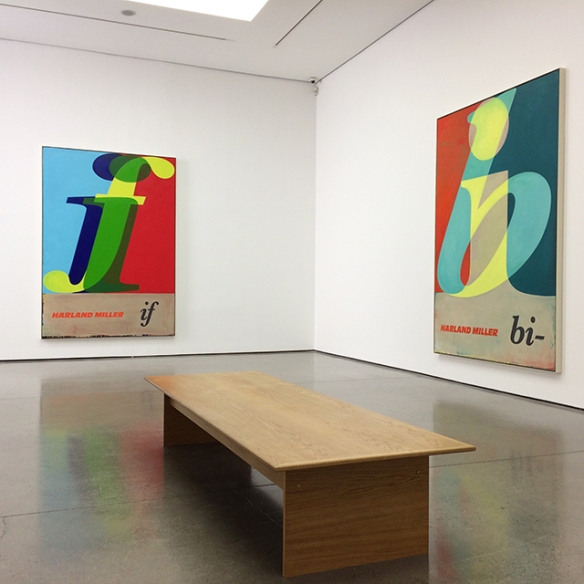
The day starts with a run up to White Cube Gallery near St James’ Park, followed by a visit to Gagosian just across Piccadilly and up past Berkeley Square. At White Cube, Harland Miller has painted more imaginary book covers using the 70’s style idiomatic of self-help manuals. He seems to look back at that era with affection and there is a suggestion in the blurb that it marked a time when such projects on oneself were seen as augmentative to an already ok self whereas now the self has become categorised by science as being afflicted by a range of disorders perhaps best left to the professionals to remedy. After these thought provoking issues, Peter Marino’s work consisting of several patinated bronze trunks, serves up a healthy serving of bling preventing any further circumspection of the soul. Above each of these floor-based works are priceless artworks by Bacon, Picasso and Warhol all hung on the wall. Taken from the Gagosian group of elite artists, these works provide a sort of imaginary setting which no doubt many rich collectors will identify with as home.
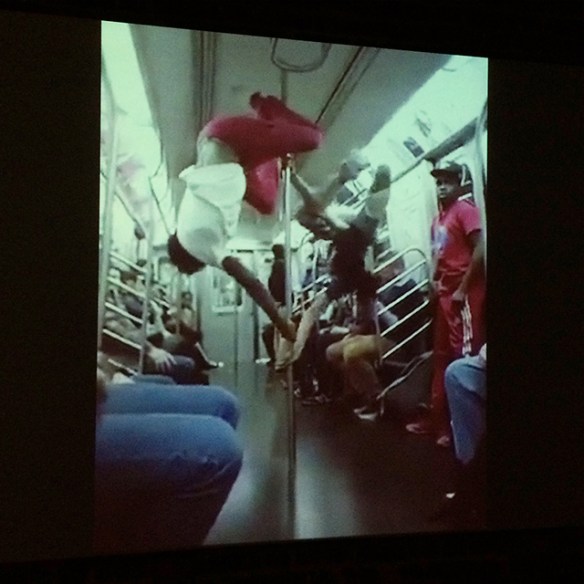
Initially when I then arrive at the Serpentine Gallery in Hyde Park and see the slogan “The most popular show ever” before being asked to queue, I wonder who might have written this in their revue. Then I realise it is the title of Grayson Perry’s new show. He is displaying vases and tapestries and some gloriously sumptuous bikes with cow horn handlebars, a motorbike and peddle bike. Judging by the crowds milling around these great exhibits, the show title rings true. Across the Serpentine lake in the Sackler gallery are more works by a black artist Arthur Jafa, exploring political and urban street life themes. My favourite work is a video showing a performance of two artists spontaneously taking over the central isle of a metro train and swirling around the central pole. As I snap the image and look at the photo, they are upside down with lights and seats receding into the distance creating a spectacle that looks like the astronauts on a space station. They are modern day “metronauts”.

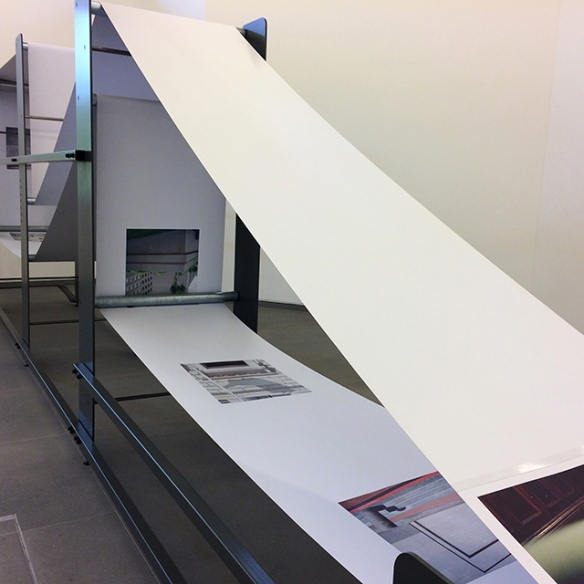
Finally the journey back south takes me to Vauxhall where Calla Henkel and Max Pitegoff are showing at Cabinet Gallery. In the middle of the gallery is a long one metre wide strip of vinyl which is being passed over motorised rollers in a complex system of zig-zags. Printed on this vinyl are occasional images of stonework lettering which, we are told, are addresses of American government organisations that have been carved onto their stone walls. Meanwhile in a sort of contra-punctual relation there are also images of the interior of an Irish bar in Berlin. Whilst the former is perhaps associated with military prowess, the latter still has associations of military exemption, a feature of Berlin life for many years. The structure of the present artwork in Cabinet alludes to a standard printing procedure of airing the vinyl strip to allow time for the inks to dry. But it is also suggestive of a much more poetical process whereby it is acting as a sort of collaging machine. Here the contrasting images from Berlin and Washington that have been printed onto the vinyl strip, whilst not actually drying together in a literal sense, are nevertheless settling together over time.
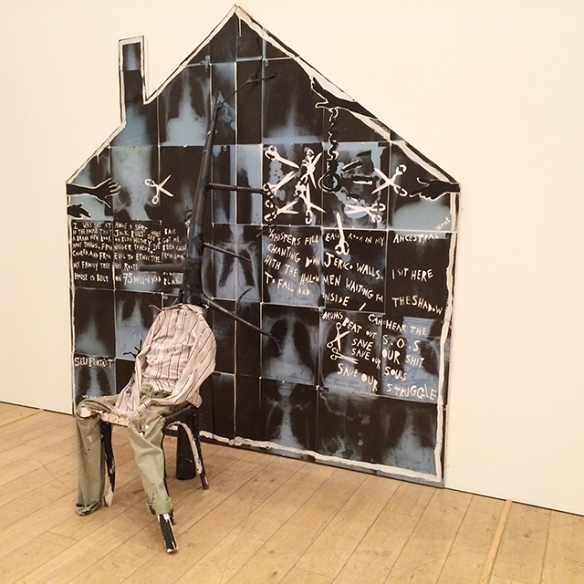
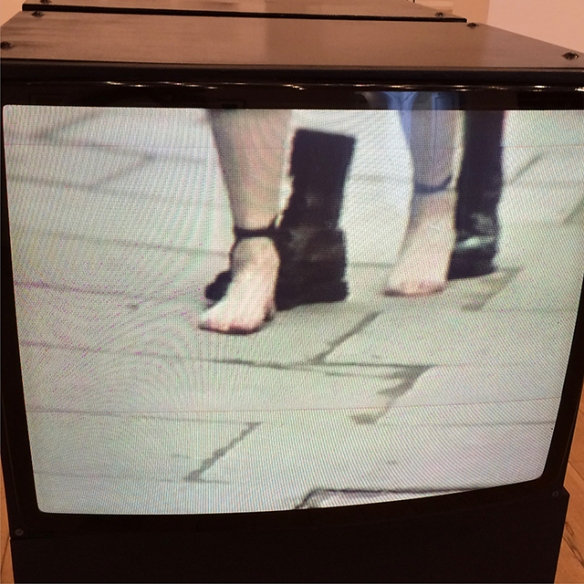
A short distance further south takes one to the South London gallery. Opposite is an important base camp for this final ascent, called Sophocles’ bakery which makes excellent cheese boreks. The placement of this bakery allows for a five minute walk, to consume the pastry, before arriving at the gallery. Inside Lubeina Himid has presented some collage-based works relating to her placement within a domestic and political culture and she carries an additional aura now as a Turner nominated artist. Meanwhile on a TV monitor is “roadworks” an early performance piece by Mona Hartoum. She walks barefoot through busy Brixton market and carefully drags DM boots attached by their laces behind each ankle seemingly oblivious to the constant chatter and comments. These video works under stressful situations, as they are described, perhaps helped to hone her abilities in making the powerful more static works she is known for today.

771
Harland Miller of White Cube with images based on imaginary book covers with very brief titles.

772
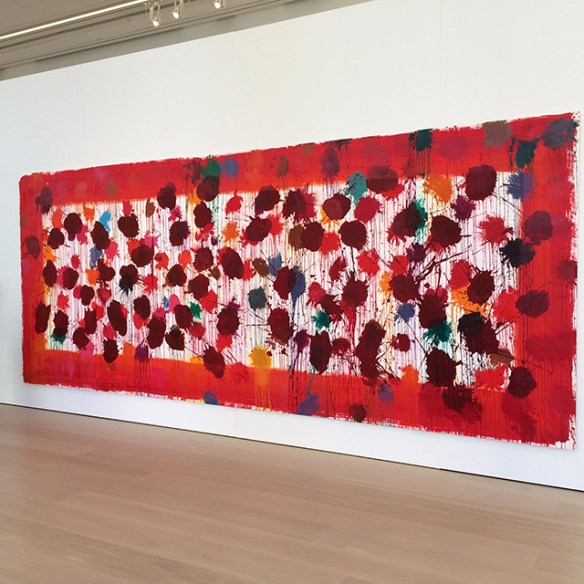
Howard Hodgkin large scale work.

773
Peter Marino at Gagosian Gallery in Davies Street with decorative bronze chests made in a classical style.

774
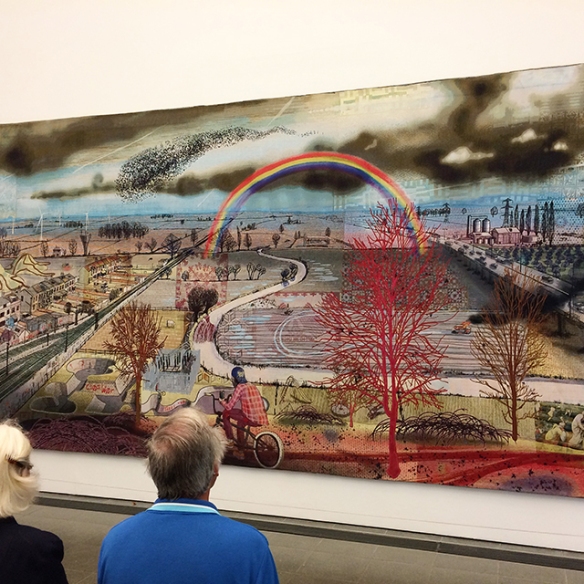
Grayson Perry of Victoria Miro Gallery at Serpentine Gallery.

775
Arthur Jafa at Serpentine Gallery with a performance of acrobatics in a metro train.

776
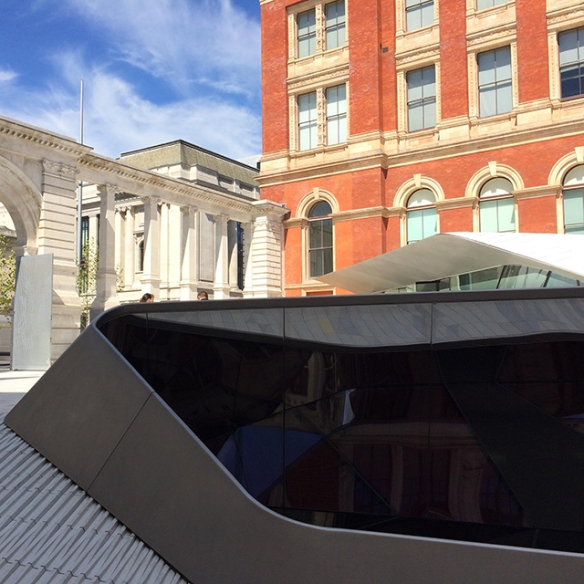
Victoria and Albert Museum have a new entrance and courtyard.

777
Calla Henkel and Max Pitegoff at Cabinet Gallery.

778
Lubaina Himid of Hollybush Gardens at South London Gallery.

779
Mona Hartoum of Lisson Gallery showing a performance by herself in South London Gallery.

Gallery run 14th June

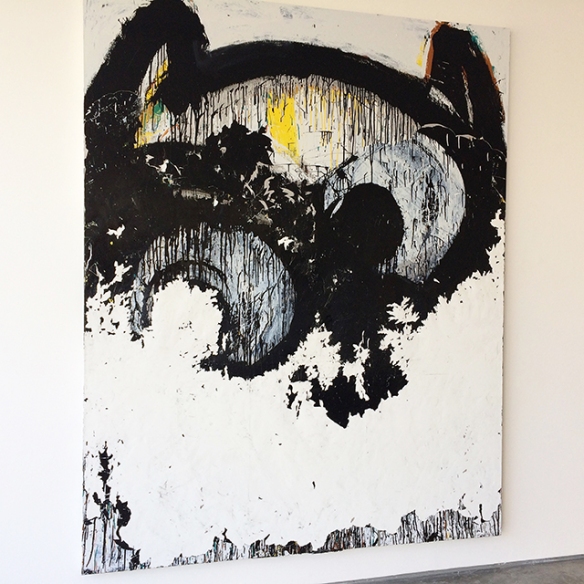
Today is scheduled to be hot at 27 degrees and suncream and a sports cap are necessary to protect against about 4 hours of direct sun. I head north west towards the Lisson Gallery using the most picturesque route available out of Peckham through a succession of small parks and across Lambeth Bridge. In gallery 1 Jorinde Voigt has beautiful drawings on display and the blurb explains that they are time based depictions of objects changing their appearances over time. We learn the artist was a cellist and of the possible connections between these drawings and musical scores. Meanwhile on close inspection the application of spray paint is immaculate and stands in contrast to the urgently scrawled text made as though by the hand of an experimental scientist. In gallery 2 Joyce Pensato has produced large paintings based on cartoon imagery ranging from Mickey Mouse to Batman’s mask. The application of paint is frantic and disorientating with hundreds of drips, scourings and a loose style more reminiscent of Abstract Expressionism than of Pop.

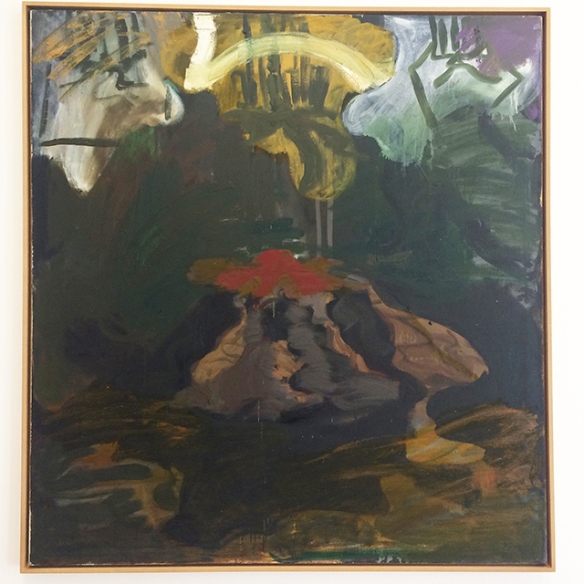
Then there is a short journey south to Michael Werner Gallery. The receptionist who always welcomes me is talking on the phone in Spanish, but still breaks off to give me a nod, and I make my way upstairs into the gallery. Marcus Lupertz is a geologist, we discover, and immediately the loosely rendered images take on a new dimension as though depicting living rock. A volcano bubbles away in one picture, at least to my imagination, but looks small and evokes no sublime terror but rather appears more domestic like a hot cauldron. Perhaps this is the effect of the artist’s own familiarity with his subject matter. David Zwirner is next a few streets away and here Lisa Yuskavage has painted large scale nudes, men and women in pairs, which can be linked to small jewel like studies shown upstairs. I admire her ability to work from studies in this way without losing any of the vitality of the original. Nearby at Victoria Miro, Milton Avery has produced beautifully rendered landscapes and portraits. We are told in the press release that he was influential to Rothko. A buyer asks for a quote and I overhear a figure in excess of £100,000 for one of the works on paper. This is A list.

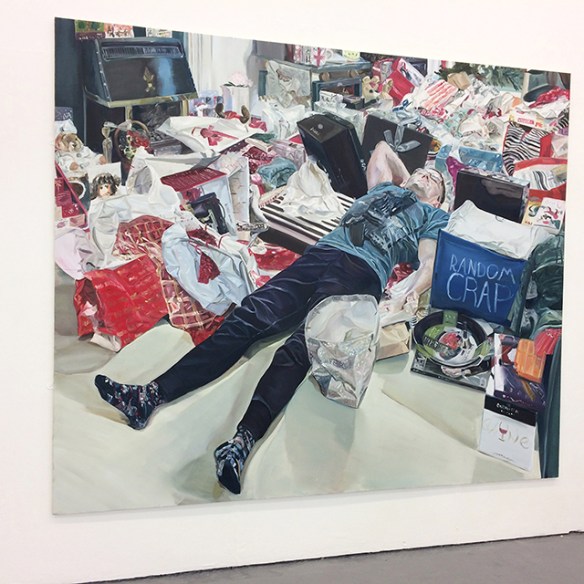
In the art colleges the student shows are continuing this week and it is the turn of the Slade MFA and PHD students to exhibit. A striking painting by Georgina Lowbridge depicts a man lying down amongst a pile of beautifully painted clutter. A young woman comes up and asks what I think of the paintings, and knowing they are hers I dutifully reply they are great, which is easy to say, in fact, because they are. After a great discussion about life at the Slade I mention that I had tried to see Florian Roithmayer’s work of cast clay on show in the observatory, a small circular building in the quad, to find out more about the PHD programme. In fact the building had been locked for lunchtime, though I didn’t mention this, but nevertheless had peered through the windows into the darkened space to his three mysterious sculptures. The most striking was a slab of clay, pinched and squeezed in a way, now quite familiar to abstract sculpture, but somehow there is excess here as though the slab has had a real going over.

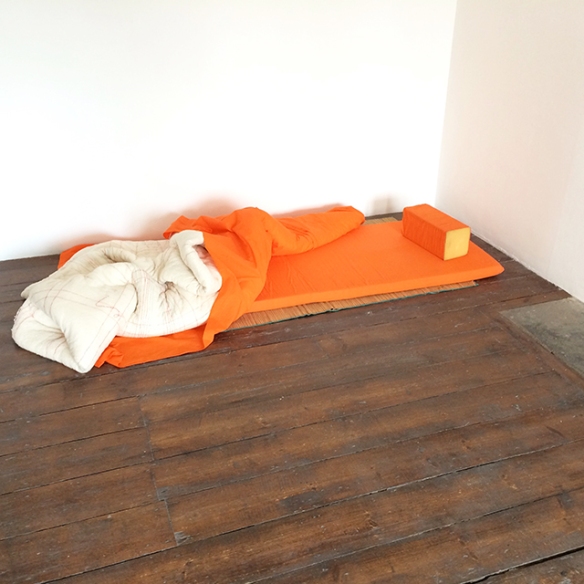
Back south the monthly visit to the Greengrassi, Corvi Mora complex in Kennington offers ample rewards with Anne Ryan displaying cutouts in the larger of the two spaces whilst upstairs a bed with bright orange sheets lies tucked in the corner. Its placement next to the concrete floor slab of a defunct fireplace merged now into the smooth white wall of the gallery, reminds me of nights spent by the fire in a small squat nearby. But the bed has rich memories of its own as a press release depicts an old photo from the 70’s showing the sculpture in its original exhibition at New York’s 303 gallery.

691
Jorinde Voigt of Lisson Gallery with intricate drawings using a style that’s almost scientific.

692
Joyce Pensato of Lisson Gallery with great cartoon imagery.

693
Markus Lupertz of Michael Werner Gallery with striking free brushwork in highly charged landscapes. As he was a geology graduate also, I fancy this to be a volcano but with unusual vantage point.

695
Lisa Yuskavage at David Zwirner London with powerful figurative paintings.

696
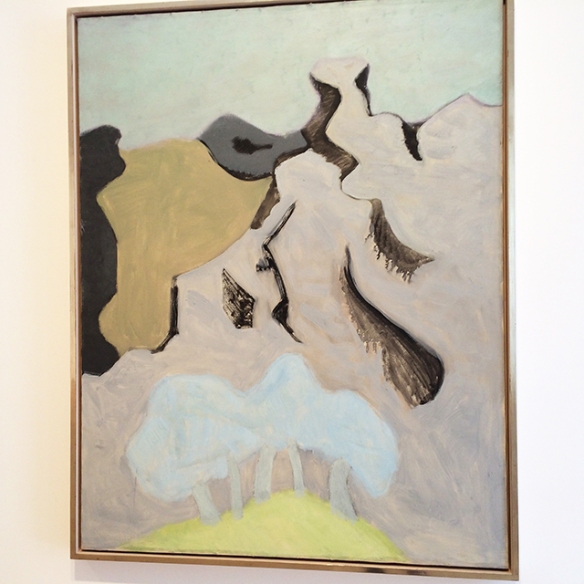
Milton Avery at Victoria Miro Gallery. This landscape has a beautiful use of colour including the delicately painted pale blue trees.

698
Dominic Dispirito at Slade School of Fine Art with great spray painted artworks.

694
Georgina Lowbridge completing her MFA at Slade School of Fine Art with three great paintings including this one. She told me she had sussed out using this clean and carefully limited palette of colours during the course and it certainly seems to work.

697
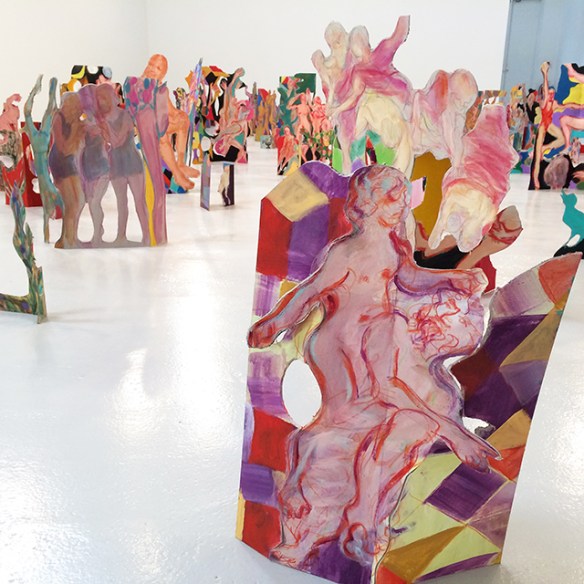
Anne Ryan of Greengrassi with a new move away from her narrative paintings. The installation is made up of over 100 cut-out images.

699
Rirkrit Tiravanija of Pilar Corrias exhibiting in a group show at Corvi Mora.
The artwork uses the space well and reminds me of a mis-spent gap year living in squats.

Gallery run 19th May

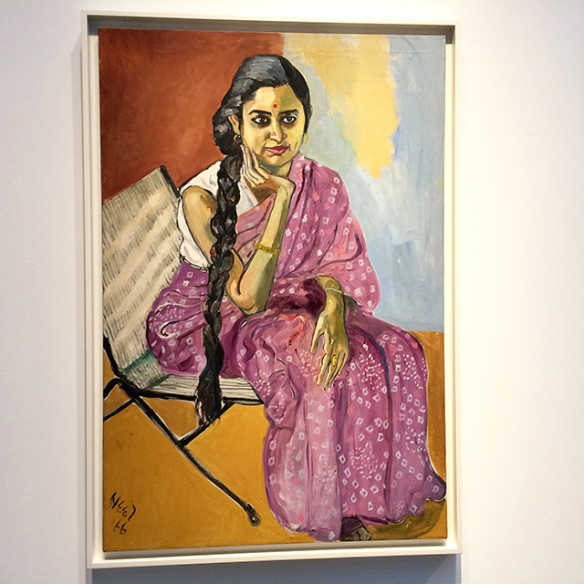
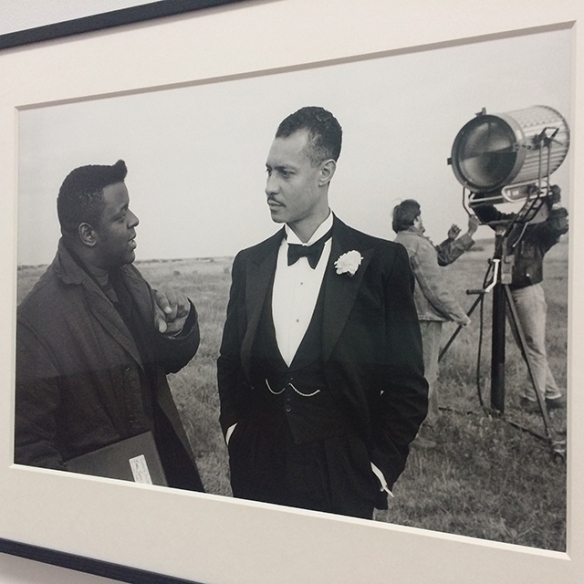
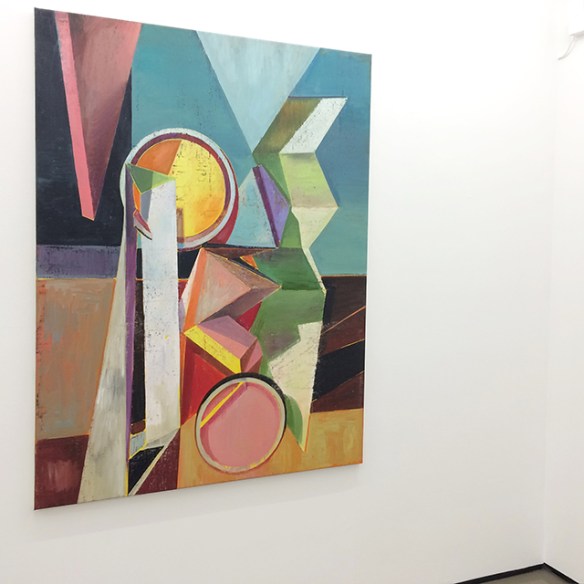
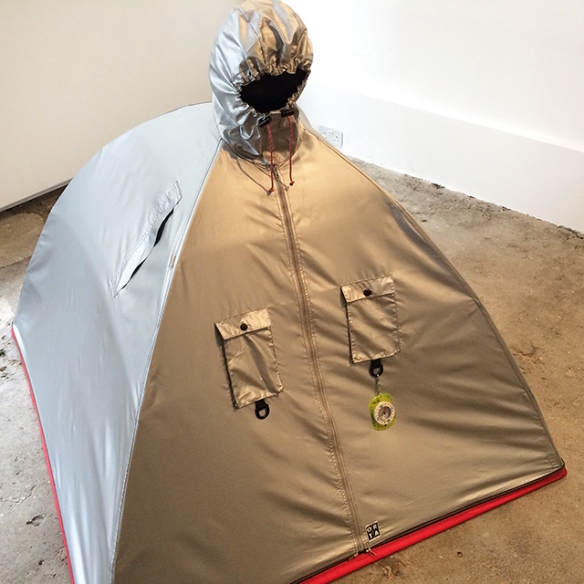
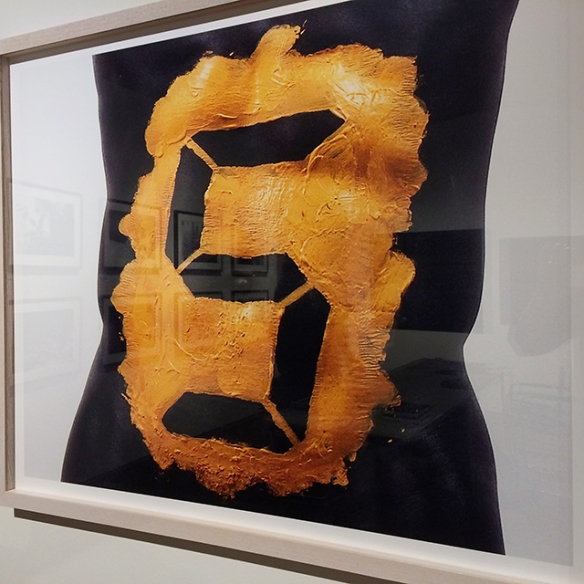
Today I would be zigzagging along the Regent’s Canal, catching the early openers such as Victoria Miro Gallery before doubling back to visit the later opening Hackney galleries. Soon the hump of the canal appears on Dalston High Street just behind a mosque. The run to Victoria Miro requires an exit at Wharf Road, about 5 or 6 bridges along. I am greeted warmly by a tall chap near the door. Alice Neel’s paintings are of friends and neighbours in Spanish Harlem, where she settled with her husband. The women all have strikingly graceful hands. Upstairs Isaac Julien displays atmospheric stills from a film. From here the route to Beers, the next gallery on the run, takes me across a main road coming down from Islington. Strong, colourful, geometric forms based on architecture fill the gallery. The shapes cast artificial shadows upon themselves whilst the surfaces are pleasingly distressed as though to upset the geometric perfection and allow the eye to feast upon the rich colours. Then a return up Wharf Road and onto the canal makes for quick progress to Wilkinson Gallery near Victoria Park. The current show comprises beautiful, intricate paintings of trees and landscapes by Elizabeth Magill. Branches divide the landscapes into gridded mosaics and in a few places where it suits the composition, the artist has not been afraid to overpaint the branches with background pushing their knotted forms deeper into the composition. There would be two more gallery stops nearby on Herald Street. First I see a powerful sound-based installation by Lawrence Abu Hamdan. Mobile phone footage flashes up on monitors accompanied by shouts and shrieks. But when the sound quietens the monitors appear to switch off. These intermittent images on about 10 different screens powerfully depict an incursion by a crowd across a barbed-wire frontier into Israel. Meanwhile in Herald Street Christina Mackie has displayed beautifully coloured objects in a way that highlights their surfaces and basic forms. Any sense of what the objects may have been used for in the past is lost in the form of the artwork. I jog back to Brick Land through a lovely park and church yard and then weave through a small warren of walkways. Then on towards The City. Raven Row near Shoreditch is an old Huguenot house and the curator and co-director of the gallery has brought together female artists who have added an edgy twist to domestic objects. Lucy Orta has made fantastic live-in objects including a tent with attached hoodie which peers out of the top like a strange periscope. Finally I return west along the River Thames and arrive at Photo-London in Somerset House. Tatsuo Miyagima, an artist I am familiar with from Lisson Gallery, has photographed a fantastic digitalised number 5 created with orange paint on the toned stomach of an athlete.

662
Alice Neel at Victoria Miro with portraits of her neighbours in Spanish Harlem New York, though she would later move to Upper West Side.

666
Isaac Julien of Victoria Miro with stills from his film Looking For Langston.

667
Genti Korini at Beers London with paintings inspired by fantastical architecture.

663
On the Regents Canal today.

661
Elizabeth Magill of Wilkinson Gallery with paintings of landscapes comprising tree branches in the foreground. Excellent rendering of the broken planes of colour between the branches.

665
Christina Mackie of Herald Street with an installation of colourful objects in unusual arrangements.

668
Lucy Orta at Raven Row.

669
Tatsuo Miyajima at Photo London.

664
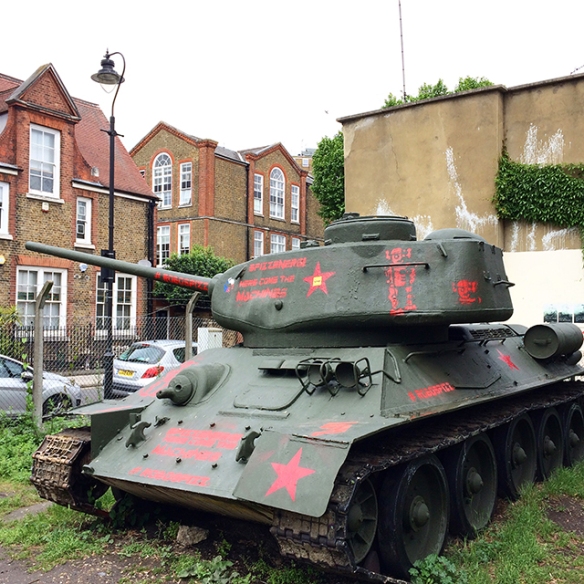
A tank parked up off the Old Kent Road near Peckham.

Gallery run 5th April

Regent’s Canal from Hackney.

611
John McAllister of Carl Freedman Gallery with negative-like natural imagery.

612
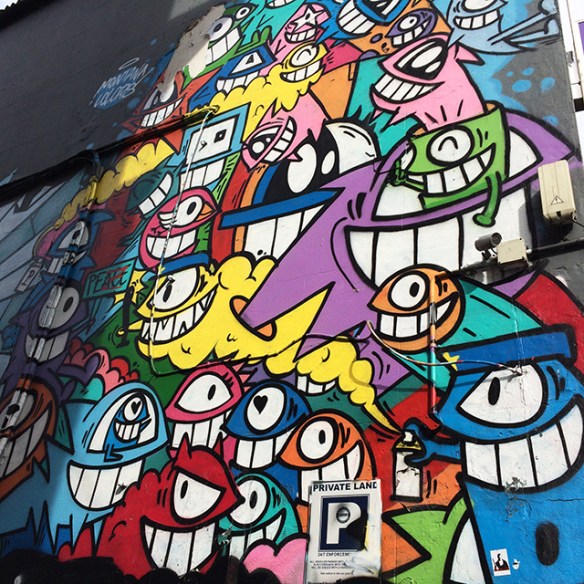
On Brick Lane.

613
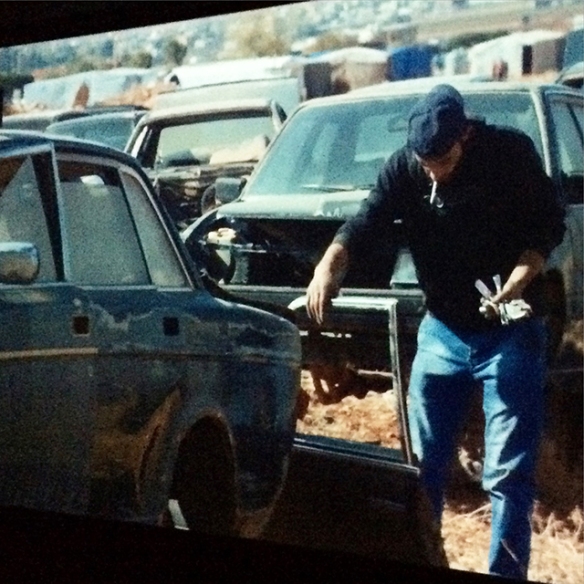
Maeve Brennan at Chisenhale Gallery with a documentary film following 3 characters who assemble or care for discarded or disintegrated objects in Lebanon. Here the car restorer in a scrapyard.

614
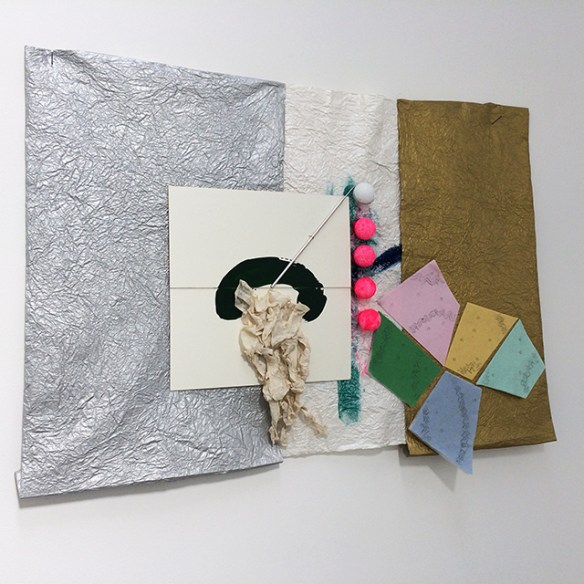
Richard Tuttle of Stuart Shave Modern Art with latest of almost 200 solo shows.

615
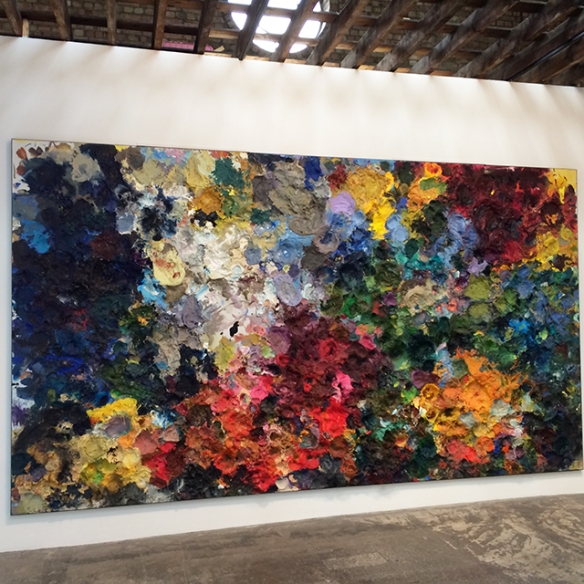
Secundino Hernandez of Victoria Miro with a giant palette piece.

616
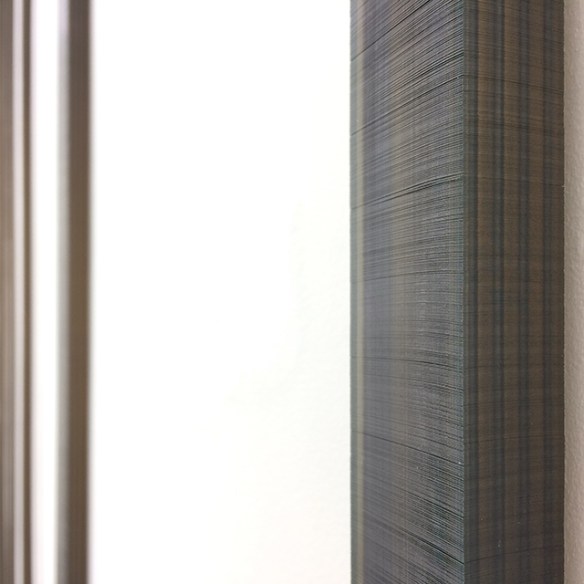
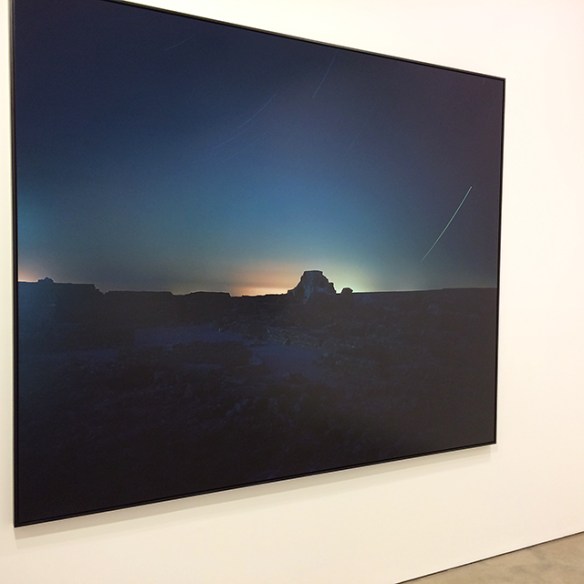
Elizabeth McAlpine of Laura Bartlett Gallery showing work inspired by film’s materiality. A 100 minute movie film stacked up in individual frames and presented as vertical columns totalling about 15metres.

617
Elger Esser at Parasol Unit with dreamlike photos from a large format camera.

618
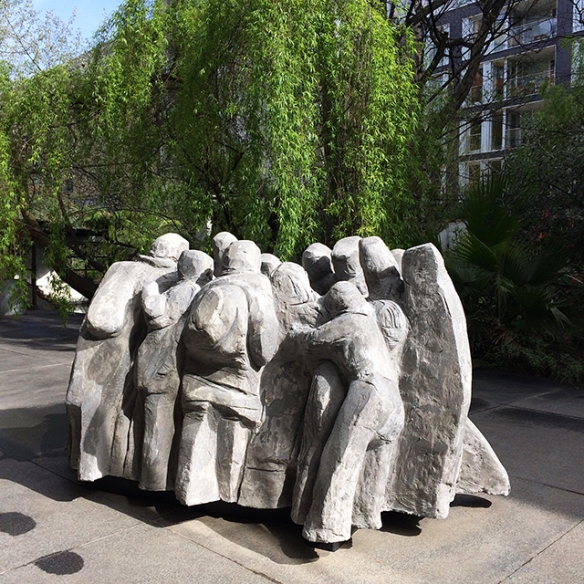
Julien Tiberi at Parasol Unit with crowding stone figures.

619
Brick Lane bicycle.