Gallery run 7th February

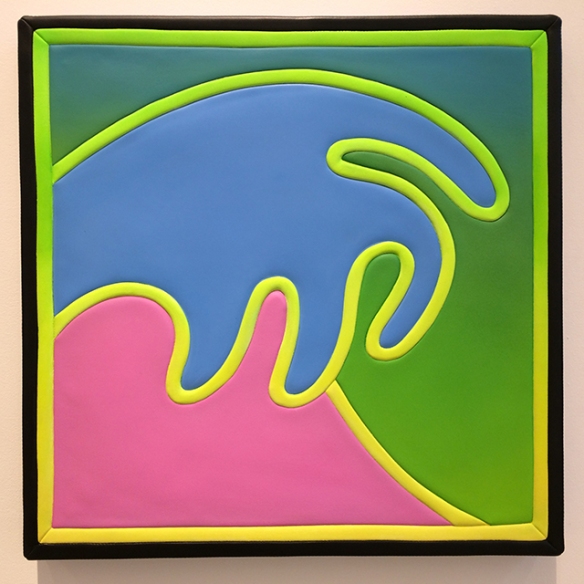
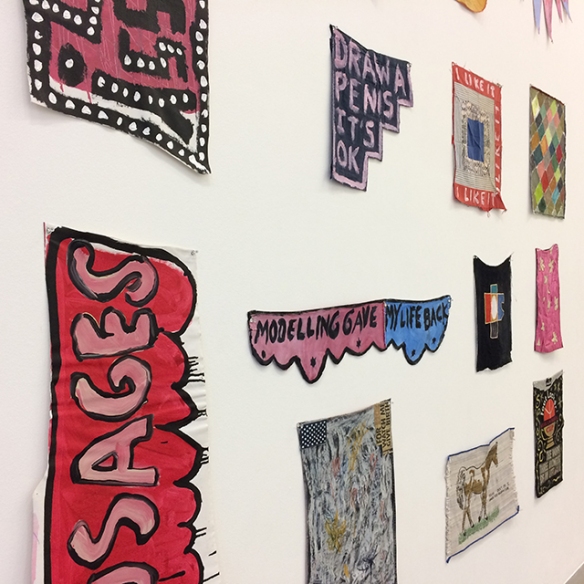
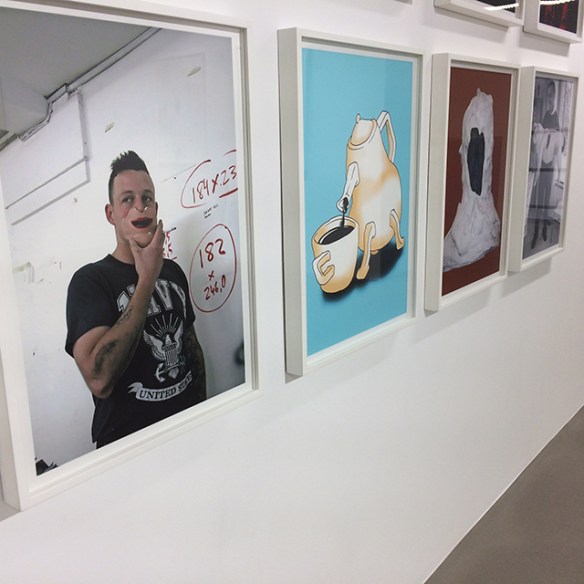
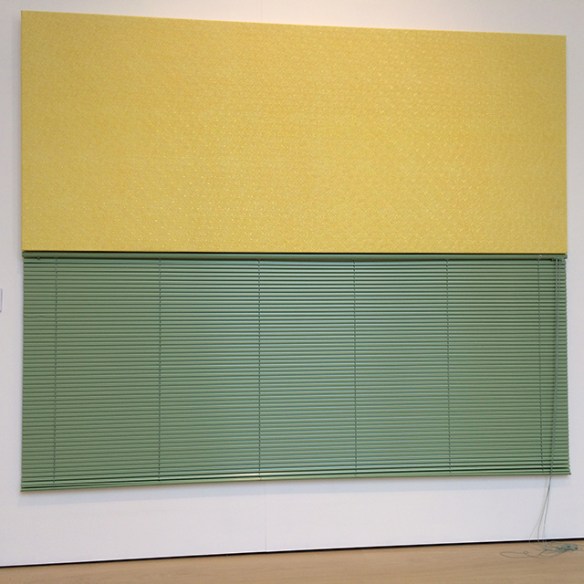
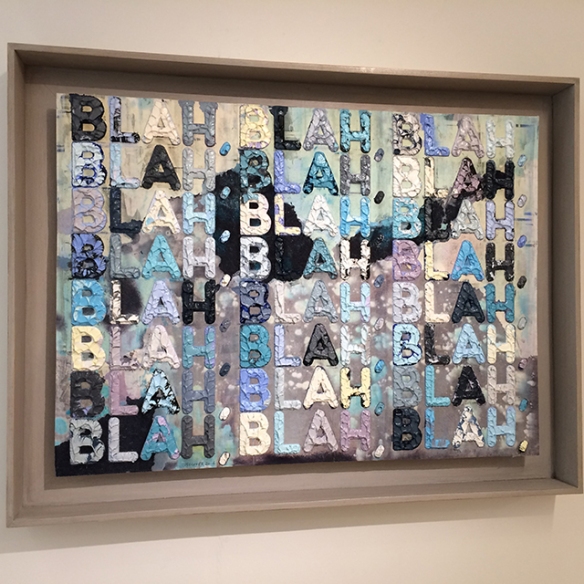
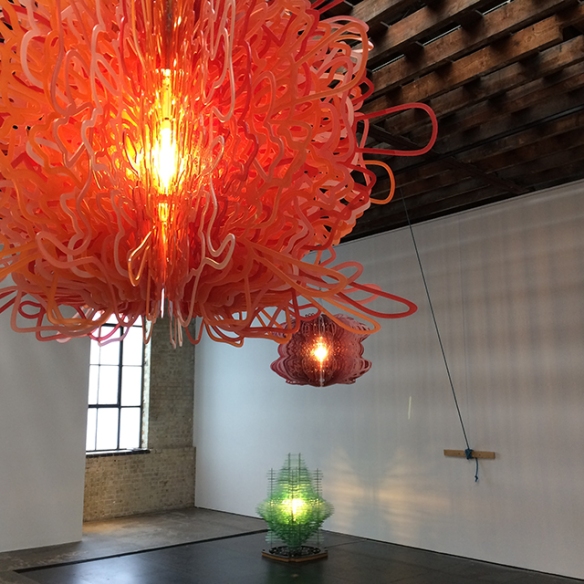
The Regent’s Canal highway describes a sort of subjective experience of running on the towpath between Hackney and Regent’s Park. Though not particularly fast in the physical sense the towpath seems quick in a kind of existential sense, namely that with several galleries dotted along its route a sensation of speed is produced by the sheer lack of things that need to be done or thought about during the journey. A few glances at boats, the occasional meandering daydream is all that separates one gallery on the canal from the next. Suddenly the finger is on the buzzer awaiting entry to Victoria Miro Gallery. Jorge Pardo, who is of Cuban American extraction and now living in Mexico, is showing wall-mounted structures that resemble beautifully coloured screens. They are painted, but not in a traditional sense, for the colour emerges from an interaction of minute speckles of paint which have either been created from abrasions into a surface of many layers or, and this seems the case here, have in fact been created completely intentionally by a programmed computer and application device. A thin hair’s-breadth groove around each speckle provides the clue that the speckles themselves have been applied with deliberate intent. On a larger scale, that is on the scale of the entire objects, we see rhythmic patterns running right across their surfaces. Waves and flow lines appear as the eye scans the intricately cut plastic and fibrous sheets. For the lamps this experience is enhanced further by the presence of the interior light source which provides a strong contrast between material and void. In addition this light source promotes a change of geometry in the object. Rather than being planar, as was the case with the wall mounted works, these lamp-like objects are radial. Intricately cut sheets of coloured plexi-glass fan out from the centre, like an elaborate array of coloured cooling fins, conveying their subtle glows to the object’s fragmented surface.

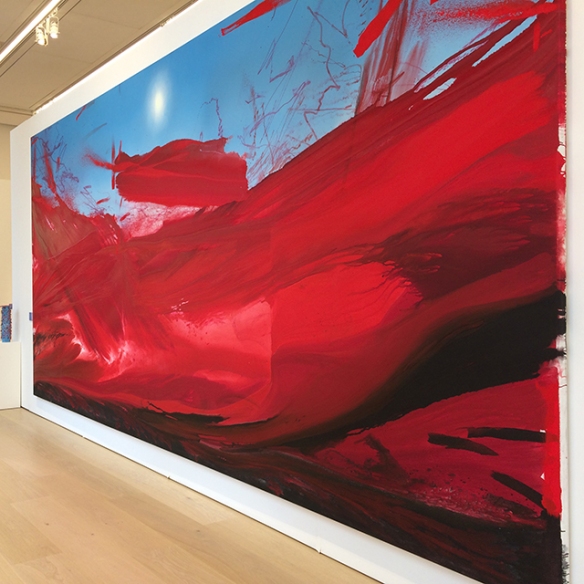
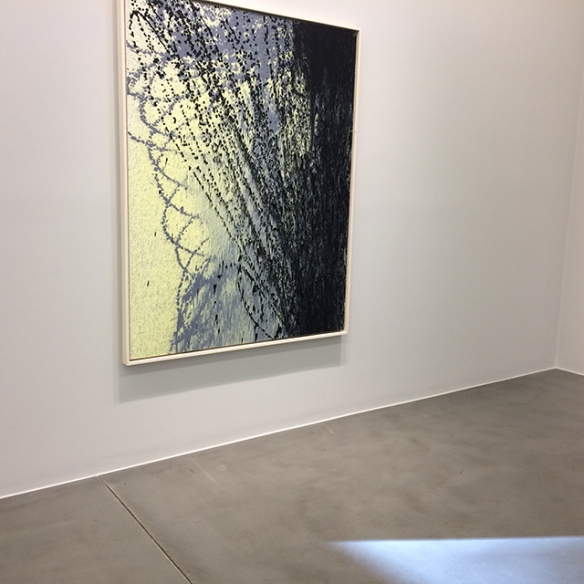
Back on the canal highway, Regent’s Park soon offers a route south to the West End. At Simon Lee Gallery, there is a display of the late works by Hans Hartung. Accompanying this display is a film that shows the artist in a wheel chair, since he is an old man, spraying and flicking paint across large expanses of canvas. Known for his gestural abstraction, the artist is now using a prosthetic device comprising a stick wand and spray nozzle. In the gallery we see the result and how the artist succeeds in his express intention of mimicking the forces of nature. Partly these forces reside within the paint itself causing the drops to cling to one another or else suddenly break free as though they were a shower of ejecting particles, but there is a deeper connection to nature too, manifest most clearly when the work has taken on more complex forms such as a spiral motif in one outstanding example. Here it is as though the artist has attuned himself to the various rhythms that define the universe itself allowing him to represent the more complex forces that create the various spinning and oscillating systems around us.

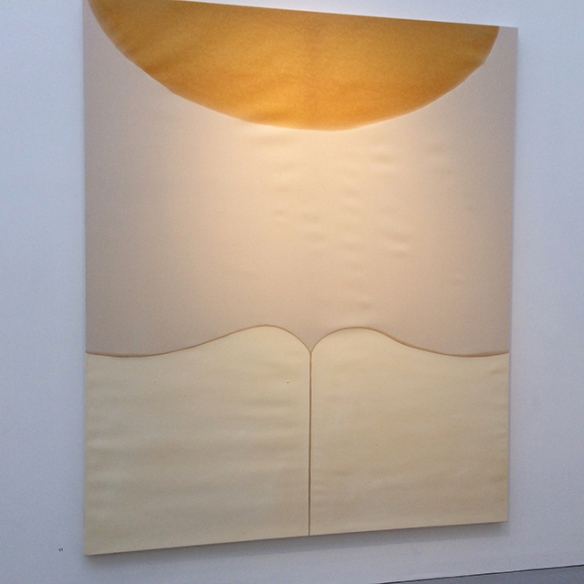
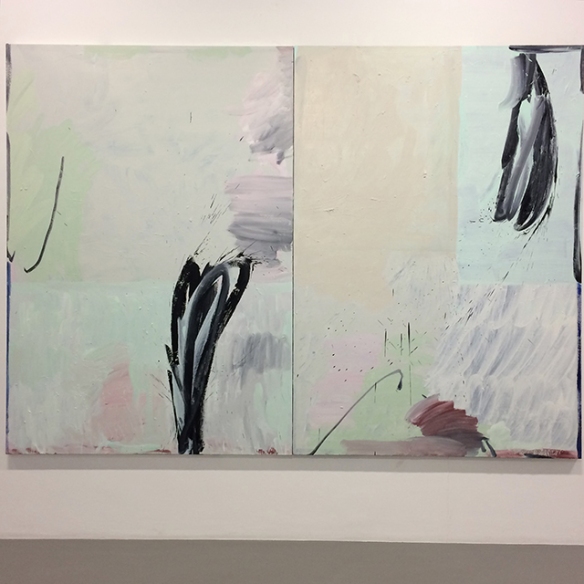
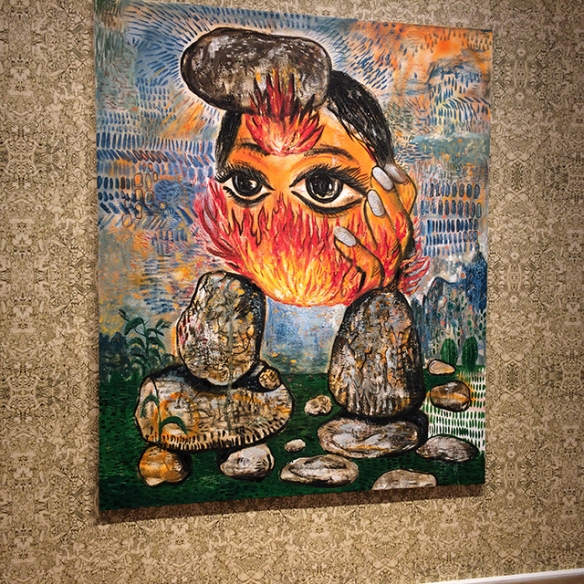
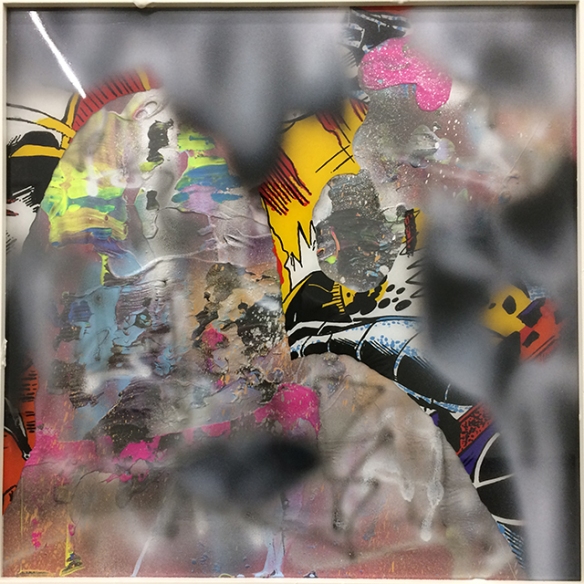
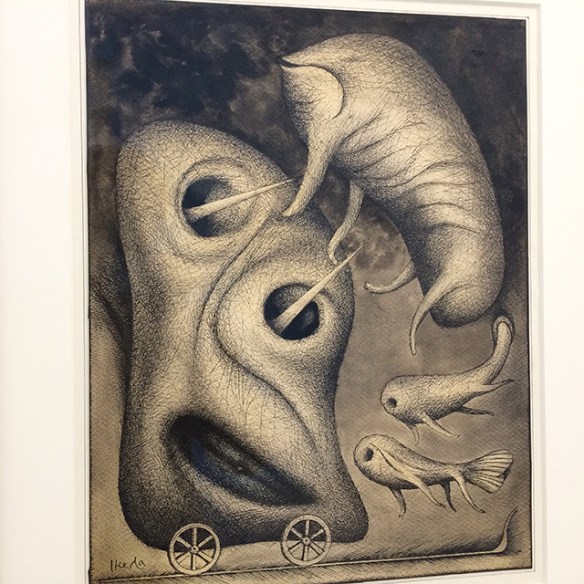
With Corvi Mora and Greengrassi galleries pairing up this month, several artists are on display in the main viewing space and it requires careful checking of the paperwork to determine which gallery is associated with which artist. Tatsuo Ikeda who as it turns out is with Greengrassi, though in previous years has also exhibited with the blue-chip giant Gagosian, has produced surreal drawings of figures sporting various limbs for locomotion, as well as prosthetic cones. The artwork is very proficient, which allows us not only to enjoy the images, but also to engage with the various distortions of nature without rejecting them on the grounds of incredulity. The images are therefore accepted on account of their near photographic-like appearance. As a passing observation it seems that the two dominant features of these works, namely their Surrealism and their Realism of execution, turn out to be unlikely bedfellows, despite the apparent contradiction of these two terms.
1001
Jorge Pardo at Victoria Miro with laser cut plastic in exotic lamps that nevertheless look very traditional.
1002
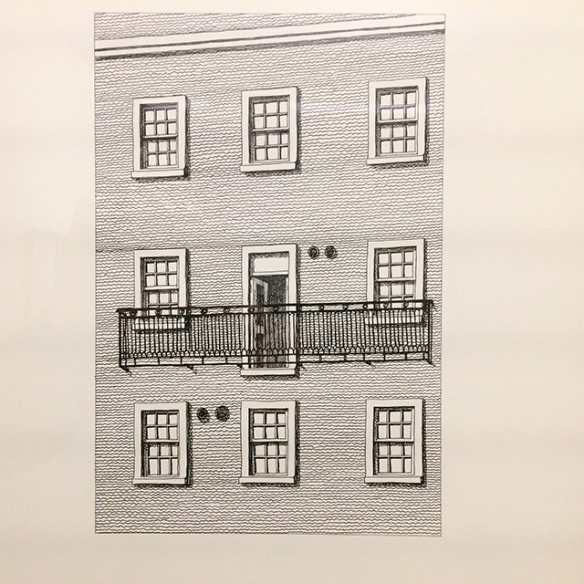
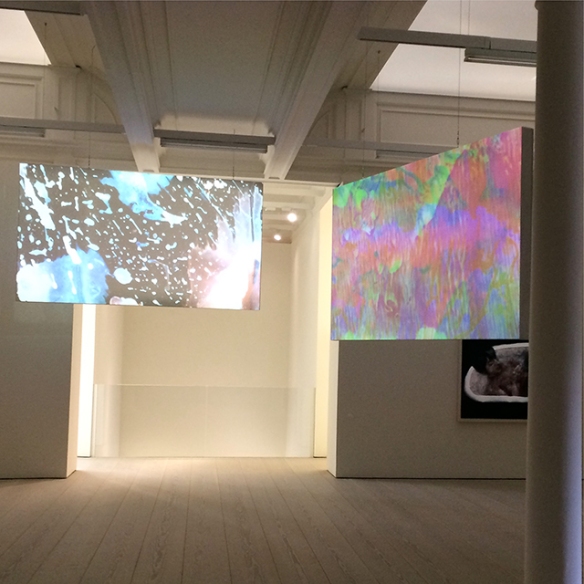
Pablo Bronstein of Herald Street Gallery showing drawings at RIBA of pseudo-Georgian architecture.
1003
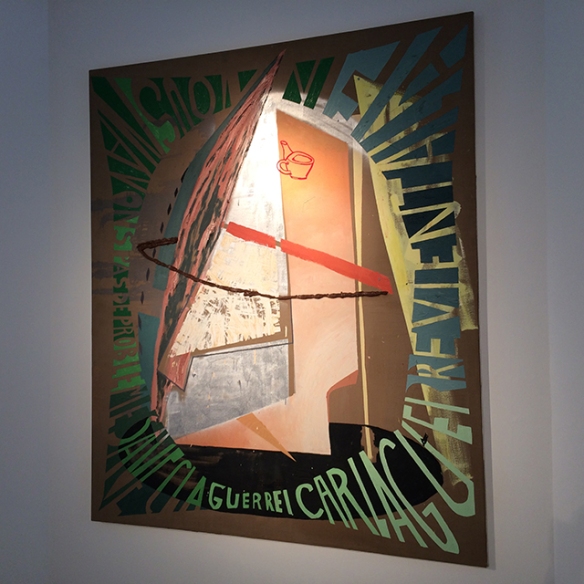
Matt Saunders of Marian Goodman Gallery.
1004
Hans Hartung at Simon Lee Gallery with paintings from late in his career made using spray nozzles and paint-covered olive branches that he could manipulate from his wheelchair.
1005
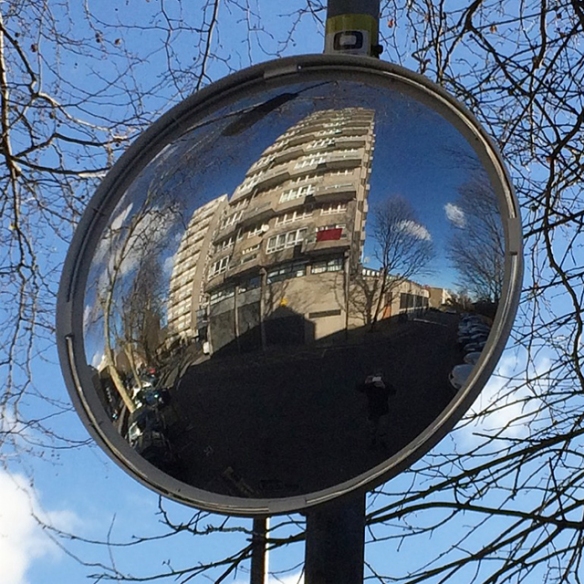
Estate near Greengrassi and Corv iMora galleries looking resplendent against a blue sky this afternoon.
1006
Tatsuo Ikeda at Greengrassi group show for Condo 2018.
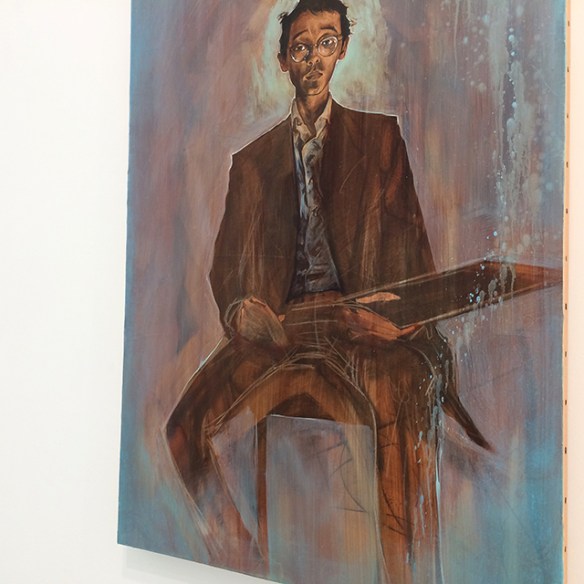
1007
Kye Christensen Knowles at Corvi Mora and Greengrassi group show as part of Condo 2018.
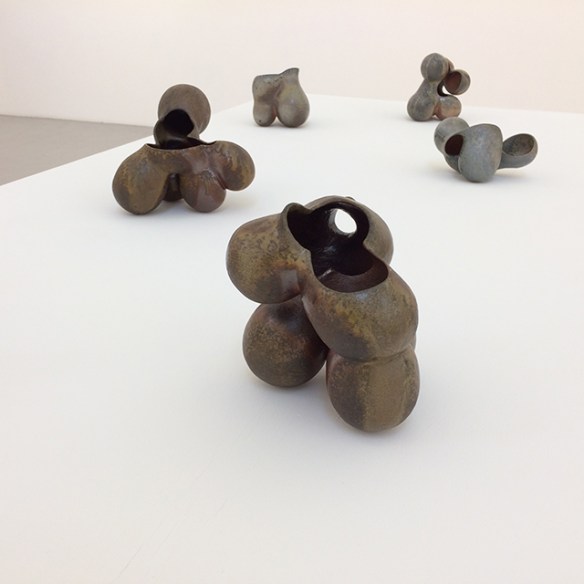
1008
John Lindell at Corvi Mora for Condo 2018.
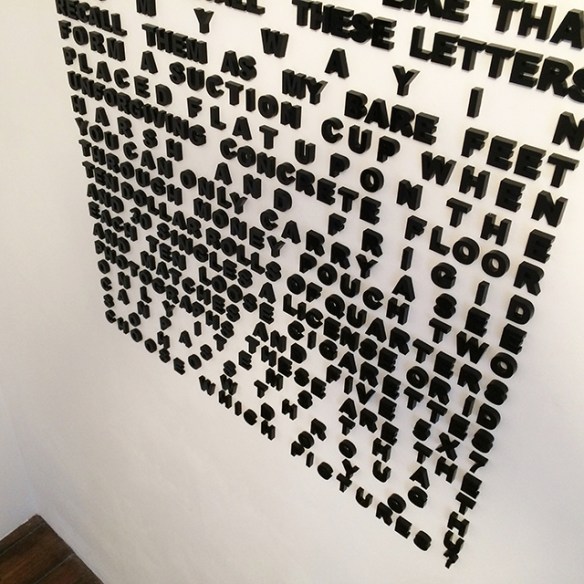
1009
Sable E Smith at Greengrassi and Corvi Mora group show as part of Condo 2018.

Gallery run 1st February

This is Condo season where many London galleries participate in an exchange scheme with galleries from around the world, offering a platform for their artists and a diversity of artistic themes that the London viewing public can experience and enjoy. The day begins with a jog along the Regent’s Canal to Hackney and a first stop at Maureen Paley Gallery. Downstairs, Eduardo Sarabia has exhibited paintings and ceramic vases. The vases contain icons from his Mexican home and though they are rendered beautifully in slick drawing further enhanced by the glazing from a subsequent firing, the viewer quickly realises these are not intended for decorative effect since they depict weapons and the paraphernalia of drug taking.

On the way to the next gallery a stunning house catches the eye. It is large, white and clearly a grand design, but the dissonance that makes it stand out is the large amount of black paint that has been expertly brushed, thrown and sprayed all over its walls in an act of sublime disdain for the modernist ideal of a white cube. These days street art, which is what is on display here, is increasingly engaging with mainstream architecture and it turns out from further internet browsing that this property is by the architect David Adjaye R.A. and proudly bears the name “Dirty House”, whilst its occupants were and may still be the artists Tim Noble and Sue Webster.

At Mother’s Tankstation, a gallery further west in Holborn Viaduct, there is another helping of Condo. Mairead O’hEocha catches the eye with a vivid painting of flowers which is exhibited amongst a group show that combines resident artists with those from the visiting guest gallery. The flowers themselves have distinct patterning and the eye moves from one bloom to another like a hungry bee, no less!, enjoying the sensations of light and colour that the artist has imbued in them.

Finally, back south of the River there is an emerging hub of galleries near Lambeth Bridge. Though the most well known of these is Damien Hirst’s Newport Street gallery, a smaller very interesting space can be found on Lambeth Walk which runs parallel. Here Rob Tufnell has moved into an old shop and located his London gallery. Do not underestimate the importance of this space by its humble context. This is an outfit with a second gallery in Cologne and frequent participations at the international art fairs including Frieze. Amongst a selection of exhibitors, the art collective Inventory has a great sculpture on display consisting of a ladder-like arrangement of computer keyboards. The keyboards are attached like the horizontal bars of the ladder to a vertical hanging structure, but at the base of this display entropy appears to have taken over in the only way possible with such keyboards, namely that their various letters seem to have FAL_EN O_T, causing them to scatter and roll like dice across the gallery floor. LJ.BL..T……K……X..C………L…………….F!


Eduardo Sarabia at Maureen Paley hosted as part of Condo London 2018.
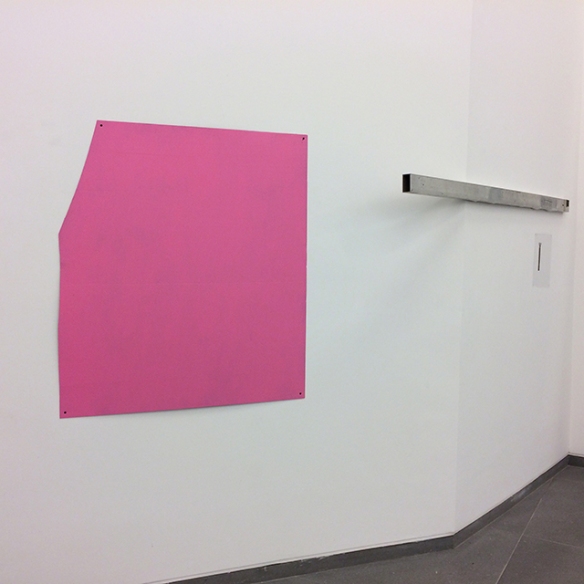

Michaela Eichwald at Maureen Paley hosted as part of Condo London 2018.
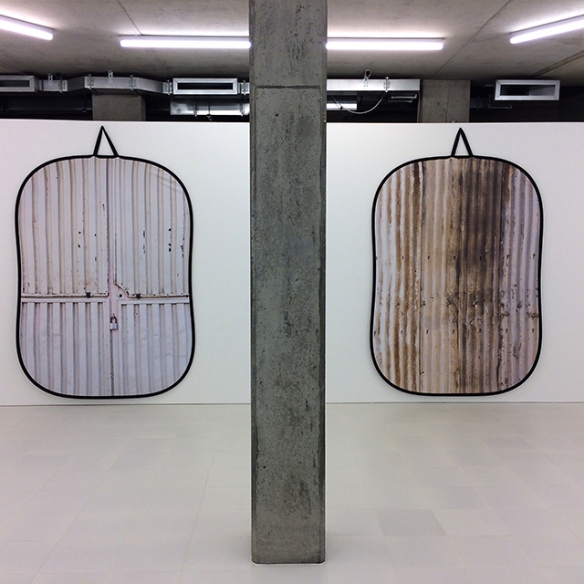

Tom Burr of Maureen Paley who are hosting Condo London 2018.

On Chance Street and Whitby Street near Brick Lane.


Andrea Geyer at Hales Gallery with socially charged logos from 60’s women’s publications.


Great Eastern Street art intervention billboard, by Sr.X


Mairead O’hEocha of Mothers Tankstation who are hosting Condo London 2018.


Sam Anderson at Mothers Tankstation as part of Condo London 2018.

Inventory at Rob Tufnell hosting Condo London 2018.

Gallery run 25th January

At Blain Southern, Rachel Howard has produced a series of black and white paintings including an interesting one with a wallpaper motif. She appears to have then developed this image extensively in red and on a larger scale with four examples shown in the adjacent gallery. For the artist, wallpaper is a powerful motif because it represents the liminal space between a safe domestic environment and uncontrollable external events such as war. In some areas the wallpaper appears to reveal this external space through a semi-transparency, whilst the red of the pattern itself becomes a vehicle for introducing a more free-flowing use of red paint symbolic, of course, of blood and strife.

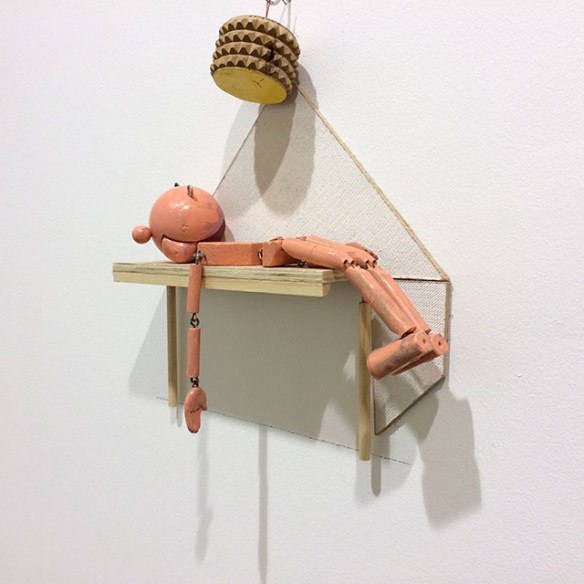
Meanwhile in the downstairs gallery, Brian Griffiths has created a puppet-like character which he has presented against simple cardboard and wooden off-cut stage sets on the gallery walls. The artist’s characteristic use of visual metaphor is clearly apparent in these simple backdrops commandeering, for example, a second hand spindle to function as a high-tech sun lamp. The introduction of figurative elements is by no means new to the artist’s oeuvre but the combination of low-tech figure in low-tech background is an interesting development.

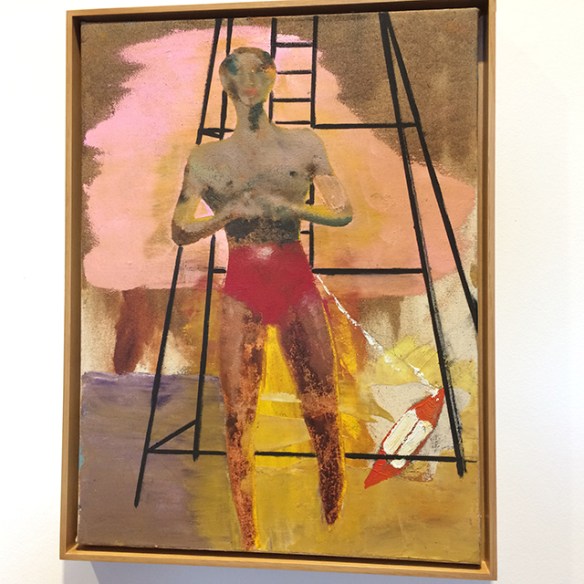
It would then be a long loop up to Notting Hill via the Regent’s Canal followed by a return through Hyde Park, which lands me back amongst the Mayfair galleries and the shiny black door of Michael Werner bejewelled with brass trimmings. Peter Doig has produced a set of images based on a powerful looking figure standing astride a sandy beach. The paraphernalia of a red and white flotation device lends an air of the everyday to the image as well as pleasing colour harmonies whilst the figure itself is more reminiscent of the mythical tales of Odysseus and a Greek ideal of the male physique.

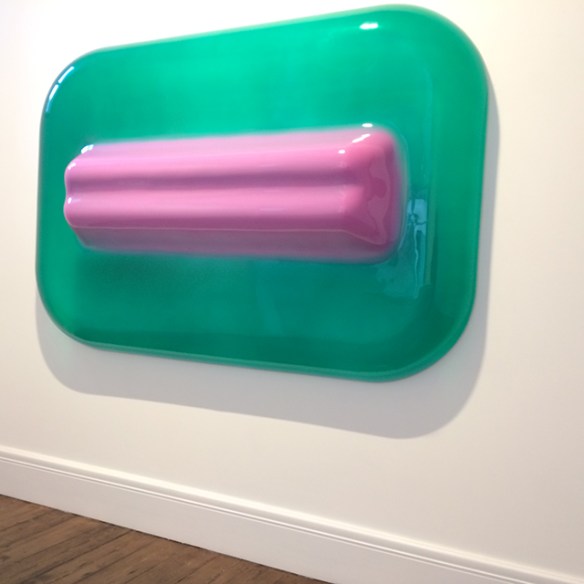
Craig Kauffmanm is on display at Sprueth and Magers with work from the 60’s that uses bright plastics. In the main window is a stunning display incorporating work by this artist alongside additional works by Donald Judd and Robert Morris. Each of the works by the three artists has been produced in a single coloured plastic and seen together they create an overall harmony as the eye moves from one piece to the other, resting upon a single colour before moving to the next. The plastic used by Craig Kauffman is actually slightly transparent and the effect is to make his works look delicious with the coloured lozenge of plastic both reflecting a warm glow of light but also, in some cases, projecting a coloured patch onto the gallery walls.

981
Rachel Howard of Blain Southern with a wallpaper motif that she has then developed extensively in a further series.

982
Brian Griffiths at Blain Southern has created a puppet-like character presented in simple cardboard stage sets on the gallery walls.

983
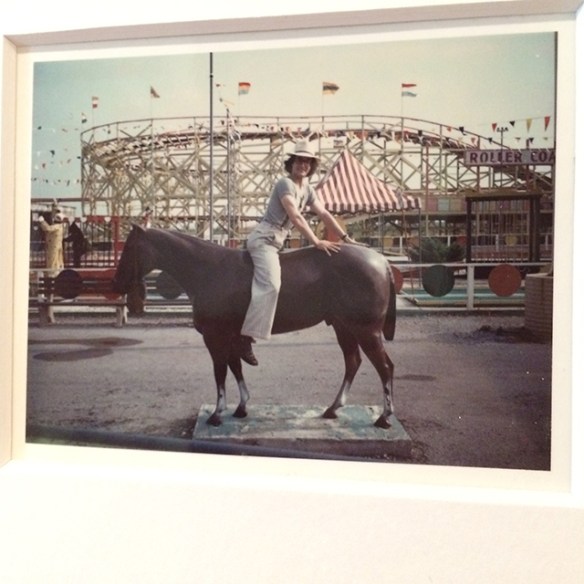
Wim Wenders of Blain Southern showing a selection of his Polaroids at The Photographers Gallery. These were an important part of his movie film preparations.

984
Peter Doig at Michael Werner.

985
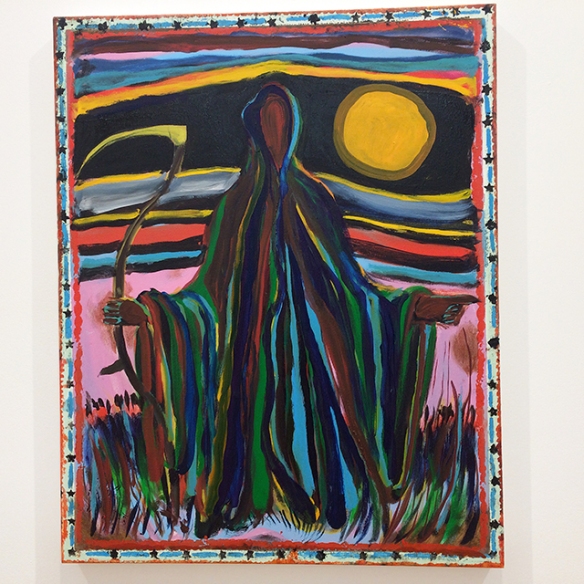
Josh Smith at Massimo De Carlo with colourful depictions of the Grim Reaper.

986
Bridget Riley at David Zwirner with new work.
Delete Comment

987
Craig Kauffman at Sprueth Magers with works from the 60’s using bright plastics.

988
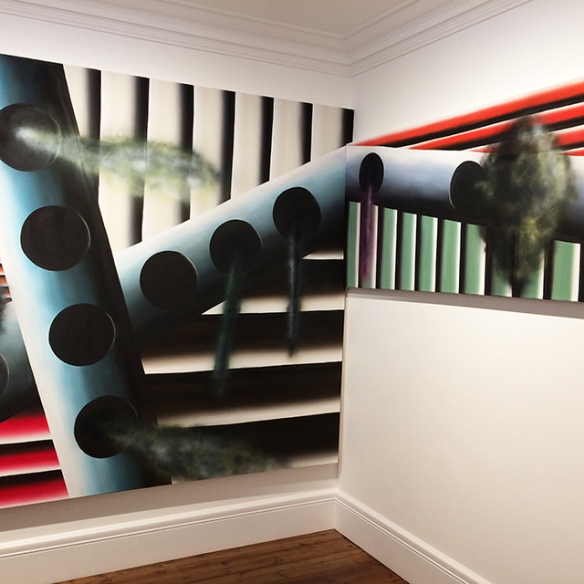
Andreas Schulze at Sprueth Magers with colourful pipework.

989
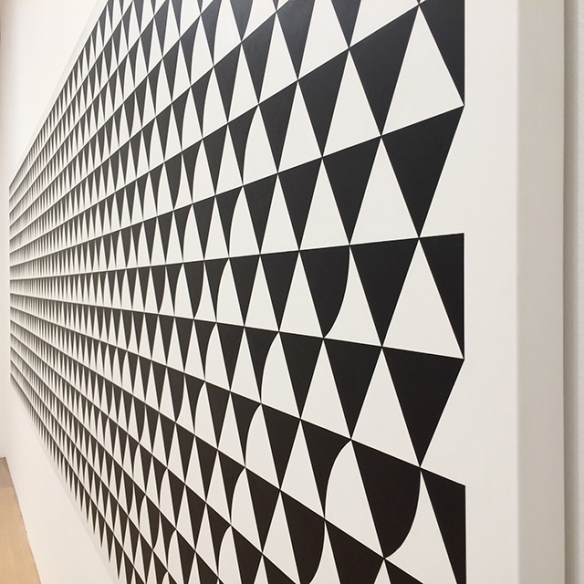
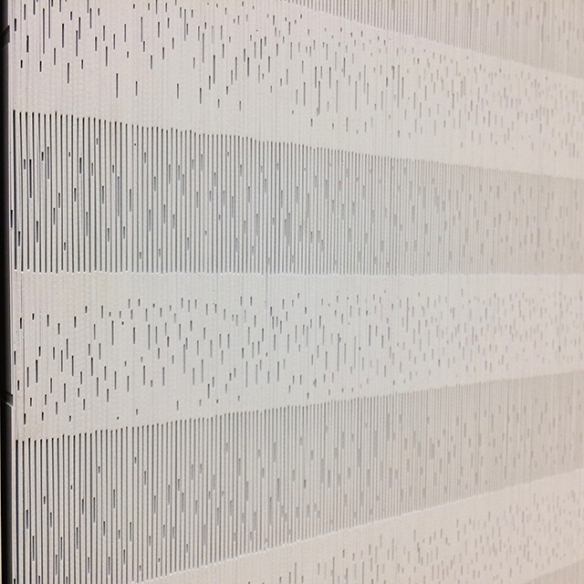
Tara Donovan of Pace Gallery has created a series of images using stacked cards with small cut-out sections.

Gallery run 18th January

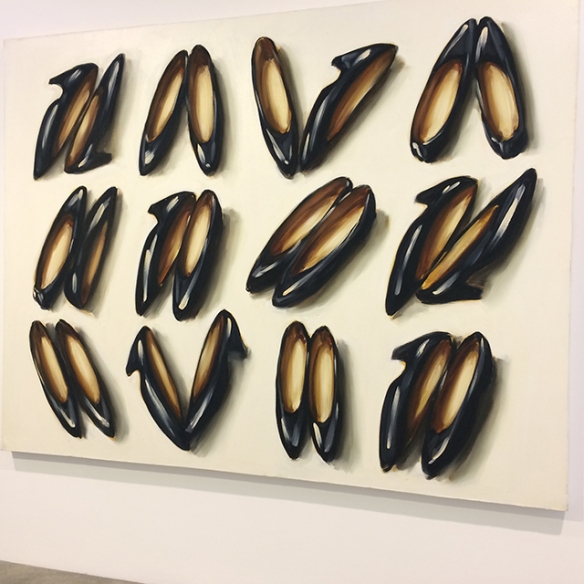
With an invite to the Foundling Museum this morning it is necessary to divide the day into two halves. The first half will be in the East and the second half in the West. Parasol Gallery, the first stop of the day, is hosting Lisa Milroy, an artist who rose to prominence in the 1990’s. Her distinctive style is a grid pattern of objects standing out against canvas backgrounds and onto which there appear to have been cast drop-shadows. The pairs of black shiny shoes make a particularly strong impression in one of the older works, actually borrowed from Tate’s collection, since they go beyond the literal representation of an object and evoke additional associations notably of mussel shells. Such metaphorical readings of paintings often come from powerful childhood memories and whilst these certainly reside within myself, it is impossible to know if such associations are also shared by the artist. A small biographical detail recently provided by a friend, that the artist frequented a stunning beach close to Liverpool inhabited by razor mussels in their thousands, adds support to this further association but ultimately just confirms our own love of resemblances.

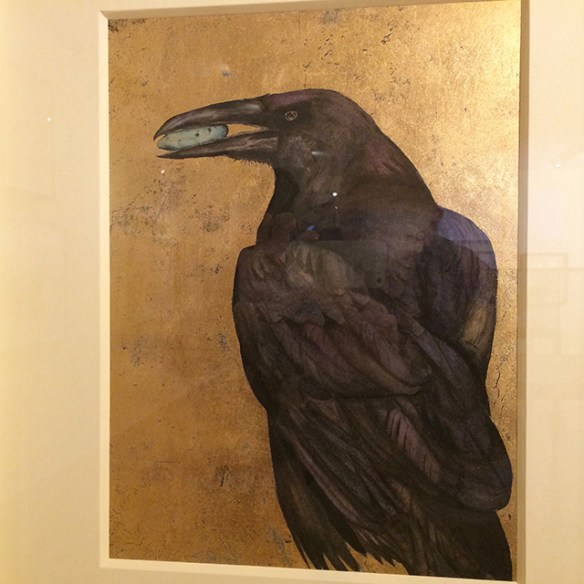
The theme of childhood memory is one that also underpins the new show at the Foundling Museum, a show aimed for children who may have lost a vital connection to their environment. Poet and writer Robert Macfarlane has turned away from our mediated worlds of digital technology and taken us on a stroll through nature while artist Jackie Morris has produced accompanying illustrations of the poet’s main themes to depict a world populated by birds, some resting on twigs, another with a pebble held delicately in its beak. What we see is a sort of hybrid world that never really leaves culture behind, for the gold-leaf backgrounds in many of the artist’s images are often more pleasing to the eye than those in which the complex structures of trees and vegetation have been presented. Perhaps nature is only digestible in small quantities. Following this theme, we find the most lucid and beautiful quote in the press release to be one that is actually set against the cultural reality of Pokamon characters. A child may be able to name over a hundred of these cultural brands, the artists inform us, but when it comes to naming the species and genera of our own natural habitats this number falls dramatically.

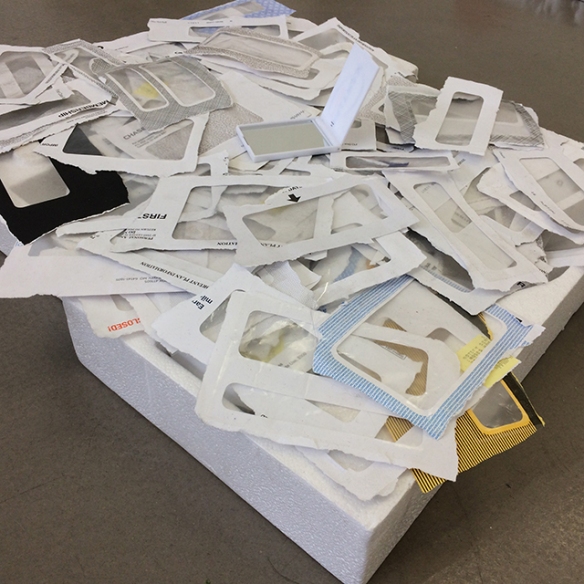
What does the window panel of an envelope mean? This is one of the questions that arises at Sadie Coles HQ where Darren Bader presents a room with a few highly collectable art sculptures mixed with tat, but where the buyer is not informed as to which is the art since this is precisely the nature of the game. In one sense then, all the work is art including the tat, since just as in a landscape the figure can only be picked out in contrast to a less busy background, here the artworks would only take their full meaning when viewed in relation to the much weaker objects that surround them. But this would be to miss the point which is that the viewer or potential buyer is expected to put their own judgement on the line, and this brings us back to the envelope windows. Are they art or simply the incidental and spontaneous product of HQ’s recycling activity? That they are reminiscent of any activity at all is why they get the thumbs up from me as accomplished artwork but this is an easy thing to say, whereas it is for the dedicated punter to make the real decision on this through a purchase.

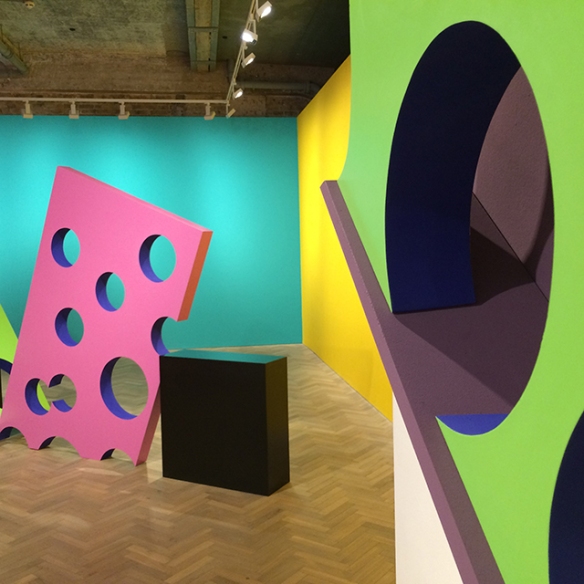
Finally, at Thomas Dane Gallery Phillip King is presenting a fabulous multi-coloured installation using painted objects that appear to have been constructed out of wooden sheet. Large circular holes punctuate a central piece that makes it appear like a giant block of cheese. Though the yellow is provided not by the object itself, which is actually a bright lime green, but by the painted wall behind, the association of colour is nevertheless strong enough to impart the idea of food to it. In all there are several of these objects propped up against each other and the overall effect is to create a space reminiscent of a stage set where the viewer can move around and observe the curiosities of colour juxtapositions and perspectival lines.

971
Lisa Milroy at Parasol Unit. Shoes, distinctive flat style, fab painting in general, but also a passing resemblance don’t you think to hinged mussel shells?

972
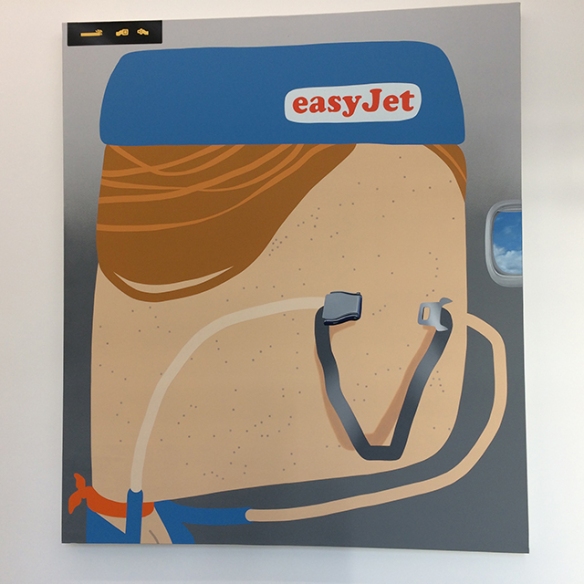
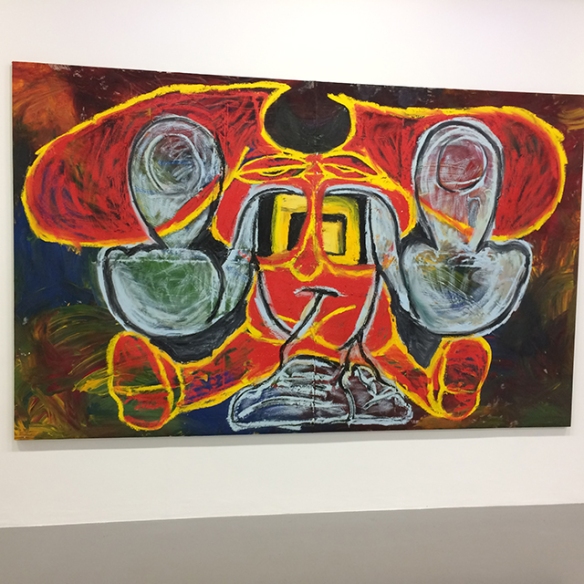
Oli Epp at Beers London.

973
Jackie Morris at Foundling Museum has produced images to accompany poetry by Robert Macfarlane.

974
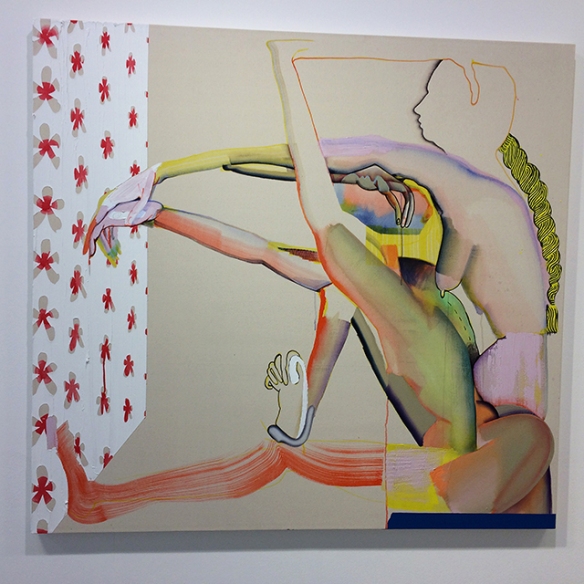
Christina Quarles at Pilar Corrias as part of Condo.

975
Gerasimos Floratis at Pilar Corrias as part of the #Condo project where artists from different galleries do a temporary exchange.

976
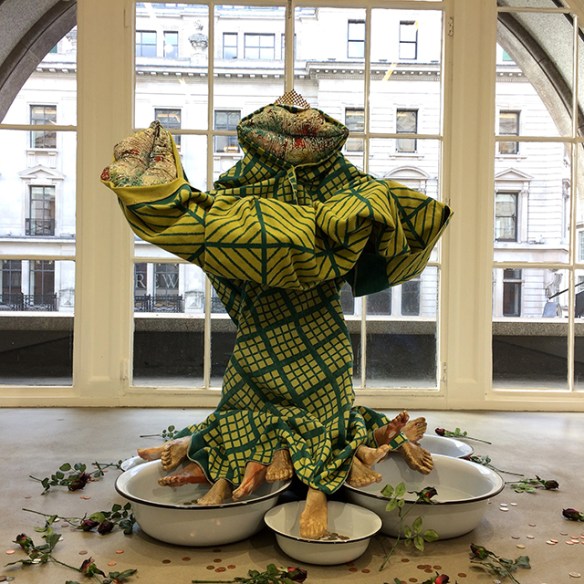
Koppe Astner at Sadie Coles HQ part of Condo.

977
? at Sadie Coles HQ. There is a room full of conceptual sculptures including this one made up of envelope windows. Four are by A-lister Darren Bader and a few others are by guests, the rest is intended to be tat! The catch is none of the sculptures are labelled and prospective buyers are invited to take a punt. I fancy this one to be a quality piece.

978
Phillip King at Thomas Dane Gallery with an installation of bold forms.

979
Martin Kippenberger at Christie’s.

Gallery run 11th January

The run to Trinity Buoy Wharf has been an attractive activity ever since a speaker at an event there, Ian Sinclair, notable for walking round the entirety of the M25 and writing a book about it, declared that this wharf, with its location next to the River Lee, marked an historic site. From here the Saxons would check out the Vikings, whilst the latter would return their reconnaissance in this direction from across the barrier of the River Lee. It is right on this junction that this smaller tributary departs the Thames as it takes its waters from the North. With a bacon roll consumed, it is time to head to the first gallery of the day via a series of waterways.

The River Lee provides quite a formidable barrier to the foot traveller even today and unlike the fairly tortuous route of a few weeks ago which required a four lane highway as travelling companion to cross the river, today’s route wends its way north past the giant docks of Canary Wharf and onwards up the Regent’s Canal, escorting me to Hackney, and indeed, arriving fifteen minutes early at one of the midday openers. PeerUK is hosting Catherine Story from nearby Carl Freedman gallery and in its window are clues to the nature of the show. Clay maquettes are the artist’s starting point and these have then been transposed to canvas as a series of Surreal looking paintings populated by chunky figures with shear planes suggestive of both limbs and machinery. They are in fact reminiscent of Cubism and with the clay being a plastic medium, the artist appears to have worked out in advance, the various folds, bobbles, distortions and protrusions, distinctive of that style, before then transposing them to the two dimensional world of paint.

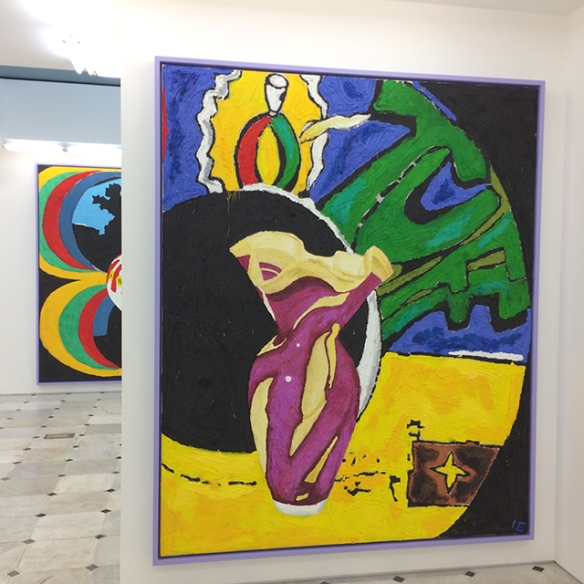
Herald Street Gallery has opened a new space in Museum Street just near the British Museum and Ida Ekblad is on show. Her rather stunning, bright paintings are actually made with plastic, a fact gleaned whilst reading her press release off the phone in those last few minutes of waiting outside the previous space. The plastic has been melted and smeared with a palette knife and yet none of its intensity of colour, whether it be derived from a previous state as coloured carrier bag or plastic household object, a specific origin that the artist doesn’t actually divulge, has been lost. Rather this detritus of daily life lives on in a strange afterlife as material of a painting, depicting the simple forms of pots that are themselves reminiscent of Greek urns, along with a whole host of other types of ornamentation ranging from flowers to simple coloured planes.

After seeing yet more good quality work up for auction at Phillips, with a couple of stand out pieces by Alex Israel and Barnaby Furnas, the next destination is south of the River at Vauxhall where Cabinet Gallery sits proudly in the middle of the aptly named, Pleasure Garden. Henrik Olesen’s musings on the nature of an object lead to an unusual, though confident display of tacked, nailed and propped materials that sit and hang against the various white-walled nooks that this gallery has made available with its slightly unusual polygon-styled floor plan. On many of the box-sections of brushed aluminium, which feature as rectangular frames or stand-alone girders, there are small inscriptions presented on clear plastic rather as one might find accompanying cooking instructions on a ready-meal, and these provide further philosophical reflections by the artist on object hood. Perhaps by giving us a general scene of peculiar part-objects to look at whilst openly questioning their validity, the artist is also trying to evoke an aspect of the human condition that has been put into words by the philosopher Heidegger, that since the Greek ages we have passed over the phenomena of the world, a general being, and instead focused our attention, to our detriment, on individual objects from which we try to extract meaning.

961
Catherine Story of Carl Freedman Gallery on show at Peer UK.

962
Ida Ekblad of Herald Street Gallery with vivid paintings made from melted plastic.

963
Barnaby Furnas of Victoria Miro provides the statement piece for auction at Phillips.

964
Alex Israel on auction at Phillips and adorning the front cover of the catalogue as befits a top ranking artist shown by Gagosian Gallery amongst others.

965
Michael Pybus on auction at Phillips.

966
Clever use of stickers on this bike.

967
Henrik Olesen presents a show at Cabinet Gallery of what could perhaps be described as partial objects, many of which are casually stapled or pinned to the wall. The show itself seems to question what an object actually is.

968
Simon Thompson of Cabinet Gallery, an artist I’ve wanted to visit for a while, has done prints of objects on rather fab rug-like objects with a hanging tag.

969
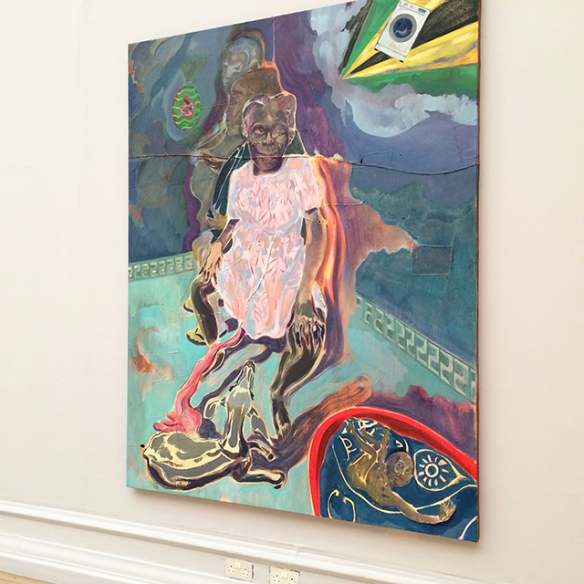
Michael Armitage of White Cube showing at South London Gallery. An allegorical piece as a mother gives birth to a goat. Not a good thing! and dreams of a better life symbolised by washing machine top right, are back on hold.

Gallery run 20th December

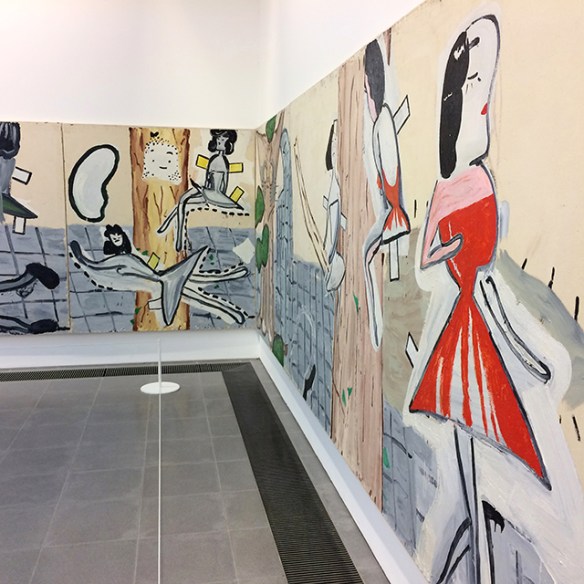
Rose Wiley has a show at the Serpentine Gallery and the jog out west from Peckham proceeds over Lambeth Bridge, along the Embankment to Chelsea before finally reaching the damp Autumn grass of Hyde Park. In the show, a great painting made of several panels, has been installed where two walls meet at right angles. A sort of half panorama is the result. Several figures float around the space, sporting tabs like the kind that were used in children’s cut-out kits for adding outfits and interspersed amongst these figures are various symbols such as ovals and bits of text, each deeply evocative. The overall effect is a painting that feels like a powerful memory since, in addition to the aforementioned symbols, there is also an extensive network of completely untouched canvas. The artist hasn’t tried to fill this space, as would be the case in a normal panorama functioning as a window on the world, but rather has left the raw canvas as a conduit allowing the eye to move smoothly from one symbol to the next.

To the north of Hyde Park lies the little cul-de-sac of canal called the Paddington Basin, and it is via this little stretch of waterway that one then arrives at Lisson Gallery, spared in the meantime from hearing the thunderous A40 traffic, by a sort of emotional bubble that this charming stretch of canal has put in place. Carmen Herera paints jagged forms that jump across the canvas like lightening bolts and it is in the first of Lisson’s two galleries that the viewer encounters them. In addition there is a surprise. The artist has installed a three-dimensional structure, about the size of two back to back wardrobes and with its shiny blue paint, it seems to encourage various dialogues with the other brightly coloured paintings in the show.

In the second gallery are artworks by Roy Colmer from the 1970’s. Think back to the tech prevalent then and we have bulky old TV sets with horizontal band patterns, flickering away due to the limits of their technology. These are exactly what the artist has evoked in his paintings with their uniformly wide bands of colour. The unique quality of these bands is that they change colour during a single pass and this is what makes them hard to pin down as simply a band of coloured paint, a feat achieved, we are told, by the artist having rigged the spray gun to switch colour whilst still applying the paint in a continuous stream.

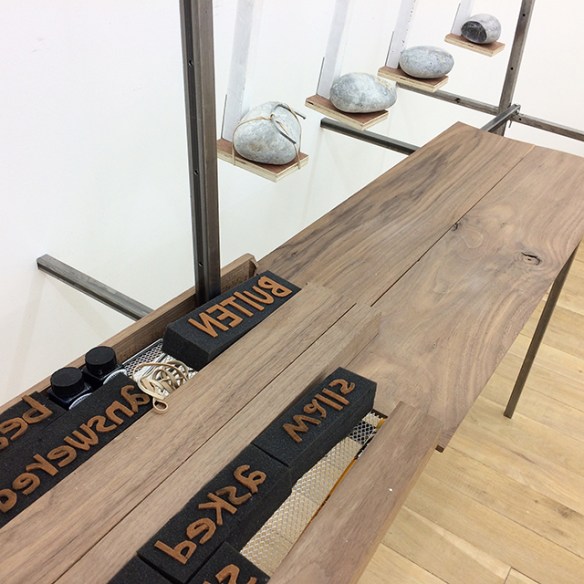
Lastly, in Brewer Street, Amanda Wilkinson has set up a new gallery after the restructuring of what was previously Wilkinson gallery. She has taken approximately half of the original artist list and of these artists, Jewyo Rhii, is showing a great installation of make-shift printing devices. Reversed lettering and some strange pivoted arms along with black lettering marks on the gallery wall accompanied by various drips and splats, provides the evidence that these machines actually work, up to a fashion. A lump of rock has been placed in a makeshift tray and this seems to function quite literally as a power supply in the manner of the swinging motion of a pendulum in a clock. With this low tech set-up the artist has enabled the viewer to turn away from the immediate function of a printing device and, rather as Roy Colmer had done, in fact, with his depictions of the TV raster pattern, offer instead a profound meditation on the general nature of the reproduced image without the burdensome presence of the duplication devices themselves.

951
The Gingerbread City in Museum of Architecture with different companies of architects offering various cameos that have fitted together in this carefully designed edible city.

952
Rose Wylie at Serpentine Gallery with a panoramic artwork that uses a novel method to portray the human figure.

953
Carmen Herrera of Lisson Gallery with evocative hard edge paintings.

954
Roy Colmer at Lisson Gallery with subject matter based on old flickering 70’s TV sets, but using a cleverly rigged spray gun that can change colour on a single pass.

955
Susan Hiller of Lisson Gallery with painted over wallpaper allowing bits of cartoon and word-caption to show through.

956
Bex Simon has designed this great public participation artwork on Westminster Magistrates Court.

957
Gower Street birthplace of the Pre Raphaelite Brotherhood.

958
Polly Apfelbaum of Frith Street Gallery with a show themed around a foot drawing by Dubuffet.

959
Jewyo Rhii at Amanda Wilkinson Gallery with an imaginative design for a printing press. The rocks help the hidden upper sections swing against the gallery wall, imparting black ink from the various word moulds in the process.

Gallery run 15th December

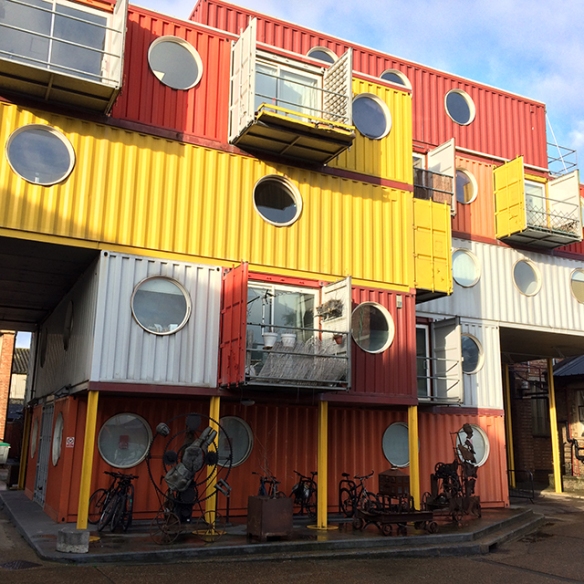
Trinity Buoy Wharf lies in the crook of land between The Thames and the River Lee. Because of the two converging rivers, this area feels fairly isolated from nearby Canary Wharf and the Millenium Dome across the water to the south. It accommodates an artist community, as evidenced by the strange and beautiful sculptures that are scattered around, but it also enjoys a strong connection to the surrounding waters. A lightship is moored at one end of an open yard whilst opposite stands an assembly of crisscrossing shipping crates, populated by creative types who can observe their environment through circular porthole windows. After a bacon roll in Fatboy Diner the time has come to make an arching detour round the loops of the River Lee and across the top right of London’s map into Hackney.

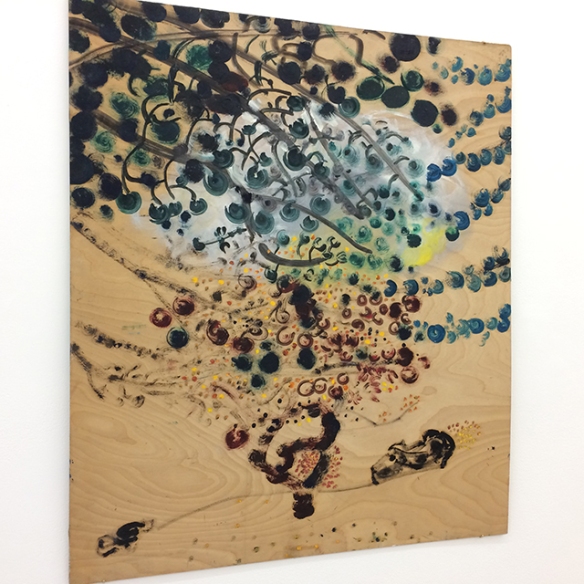
The Approach gallery has drawings and paintings by Bill Lynch, who as we understand from the press release led a free-living existence, taking on decorating jobs to make ends meet, all the while exploring the intricacies of fluid mark-making, prevalent in the tradition of Japanese landscape drawing and calligraphy. A tree appears in one of the artist’s paintings and it is opening up its foliage with the energy of small coiled springs, a state of affairs depicted with tight, circular brush marks amongst the living network of dark twigs and branches.

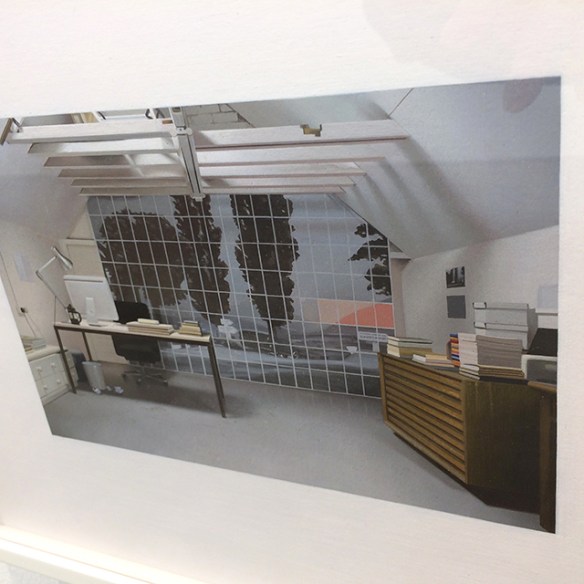
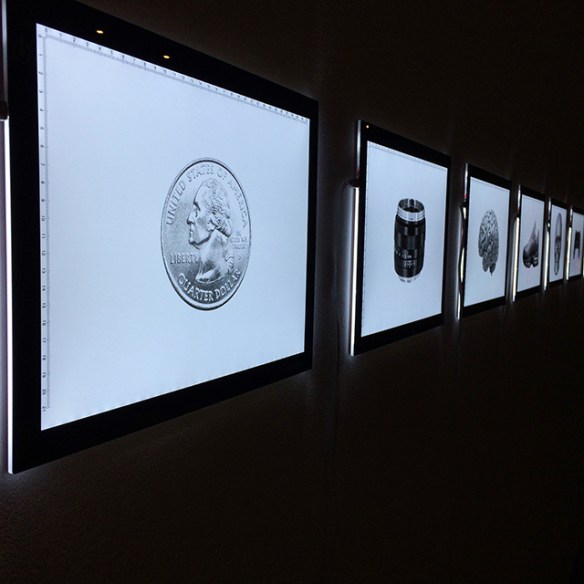
At Maureen Paley, a neighbouring gallery in this East London cluster, Andrew Grassie has made paintings that rival even Vermeer in their precision and use of colour. They are barely bigger than postcards yet carry a wealth of detail. The white beams of an open roof space recede towards a vanishing point, whilst objects associated with a functioning studio, since this is the chosen subject matter of the series of seven paintings, appear as if by magic with minute flecks of coloured paint, all the while being contained within a flawless, photographic-like surface. A few doors away in Herald Street Gallery, a dinner plate sits on a plinth. Oliver Payne seems more interested in the various distractions that might divert us away from art rather than the many objects catalogued in the previous show that are intended to make us think of art-making itself. Indeed, it is a testament to the left-field nature of the present show that none of its objects conform to the canon outlined in the previous show, neither the plate of cold chicken and pasta sitting on the plinth nor the array of eight I-pads that, despite all their powerful processing capacity, have been requisitioned purely for the purpose of displaying a single image, something of course, which could have been done with a piece of back-lit cellophane, were the artist not interested in turning his critical eye on digital technology itself.

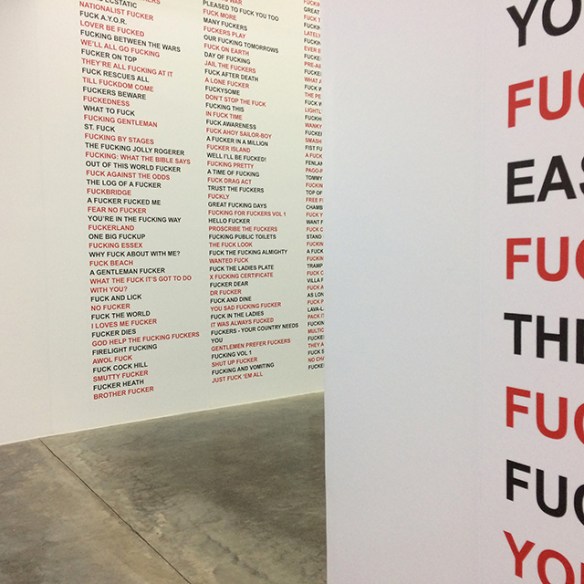
Finally, back south of the river, Gilbert and George have been having a giggle thinking up how the F-word can be inserted into short pithy slogans. As the eye scans across the alternate red and black fonts of F-word wallpaper a kind of rhythm emerges. The two artists switch between being the randy agents of various described acts outlined in block capitals on the one hand, to being puppeteers of the English language on the other. Familiar slogans become wilfully distorted as the artists introduce the necessary four letter insert. A game is being played, for which we know the rules, and which all the while is being powered by the free-flowing imaginations of G and G, revealing in the process a sort of inner portrait of the two artists.

941
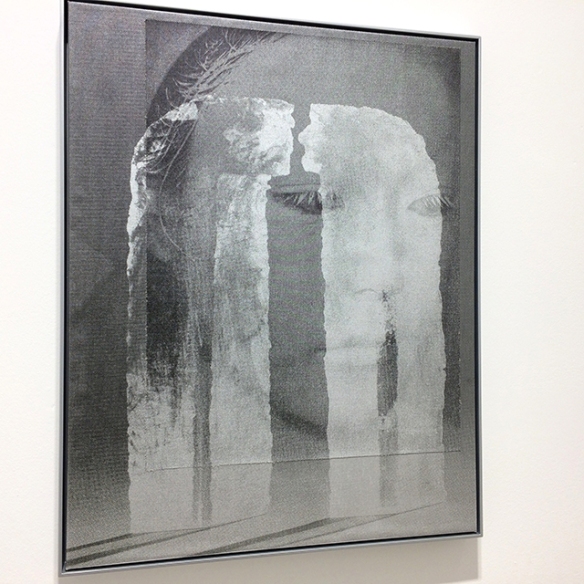
Ilya and Emilia Kabakov at Tate Modern with layered images.

942
Trinity Buoy Wharf.

943
Bill Lynch of The Approach Gallery with paintings on wood that appear to be inspired by the Japanese tradition of prints and calligraphy.

944
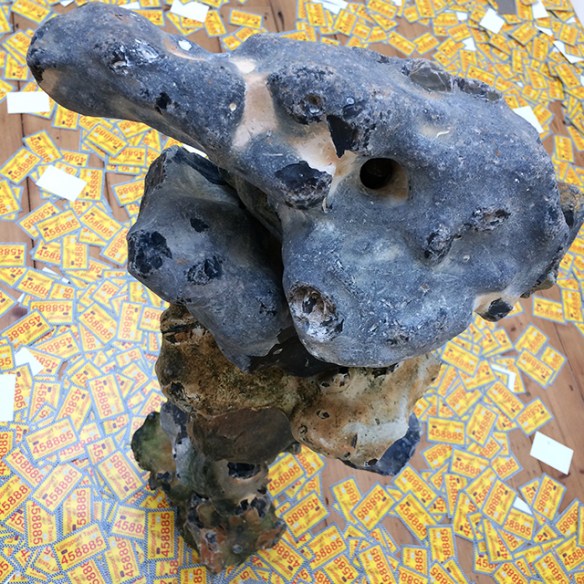
Jack Lavender of Approach Gallery with assembled rocks and taxi cards.

945
David Noonan of Stuart Shave Modern Art. The artist was there talking to friends about his work and it was great being able to eavesdrop!

946
Andrew Grassie of Maureen Paley with photorealistic paintings.

947
Oliver Payne of Herald Street with a new display format of wall-mounted iPads carrying a single image.

948
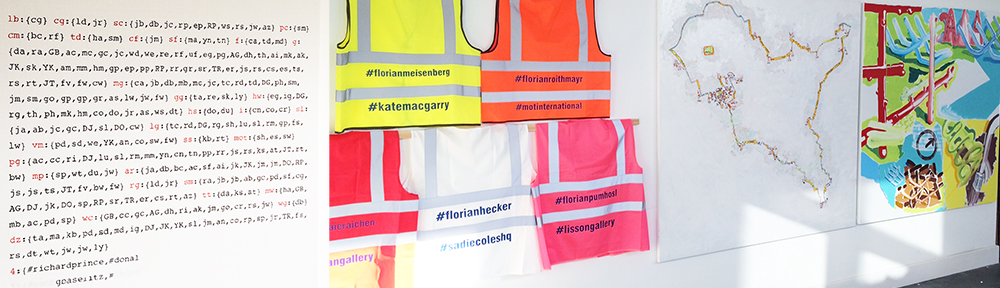
Florian Meisenberg of Kate MacGarry.

949
Gilbert and George at White Cube with rude words wall paper.

Gallery run 6th December

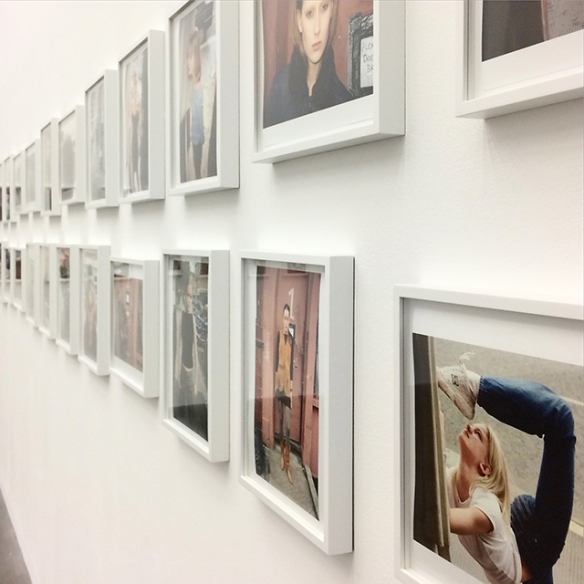
My phone is being sorted out this morning leaving me temporarily camera-less. Nevertheless this hiatus is a chance to build up the jogging miles before my retrieving of the device and doing the gallery visits in quick succession. At Alison Jacques Gallery, Juergen Teller is displaying a series of photographs called Go-Sees. The title used here refers to the term in the fashion industry of an informal introduction between photographer and aspiring model. In this exhibition the models have crossed over from the fashion industry into art. They are shown posing in a frequently used doorway or against a familiar backdrop revealing, all the while, different levels of engagement with the camera. Some models are at the artist’s front door waiting to be let in and have been caught unexpectedly from above, whilst others have adopted contorted gymnastic poses thereby taking control of the photograph and demonstrating a power of their own.

A few streets away at Pilar Corrias Gallery, Mary Ramsden has exhibited abstract paintings with dynamic motifs. A swoosh of paint arcs over the canvas and at its apex, where the droplets can no longer hold together due to the force of the brush swerving in a new direction, a secondary ejection occurs. The droplets have broken free and splay out across the canvas. This arching swoosh is a gesture but also a symbol, since the artist appears to have reproduced it at will, not only in its general shape, but also in its dynamism, harnessing the forces of nature to eject the paint spray at the chosen point. Other details stand out too, though with less dynamism, such as a bright pink strip of paint up the outside of the stretcher frame. It is normally a dead space that carries only the residues and traces of the main action on the painting’s front surface, but here on this side strip the artist appears to have intervened amongst the various accidents.

Sadie Coles HQ provides two further spaces for today’s run. At Kingly Street, Kati Heck has produced a central hexagon structure in the centre of the main gallery. Six paintings are displayed on its inner walls forming a sort of panorama of images. The images themselves are very strong, comprising figures and various objects of symbolic importance, all boosted in their immediacy by the economy and panache of the brushstrokes. Some of the background colour actually appears to have been applied with decorating brushes, evidenced by the width of their strokes, whilst other areas are omitted altogether, suggesting a confidence and good judgement on the part of the artist. Arms are detached from hands, a piece of sky missing, but each such intervention is done with a plausible logic thereby keeping alive the interest for the viewer.

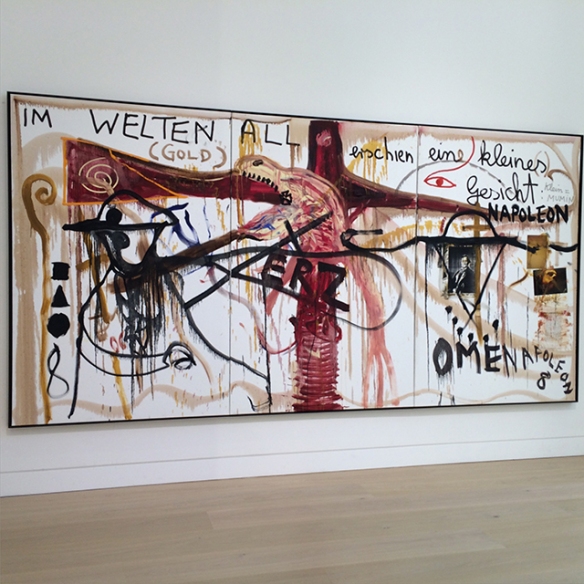
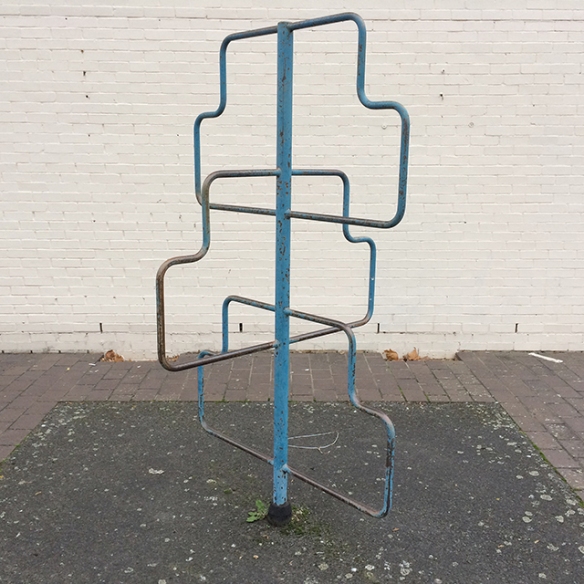
With the day rapidly passing, there is a chance to see some work at Phillips. Jonathan Meese has a large image that oozes German Expressionistic appeal. The tell-tale fragments of German vocabulary along with roughly rendered figures populating the picture space, create a distinct style and attractive image. Finally in Peckham a climbing frame with art aspirations of its own catches the eye. The steel with flaking blue paint looks great and its image on Instagram sits in the middle of the other eight like a sort of carousel.

931
Juergen Teller at Alison Jacques Gallery who photographed aspiring models in informal settings called Go-Sees.

932
Mary Ramsden of Pilar Corrias.

933
Adriano Costa of Sadie Coles HQ.

934
Urs Fischer at Sadie Coles HQ with prints and photos.

935
John Armleder at Phillips.

936
Mel Bochner at Phillips.

937
Jonathan Meese at Phillips.

mm938
Kati Heck at Sadie Coles HQ with very good figurative painting that isn’t too finished in places.

939
Old frame in Peckham.

Gallery run 1st December

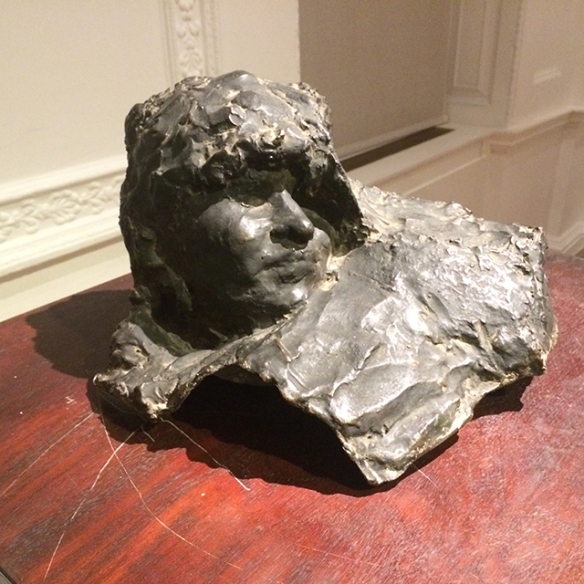
Galerie Thaddaeus Ropac, Sprovieri and BlainSouthern are amongst the latest venues to be checked out on this week’s run. The first on this list, Galerie Thaddaeus Ropac, is showing work by Arnulf Rainer, Lee Bul and Medardo Rosso, whose displays are in the various ornate rooms and hallway spaces that fill a classically styled building. Due to the precious nature of Medardo Rosso’s sculptures, a specially sealed room has been created. It has curtains on both its doorways and a heater that raises the temperature to considerably higher than the freezing day outside. Apart from this unexpected warmth, the sculptures themselves offer a real pleasure for the viewer. They actually appear to have emerged from chunks of matter bringing with them a strange life-force to the blocks of inanimate material from which they are cast.

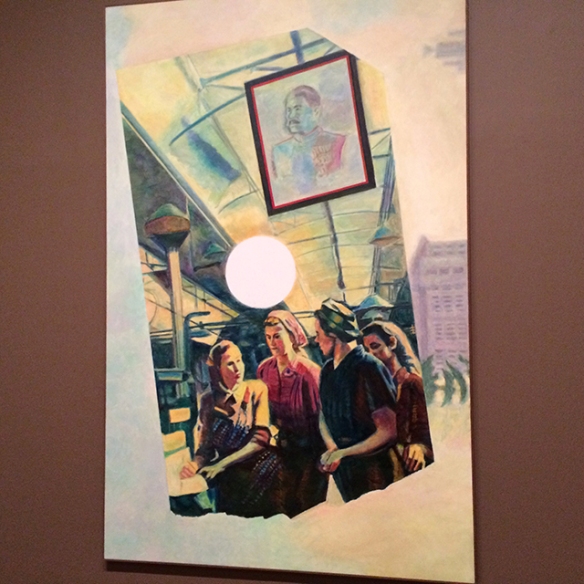
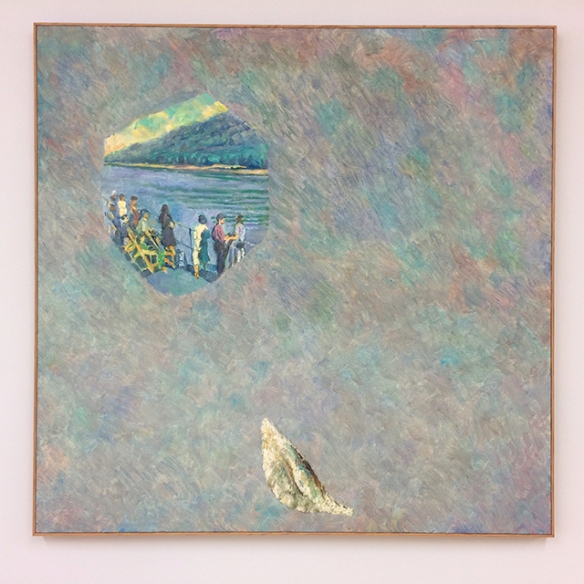
At Sprovieri, the artists Ilya and Emilia Kabakov, who are enjoying a current major retrospective at the Tate, have three paintings on display. Each of these paintings explores the relations between the surface plane of a painting and its picture plane, in other words the physical surface of an image and the illusory perspectival space that lies just beneath it. This dual space of a painting was truly liberated 100 years ago with Russian Suprematism, we are told in the press release. To use an extended metaphor of my own, the angular forms of the new avant-guard movements managed to haul themselves out of the illusionistic world of landscape and still-life, to sit on the paintings’ surfaces, rather as the first amphibians, in fact, had found themselves liberated from water and free to roam land! In this particular show the artists have employed angular forms that are reminiscent of Suprematism but painted in muted pastel hues and beneath these shapes are various rural landscapes. This duality not only adds narrative interest, but also demonstrates as a fate accomplis, the simultaneous existence of the two different painterly spaces the artists were keen to depict.

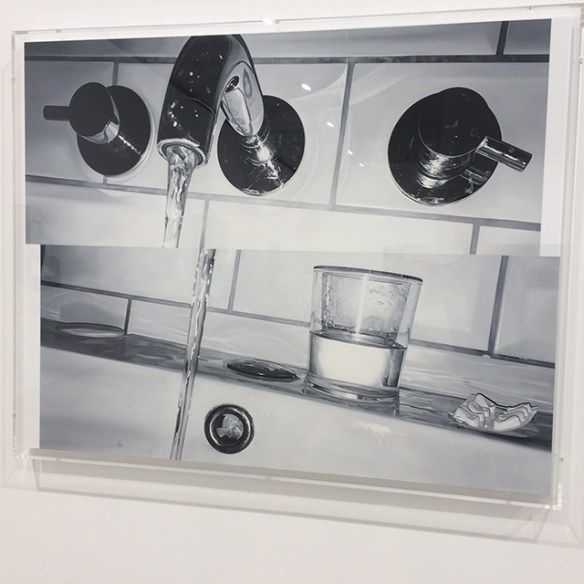
At Blain Southern, a gallery my friend has recommended to visit, James White is displaying paintings of glasses and associated objects. Catching a glimpse of them through the window last week, they looked like black and white photographs but this week they are revealed as highly realistic monochrome paintings. Every cut in the crystal of various glasses unleashes a new cascade of white paint executed in small brushstrokes. Close up their materiality is clearly discernible but from afar they dissolve into an overall impression of light.

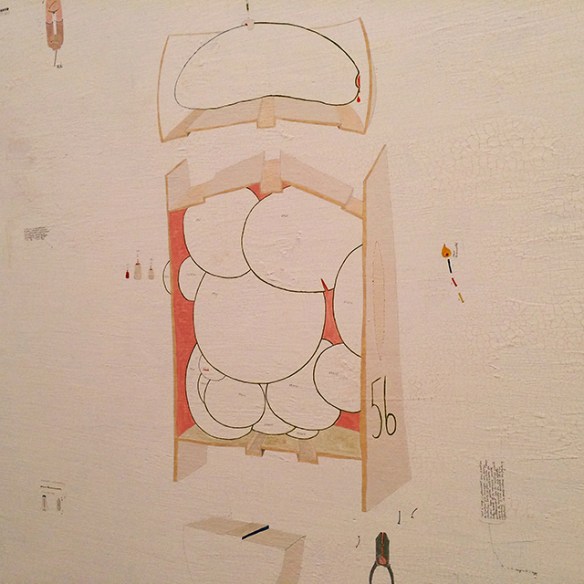
The rest of the run is dictated by the cold weather, since a dead phone (and need for mince pies) necessitates a jog to Hampstead, albeit through some lovely parkland, and then back again in search of Apple HQ and a new battery. The process of queuing for the item actually provides the necessary warmth to bring the phone back to life and to photograph some remaining artworks. At Hauser and Wirth, Jakub Julian Ziolkowski is displaying some vivid paintings, whilst at Raven Row, and with the battery still surviving, Gianfranco Barruchello has produced drawings that resemble mind maps. A container is made with a few pen strokes and encloses several pinkish spheres. From here a cartoonish figure starts to come to life, as though the imagination has bestowed upon these spheres the power to regenerate into a network of vital organs. Perhaps the artist has tapped into yet another type of space then, a third type in addition to the picture surface and illusionistic spaces previously described, a space where the artwork is a trigger of images without needing to provide all the details itself.

921
Arnulf Rainer at Galerie Thaddaeus Ropac with abstract works from the 50s and 60s.

922
Medardo Rosso with early 20th century works at Galerie Thaddaeus Ropac.

923
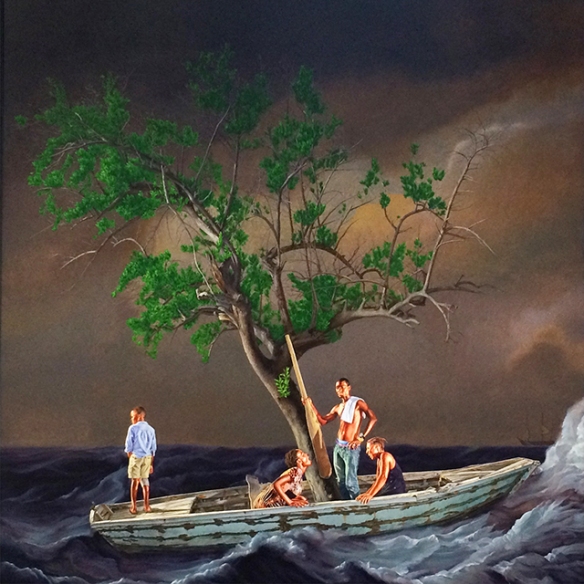
Kehinde Wiley of Stephen Friedman Gallery with paintings of brave boat steerers adopting heroic poses from famous western paintings.

924
Ilya and Emilia Kabakov at Sprovieri with compositions experimenting with relations between the image and picture planes.

925
James White of Blain Southern with intricate painted monochromes featuring transparent materials in close-up often invoking narratives.

926
Jakub Julian Ziolkowski of Hauser and Wirth with images by his invented alter-ego, who depicts nature as it is sensed rather than seen.

927
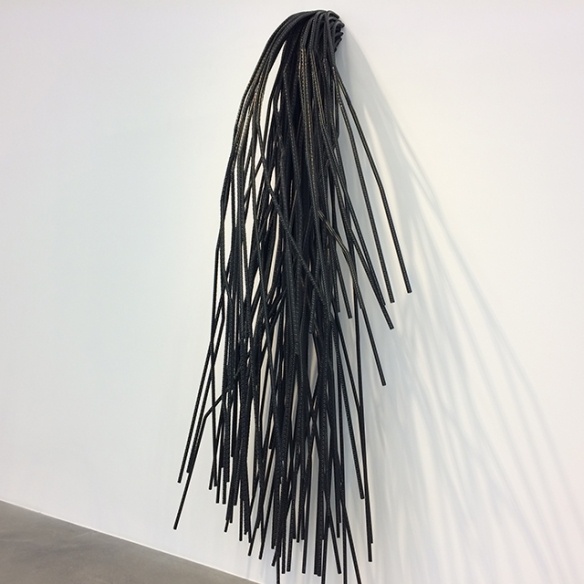
Monika Sosnowska of Hauser and Wirth with sculptures from industrial materials, including steel reinforcement bars here.

928
Luciano Fabro showing iconic works from the 60s at Simon Lee Gallery.

929
Gianfranco Baruchello of Massimo De Carlo showing at RavenRow. Detailed drawings resemble mind maps.

Gallery run 22nd November

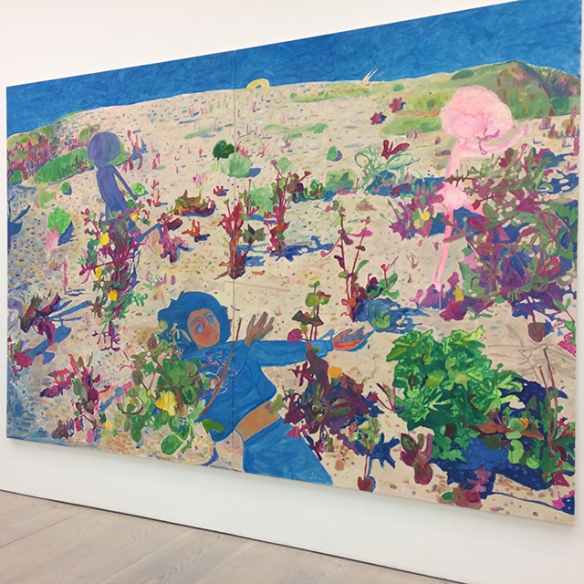
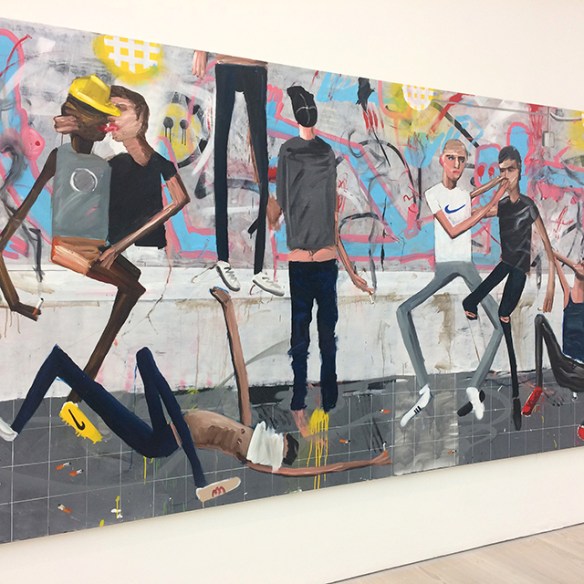
The Saatchi Gallery has been closed for the last two weeks and today’s run offers an eagerly awaited opportunity to check out the group show there. Makiko Kudo, who was previously on the books of Wilkinson Gallery before its recent closure, is showing paintings in one of the rooms. Her subject matter includes figures and trees and a multitude of interactions between them. The figures actually appear to have been gathered up by the arboreal companions and then raised to a viewpoint where they can look down upon the world as though from a lookout post or treehouse replete with those memories of childhood. Also of note in the group show is Dale Lewis. His paintings of street kids and workmen in visibility tops are striking. The figures are all engaged in energetic mannerisms around tables or standing in groups and their movement is conveyed effortlessly, with the figures’ flailing limbs sometimes occupying several positions at once.

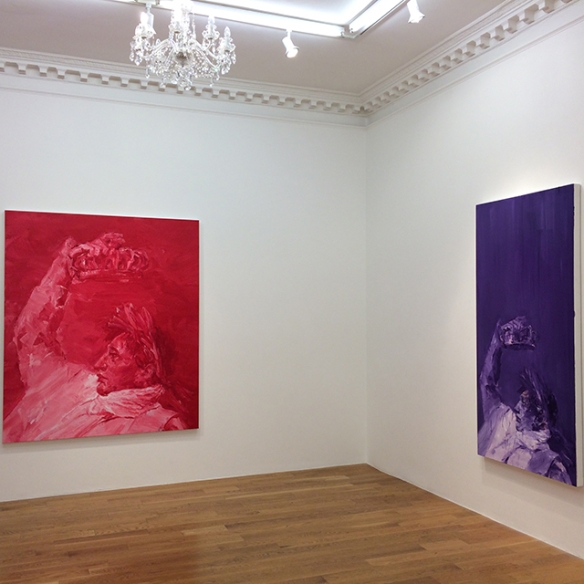
Meanwhile, though not quite literally, my own flailing limbs have taken me to South Audley Street where Massimo De Carlo gallery is showing Yan Pei Ming. This artist has depicted the famous scene first rendered by the painter David, in which Napoleon has taken his crown from the then Pope and is lowering it onto his head, his first act as emperor. For an event of such historical importance the painting has to be good and the artist doesn’t disappoint. He has rendered the image not just once, but five times over in a series of tinted, coloured monochrome paintings. Two of these striking images are actually placed beneath the gallery’s own elegant chandelier, and whether by accident or design, the painted crowns seem to sparkle and refract in a way that is prompted by the illuminated glass immediately above them.

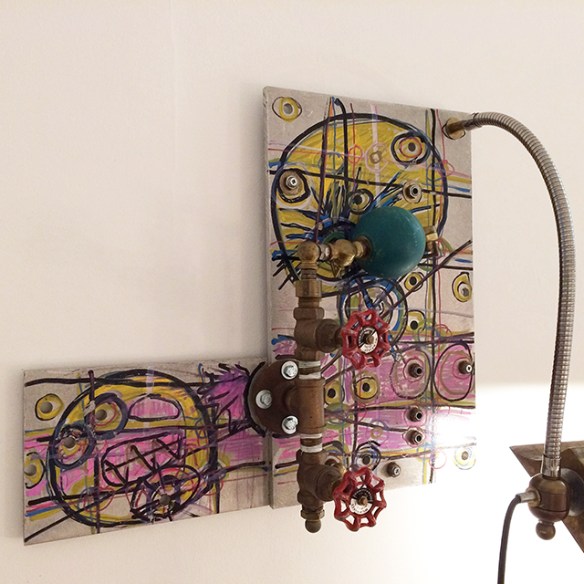
At Southard Reid, the gallery assistant is on the phone. But she helpfully gestures to the press releases presented in a neat pile at the foot of a small staircase. The artist R M Fischer is from New York and undergoing something of a renaissance, we are told. He has made a particularly impressive work using plumbing fixtures, such as taps and pipes, to create a sort of bas relief against a background that is itself reminiscent of a section of bathroom wall. On this surface, almost like a graffiti artist, he has rendered fat lines with marker pens and possibly oil sticks, to create the rough forms of cartoon faces. These in turn have commandeered an occasional washer or random mark to act as make-shift eye or expressive feature.

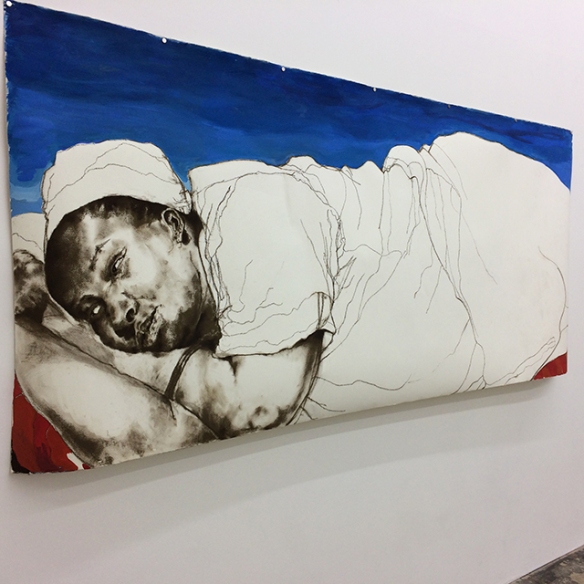
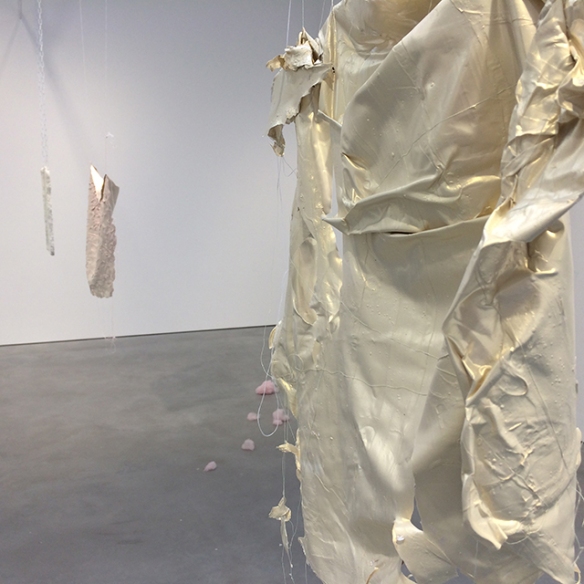
From here it is eastwards. Having slightly overdone the Thames and Regent’s Canal routes in the past, today will use the busy streets, populated by cars and people, to play host to the remainder of the run. Hollybush Gardens is accessed by a staircase that connects the main road to a small network of streets below and it is in this hidden enclave that Claudette Johnson is on display. She has made beautifully economic paintings of figures that dominate the space in which they are portrayed and her sitters, who are all from ethnic backgrounds, appear empowered to leave the confines of the picture plane at any time of their choosing. Finally, at Stuart Shave Modern Art, Karla Black has produced delicate artworks of abstract marks on glass, paper and polythene. Light is the companion to these swirling compositions. It plays across their various surfaces and many of the artworks, despite their simple materials, resonate and glow like the insides of giant shells. Responsible in part for this is toothpaste which the artist has requisitioned from her toiletry bag, along with nail varnish, and then added to her artworks. Through these cameo appearances of objects that populate the artist’s own daily routines, she has not only created interesting visual effects, but also instilled herself in the artworks as an additional presence.

911
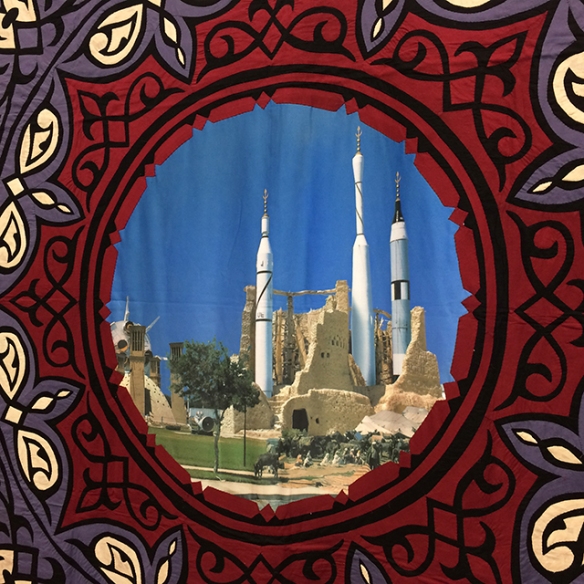
AES+F at Saatchi Gallery with photoshopped minarets in traditional settings but the minarets are actually rockets.

912
Makiko Kudo at Saatchi Gallery.

913
Dale Lewis at Saatchi Gallery.

914
Yan Pei Ming of Massimo De Carlo with reworking of a famous image in which Napoleon was crowned emperor.

915
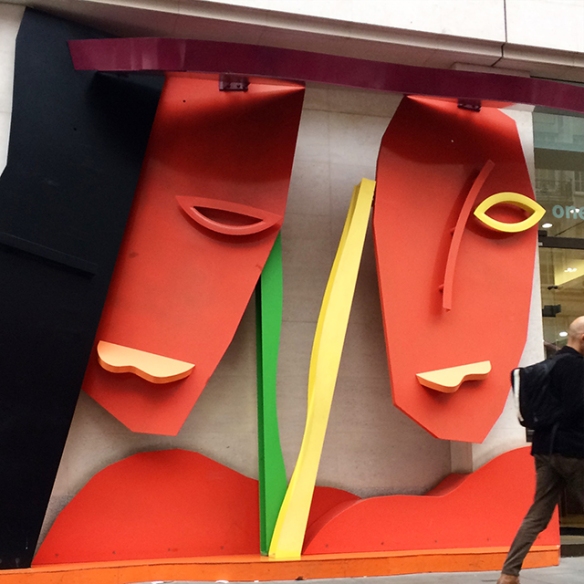
Bruce McLean with a public sculpture just off Regent Steet called Handbag Heads.

916
R M Fischer at Southard Reid with a sculpture incorporating plumbing parts and some drawing.

917
Claudette Johnson at Hollybush Gardens with dominating portraits.

918
Karla Black at Stuart Shave Modern Art with delicately coloured materials using a range of pigments and extenders including toothpaste and nail varnish alongside traditional watercolour pigments.

919
Nick Flatt and Paul Punk showing in a drawing show at Beers London.