Gallery run 15th November

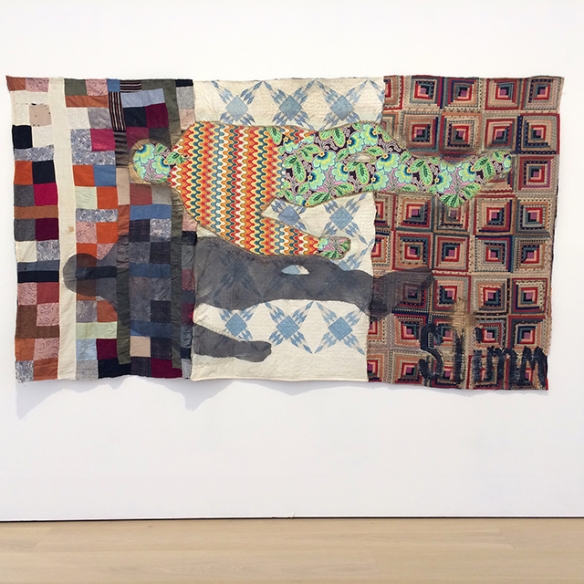
With a lap round The Serpentine in Hyde Park taking the time up to ten o’clock, the first gallery of today’s run should now be open. But alas, my check of opening times on the internet last night was not done accurately enough and it turns out the gallery is in fact closed today for refurbishments. Fortunately one of their artists, Sanford Biggers, is showing just a few hundred metres away at Phillips auction house. The good fortune of spotting the gallery artist in this alternative venue is further enhanced by the quality of the work. It comprises a delicately stitched, embroidered quilt cover with a back story that it was donated to the artist along with many others from families whose ancestors were effected by slavery. This has become part of the rich historical narrative of the artwork itself.

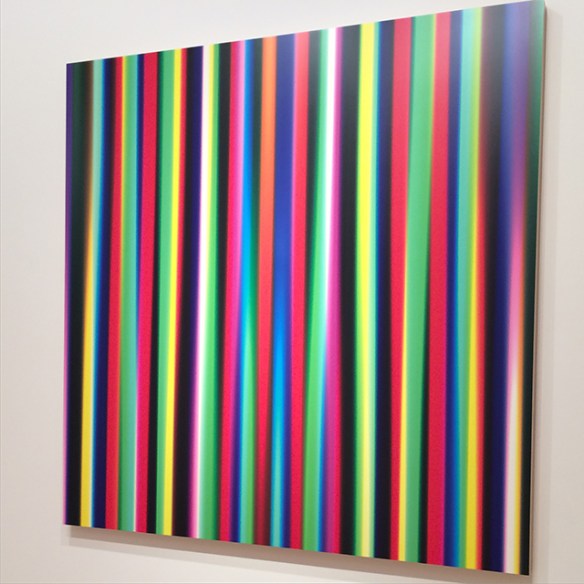
A few blocks along in Victoria Miro, Stan Douglas is displaying photographic-based work. Although primarily the show focuses on high-resolution photographic reconstructions of the London riots of 2011, there are also two abstract works. These additional abstract works are fascinating because they are actually based on simple jpeg images of geometric shapes but where the information of the original digital files has been altered in a systematic way. The resulting rhythmic patterns, we are told, reveal the wave patterns that make up the structure of all jpeg files.

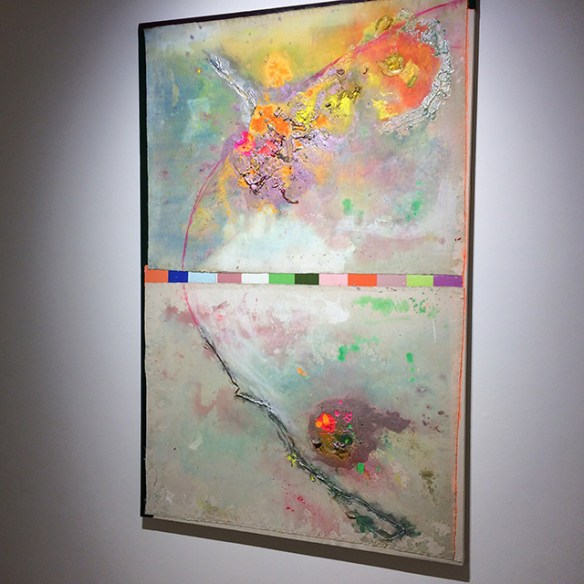
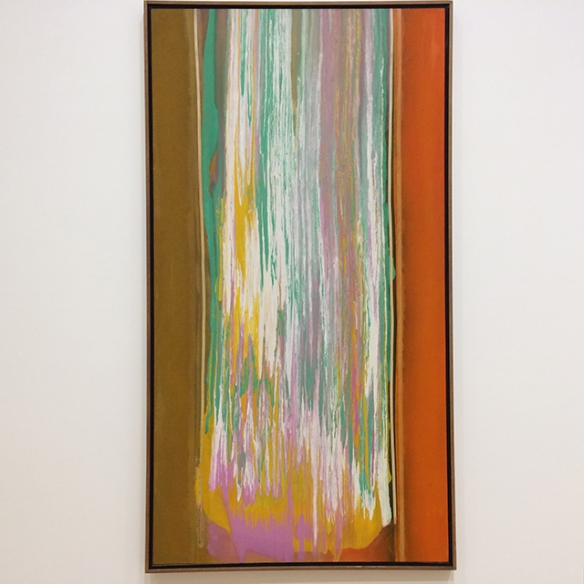
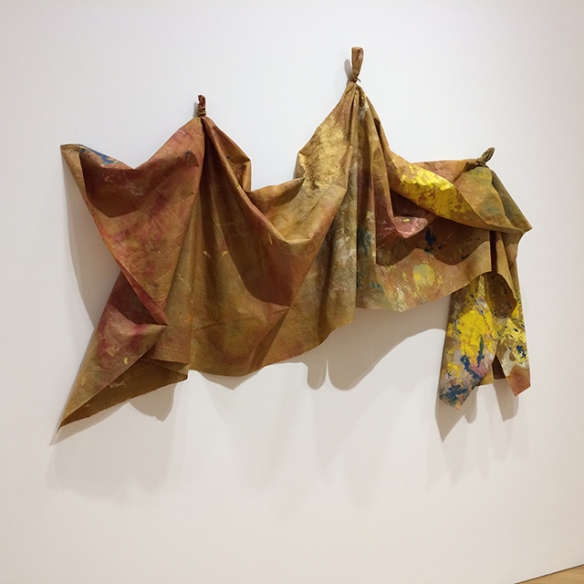
Nearby in the hub of galleries close to the Royal Academy, Pace Gallery is showing some of the American Abstract Expressionists. The dominant figure in this group, at least from an historic perspective, is Kenneth Noland, and the show builds on this popularity by also including works from other important artists from that movement including Frank Bowling and Sam Gilliam. The former has poured paint down the canvas and despite the absence of a brush, has created an elegant and ordered painted surface, evidenced by the clean boarders on either side of a main channel that comprises a complex multi-layered surface of paint. Meanwhile, the latter artist has removed his canvases from their stretchers altogether. They have been bunched up into a few hanging points and suspended from the gallery walls.

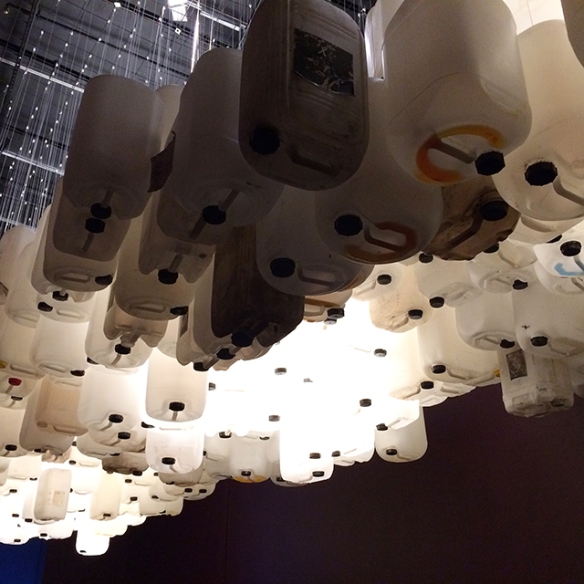
The London art scene is buzzing right now with the Basquiet show at the Barbican. Today’s run actually takes in a concurrent show in the building’s second gallery, known as The Curve. John Akomfrah has collected a multitude of chemical containers with their coloured residues still visible in white plastic grooves. He has then suspended them from the ceiling where they mingle with the lighting to create a stunning spectacle of glowing white plastic. The artwork actually references the anthropocene, an emerging name for Earth’s most recent age, and one that is characterised by human influence rather than geological change. On this account, the artwork draws more attention, in fact, to the pollution of these chemical containers than to their sublime beauty. Perhaps also on this solemn note, it is where today’s blog comes to a close, though the run itself would take in David Blandy at Seventeen, Omar Ba at Hales Gallery, Alan Belcher at Greengrassi and Abel Auer at Corvi Mora, all offering great exhibitions over the rest of the day.
901
Sanford Biggers of Massimo De Carlo on show, and for auction, at Phillips.
902
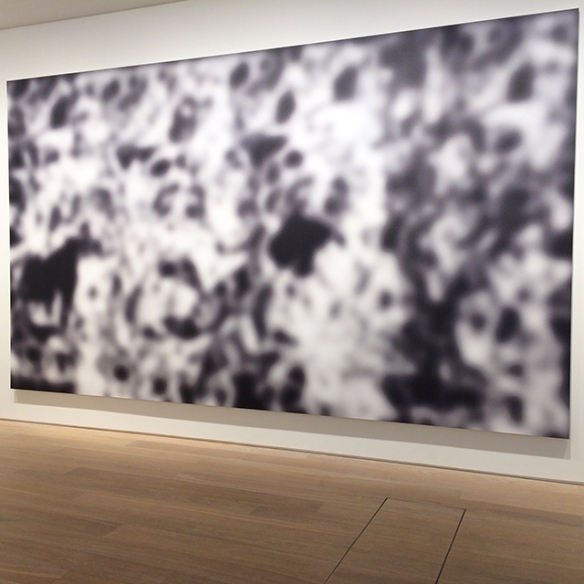
Stan Douglas at Victoria Miro with a manipulation of a jpeg file. These familiar digital files, used for storing images, use clever techniques to compress them and the artist has intervened in some way to produce an image that reveals this underlying technique as an image of its own.
903
Frank Bowling often represented in London by Hales Gallery on show here at Pace Gallery.
904
Sam Gilliam at Pace Gallery with a detached canvas.
905
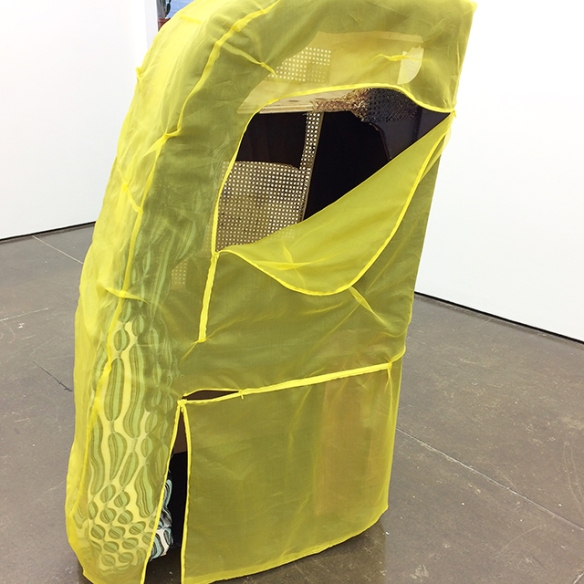
John Akomfrah represented by Lisson Gallery showing at Barbican. These are chemical containers that the artist has used to represent, with some beauty, the Anthropocene, our current geological time period by some accounts.
906
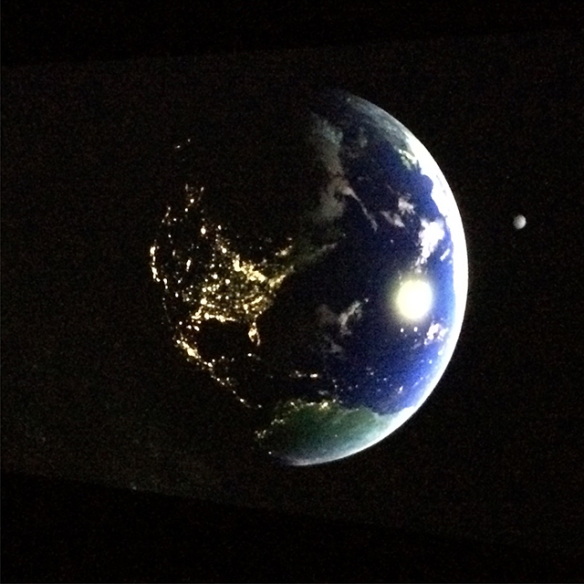
David Blandy of Seventeen Gallery with a digital reconstruction of the solar system.
907
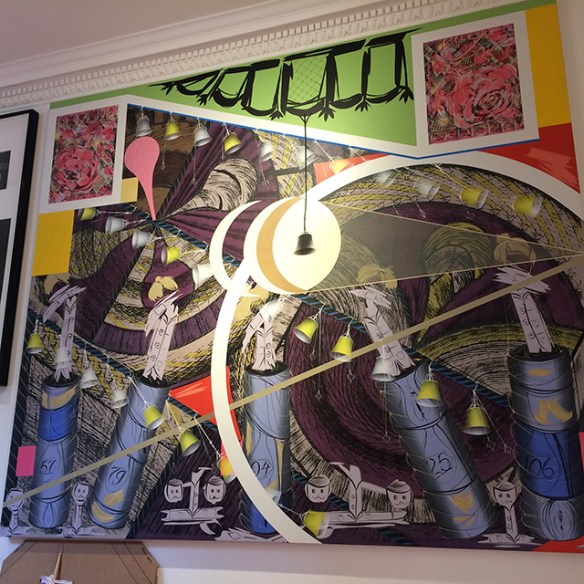
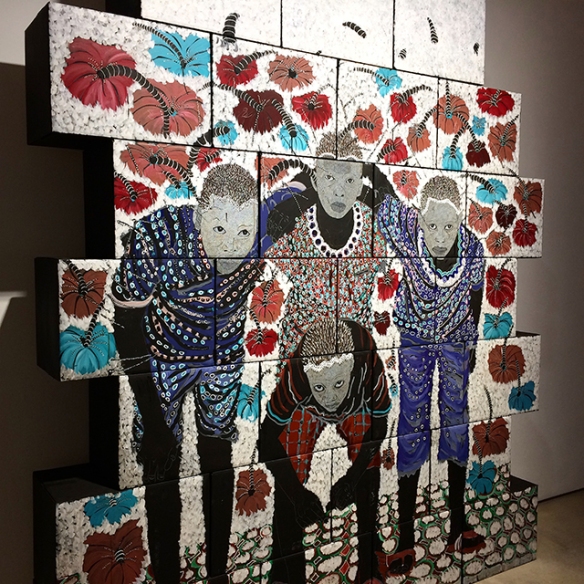
Omar Ba of Hales Gallery draws on the experiences of his native Senegal to develop his rich symbolic language in paintings.
908
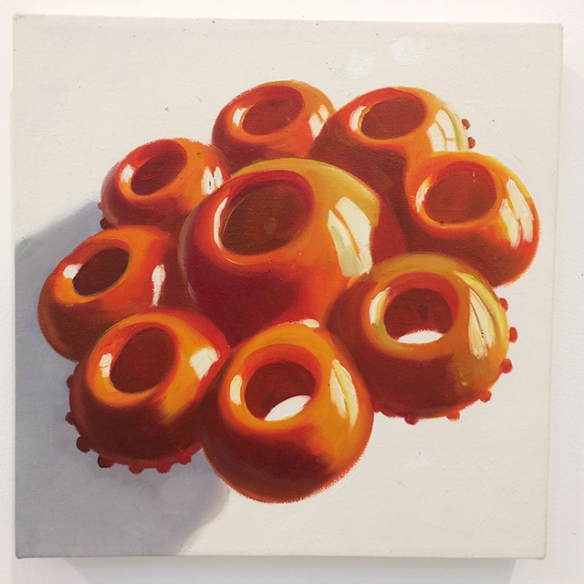
Alan Belcher at Greengrassi with paintings of geometric objects that accompany, in his show, paintings of ducks, fish and shellfish each having a surreal quality.
909
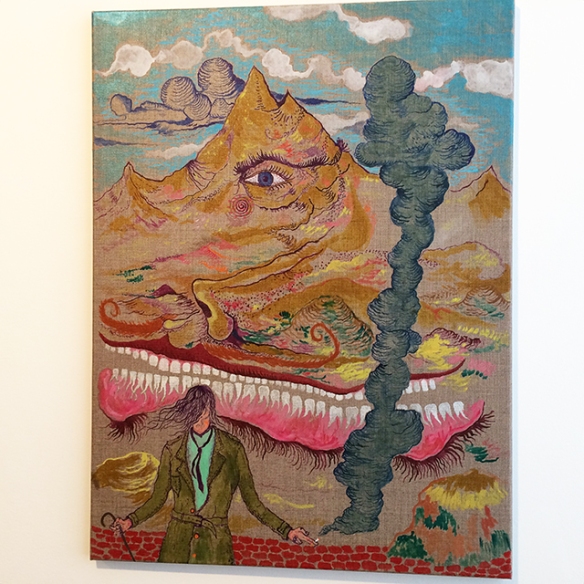
Abel Auer of Corvi Mora.
Gallery run 9th November

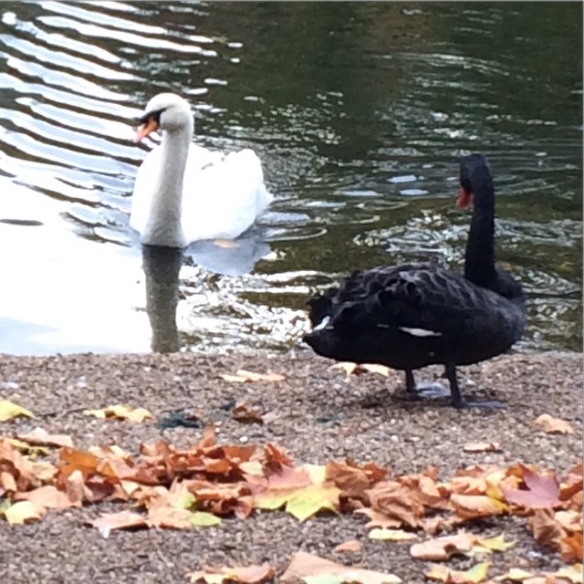
After a run through St James’ park and spotting a black swan, which in 1738 was used as an example by philosopher David Hume of an inconceivable event of such rarity that it might as well be compared to the Earth no longer orbiting the sun, today’s run continues northwards to the first gallery of the day. The galleries themselves are subject to similar laws of induction that aroused the attention of Hume, whereby oft repeated events start to seem almost necessary in the future, and in this vein, today’s planning takes into account that it would be almost inconceivable that White Cube gallery and Marian Goodman should not open at 10am, Sadie Coles HQ and Thomas Dane galleries would not open at 11am and Mother’s Tank Station would not open at 12 noon, though in the case of the latter there is slightly less inductive certainly of this owing to the status of the gallery as a relative newcomer.

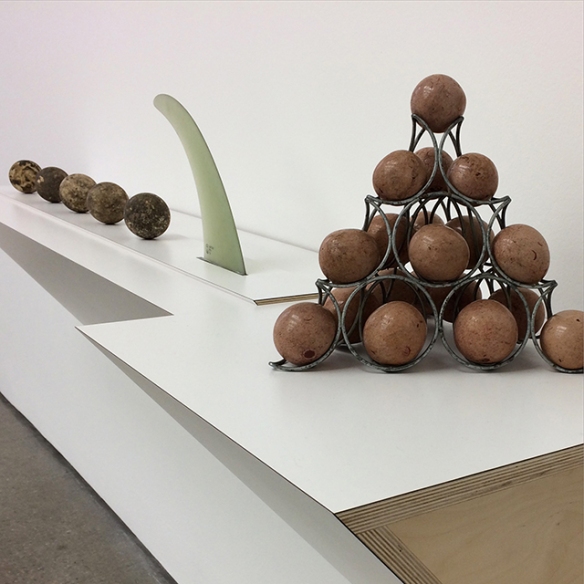
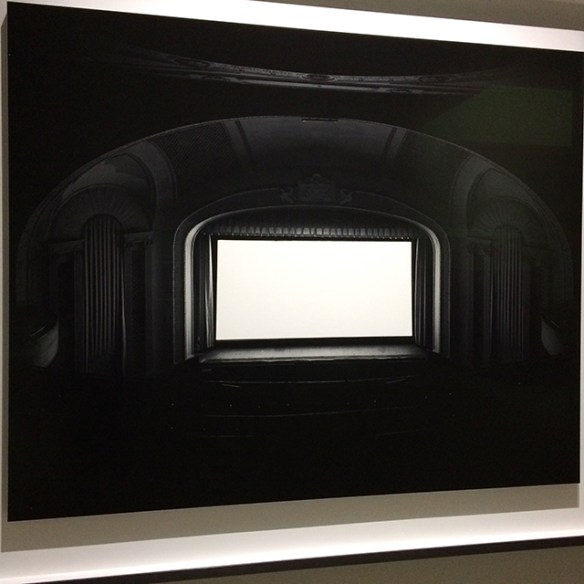
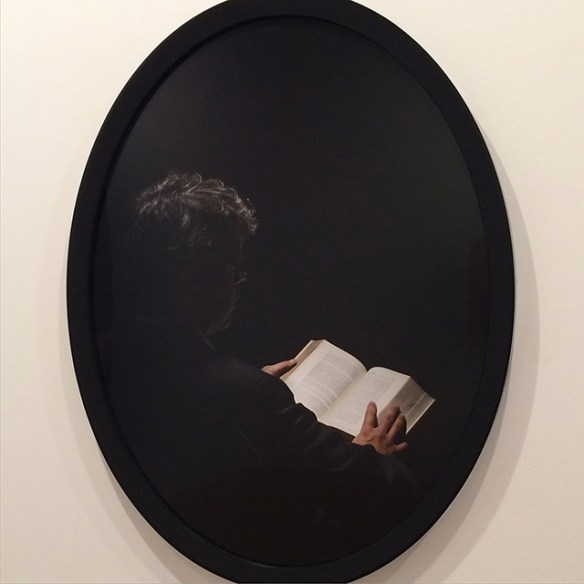
With an itinerary set out, then, for the arrival at each gallery shortly after their respective opening times, the run is under way. First stop is White Cube. Haim Steinbeck has made elaborate shelves that look almost like triangular plinths. He has then arranged objects on them and in many cases even embedded the objects into smaller triangular plinths that nestle into the larger ones, fitting snuggly due to their precision of craftsmanship. The press release claims that these resting and embedded objects evoke nebulous associations reminiscent of how words function in a sentence. As a witty addition to this worthy aim, the current show uses surfboard fins in a variety of different coloured plastics. They have been flipped over whence they resemble the fins of sharks, the bane of any surfer, and function as a cipher for the commodified terror that has permeated our popular culture with films like Jaws. Elsewhere and with the clock confidently past 10am Marian Goodman gallery is hosting Hiroshi Sugimoto. This artist has photographed movie theatres and music halls incorporating a white projector screen as both focal point and also sole light source. Appearing as brightly lit, white rectangles these screens have in fact acquired the illusion of being white through the conjunction of the flickering forms of an actual movie and the long exposure of the artist’s photograph.

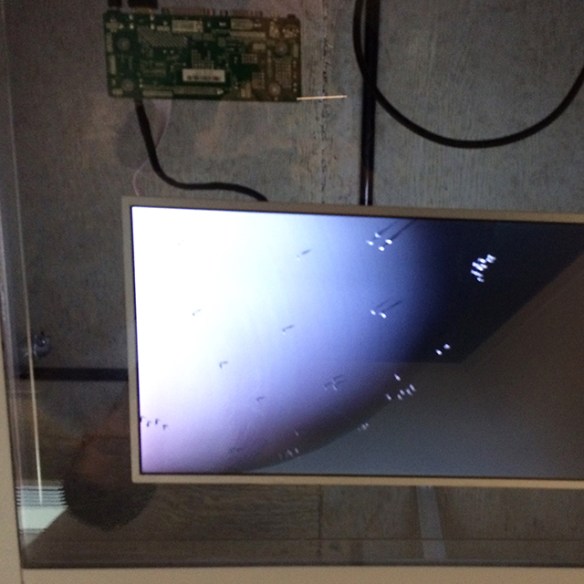
As the clock strikes 12 noon, Mother’s Tank station seems to be strangely elusive. The SatNav dot is directly above my location and then a glance upwards reveals the viaduct that straddles Farringdon road and which defines the upper level of the City’s geography at this point upon which Mother’s Tankstation is also situated. Yuri Pattison has excavated into the fixtures and fittings of the gallery’s temporary space and created small cavities. A square ceiling panel is casually pushed to one side whilst on the floor, tiny traces of carpet adhesive accompany the occasional excavations downwards. Circuit boards and computer screens populate this strange part-hidden world and on these circuit boards, which are fully functioning, software creates migrating crowds of tiny figures which interact with each other and even, as the gallery assistant tells us, commit a few murders.

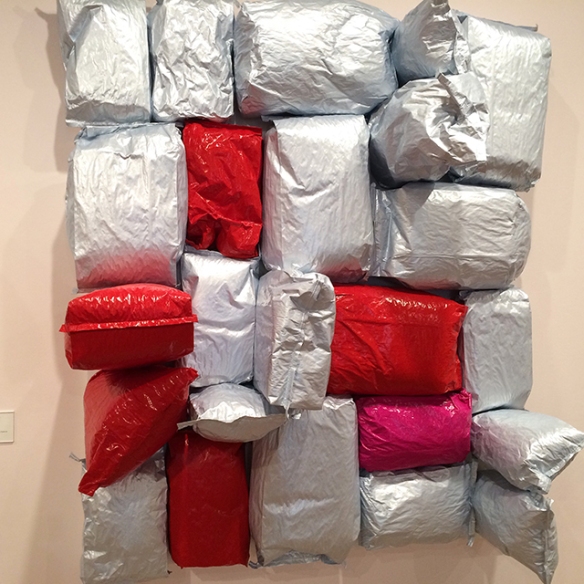
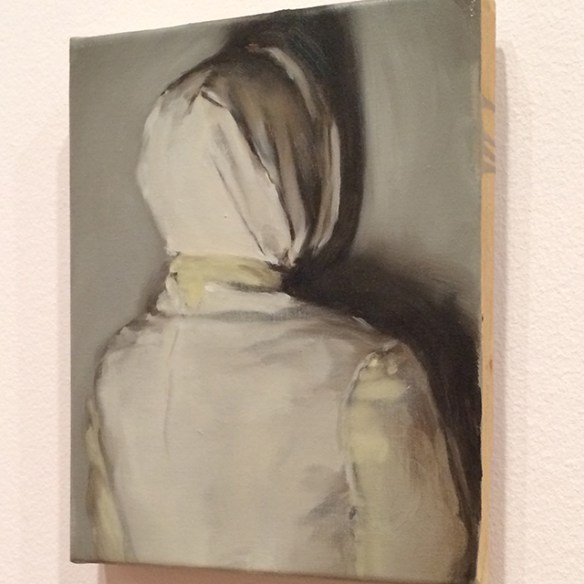
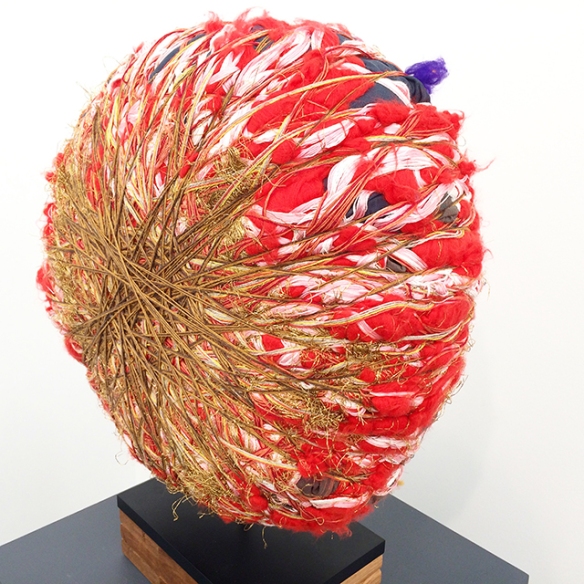
Finally, at Whitechapel Gallery a small show of previously stored artworks is enjoying a rare exposure to the public. Michael Borreman’s hoodie portrait is stunning whilst Jim Lambie’s red and and silver bags is equally impressive . It is assembled, one assumes, into some sort of soul, since the secondary theme of this show is portraiture. Lambie’s piece actually evokes the feeling that it has been seen before which either means that this is the case or, more impressively perhaps, that it hasn’t been seen before, since this after all is the remit of the show, and that instead it has acquired its sense of familiarity by actually tapping into some sort of fundamental truth which simply makes it seem familiar.

891
Black swan and white swan in St. James’ Park.

892
Haim Steinbach of White Cube with wall mounted arrangements of objects that create associations like sentences.

893
Hiroshi Sugimoto at Marian Goodman Gallery with photos of old cinemas. The artist has used long exposures whilst a film plays in the cinema he is photographing, causing the cinema screen to appear white.

894
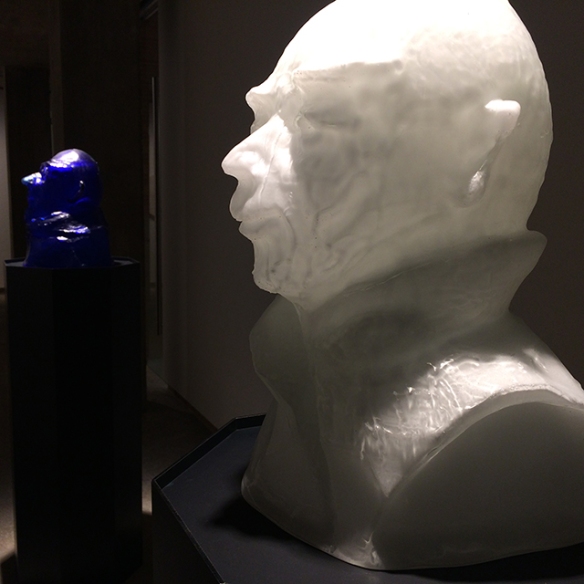
Thomas Schutte of Frith Street Gallery with glass busts blown in the Murano workshops of Venice.

895
Catherine Opie of Thomas Dane Gallery with intimate photographic portraits.

896
Yuri Pattison of Mother’s Tank Station with computer screen imbedded in the gallery ceiling which is showing crowds of small figures. These are generated by a computer programme and can be observed acting in certain ways and with certain objectives.

897
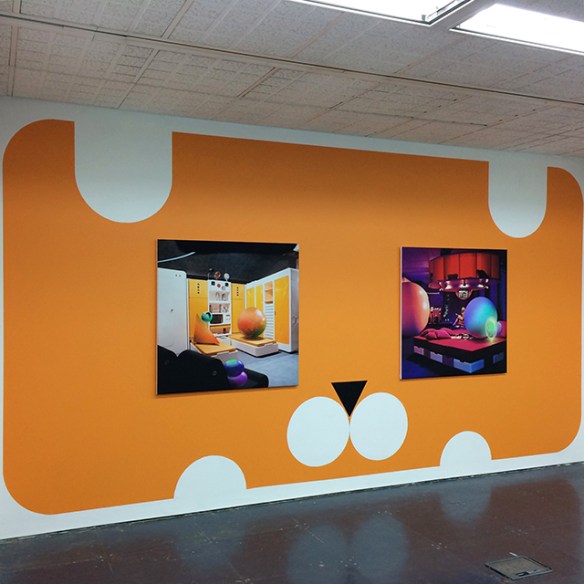
Ad Minoliti at Project Native Informant with an installation of painted wall and two inkjet reproduced images.

898
Jim Lambie of Sadie Coles HQ at Whitechapel Gallery.

899
Michael Borremans of David Zwirner with a typical hidden face painting, at Whitechapel Gallery.

Gallery run 3rd November

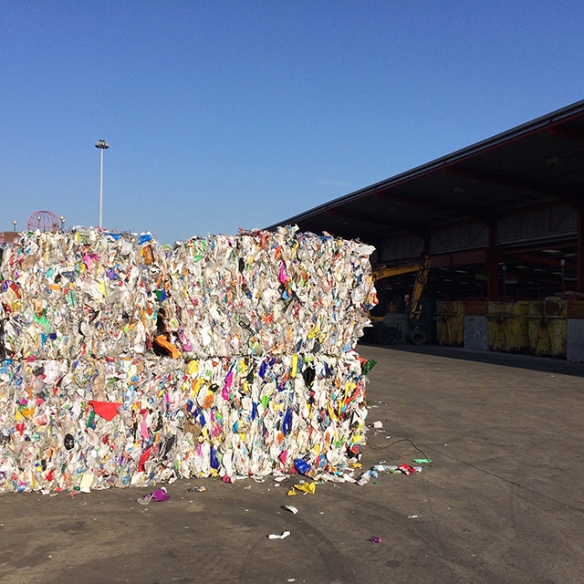
Bright sunshine is taking the chill out of the air this morning. The sun is behind me making the jog out west along the River Thames towards Wandsworth particularly radiant. Several bridges intersect this stretch of river before one arrives at the Wandsworth recycling centre, a first base on this run and site of an excellent bacon sandwich van. The owner has been trading since before dawn, she says, despite the hour gained from changing clocks. The recycling centre itself seemingly provides much of the business as visibility tops file down the narrow pavement before placing their breakfast orders. With bacon sandwich in hand the first photo opportunity of the day presents itself, a beautifully packed wall of recycled plastic, with the sun’s rays making the different colours sparkle like jewels.

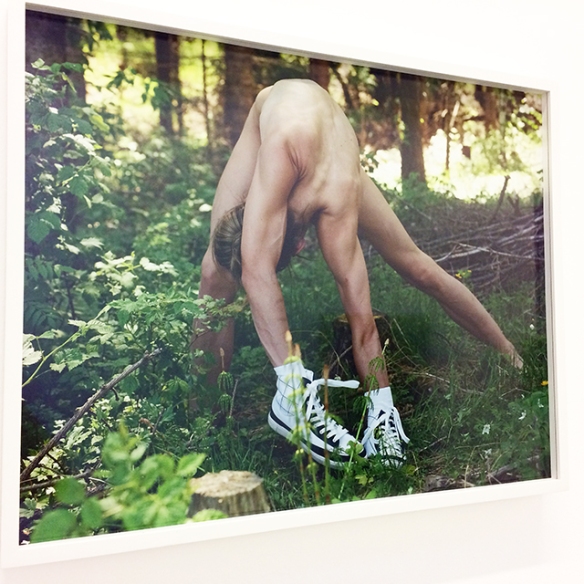
Across the river, the Serpentine Galleries are showing an upcoming American artist called Wade Guyton. He specialises in digital imaging and printing processes but adds a painterly twist by incorporating drips and dislocations into their forms with a joyful array of “mistakes”. These are either accidental or intentionally orchestrated, but either way are very effective in upsetting the order of the original image. In the other gallery Torbjorn Rodland has produced uncanny photographs that incorporate familiar objects such as shoes, food and figures. All of these compositions have been disturbed in some way. A man appears to have thrust his legs in front of his head, with the consensus being that he has performed some extreme yoga pose. But then there is the realisation that what seemed like legs are actually arms, since the performer has had shoes placed on his hands, and his head merely nestles slightly uncomfortably behind one of his arms.

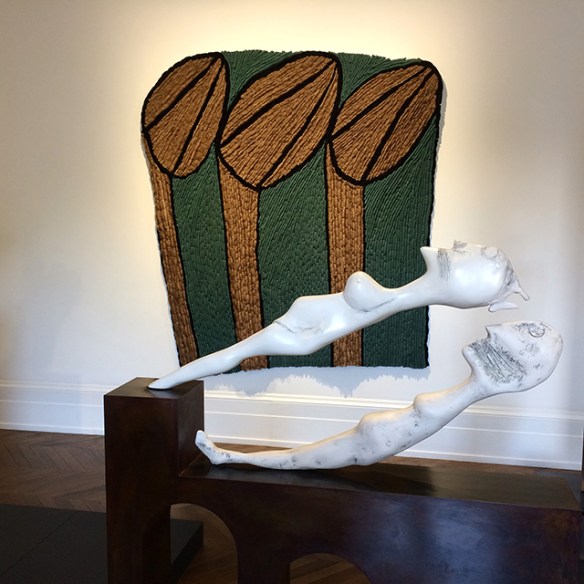
The short run through Hyde Park then leads to Upper Brook Street where Michael Werner is showing Enrico David, a sculptor who was at St Martin’s College at the same time as myself. On this account there is added interest for me. The white sculpted figures with their strange and ornate metal attachments, provide a powerful spectacle to the viewer but also remind me of the artist’s distinctive style clearly evident as a student at college. At Timothy Taylor gallery, a few streets away in Carlos Place, Alex Katz is showing paintings of woodland alongside sculpted portraits and drawings. The woodland paintings, in particular, reveal the artist’s vitality as paint streaks across the canvas in broad strokes. Whole tree trunks are rendered in single swipes while additional twigs are depicted with the same economy as the trunks and appear to twitch like the whiskers of a living animal.

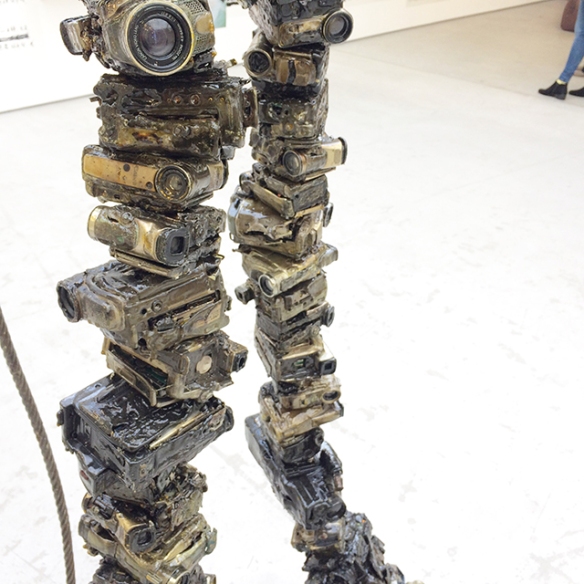
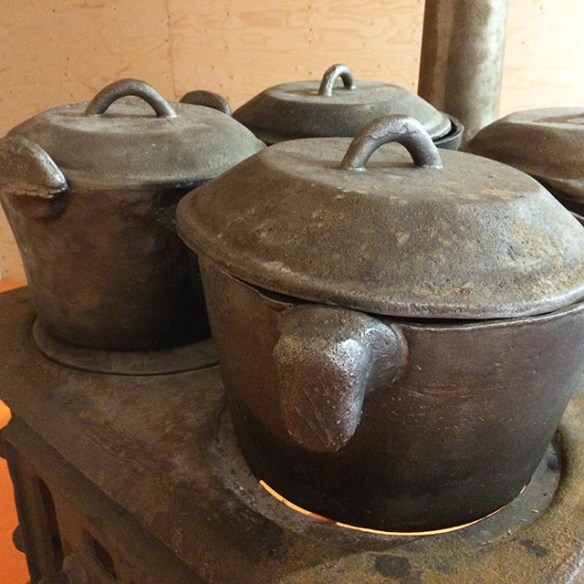
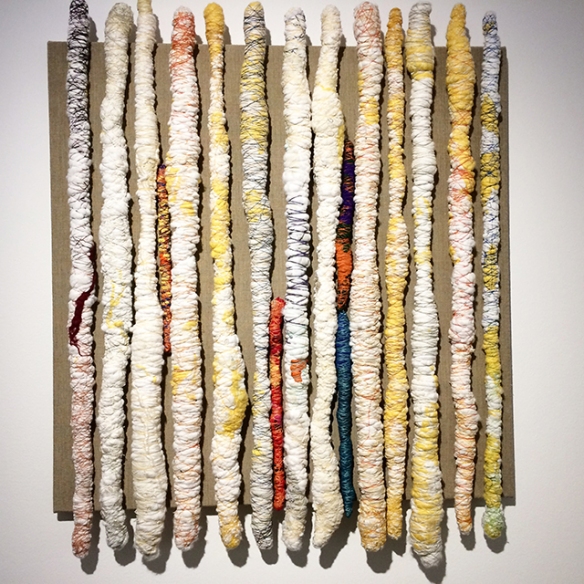
As the sun comes round to the south in the early afternoon there are just three remaining stops to complete, but surprises will await at each of these. At Sadie Coles HQ there is a group show of Eastern, non-European artists. Of this interesting selection, Xu Qu, who is normally represented by Almine Rech gallery, has produced a striking garland of video cameras, which are all threaded onto a thick steel cable. Then round the corner at Pilar Corrias, Rirkrit Tiravanija has filmed the making of a feast cooked in ritual fashion on a giant, cast iron stove. Though traditional in its design, the welding and cast iron of the stove reveal that this object was in fact specially made for the occasion and furthermore that the utilitarian knobs and handles are all scaled up from a smaller original design. They are now barely practical in their new setting and as such take on the mantle of art object. Lastly, and as our finale for the day, Alison Jacques gallery is showing Sheila Hicks’ fantastic, woven, wool pieces. Some of these intricate structures have been mounted on a canvas support, further challenging the viewer’s preconceptions that a difference exists between craft object and artwork.

881
Wandsworth Recycling Centre.

882
Wade Guyton at Serpentine Gallery with ink jet accidents and images that have a painting quality to them including this illusory effect of depth.

883
Torbjorn Rodland at Serpentine Gallery. The shoes create the illusion of a strange contorting posture at first.

884
Enrico David of Michael Werner.

885
Alex Katz of Timothy Taylor with intense images applied in thin washes of paint.

886
Xu Qu at Sadie Coles HQ with a giant video camera garland on metal cable.

887
Rirkrit Tiravanija of Pilar Corrias with a cast over-sized stove and enlarged saucepans which were used to prepare a feast.

888
Sheila Hicks of Alison Jacques Gallery with fabric structures attached to a standard canvas.

889
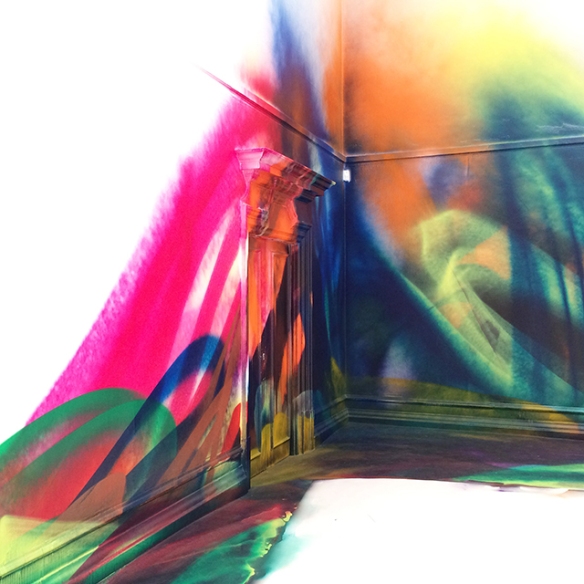
Katharina Grosse at South London Gallery with spray paint that looks like draped fabrics.

Gallery run 27th October

The main feature of today’s run is the exceptionally long and attractive stretch between Camden Arts Centre in the west and The Approach Gallery in the east of London. Over half of this journey is off-road.

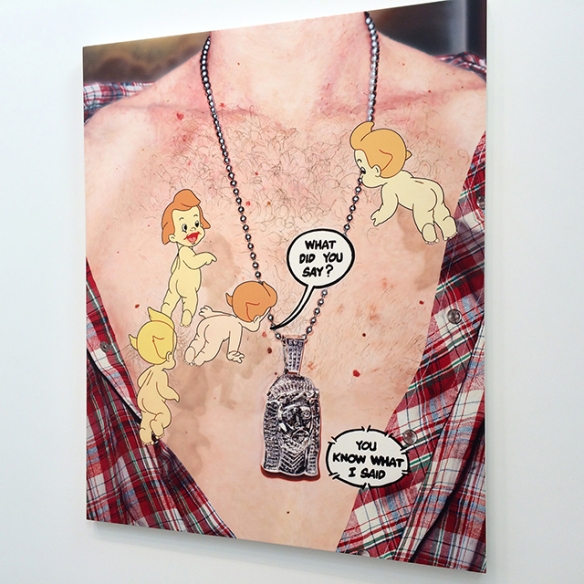
Rewind two hours and I am in Newport Street Gallery at Damien Hirst’s fifth show since opening the showcase space for his own collection. Like Jeff Koons from an earlier show Dan Colen, along with Hirst himself, are all on the books of Gagosian. Without really following the logic of an argument, this simple association suggests maybe there is some swapping of priceless art pieces between these giants of the contemporary scene. Colen is included in this accolade because he is a rising star and his limited edition of glass bottle and glass cig butts on sale at the entrance for £1600 looks good value on this account. Colen’s works are summarised as essentially self-portraits, by the blurb, and that seems right. For as well as the photo-realist self portrait with its cartoon-like addition, featured, the sculptural works all involve an activity by the artist, be it sticking chewing gum to a canvas or collecting rubbish from New York’s streets and then turning it into improvised paint brushes.

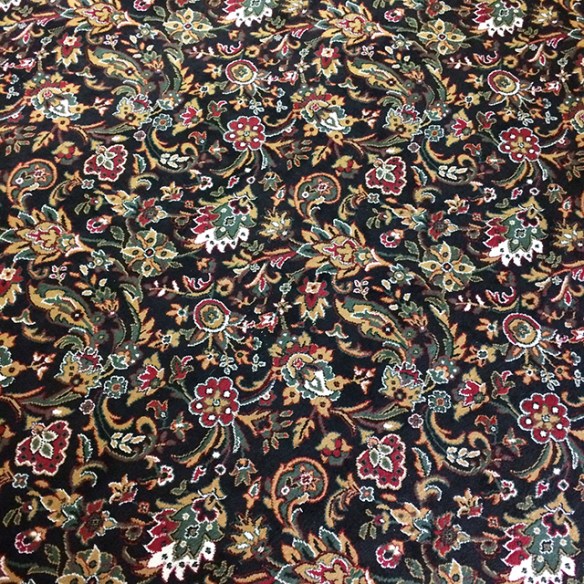
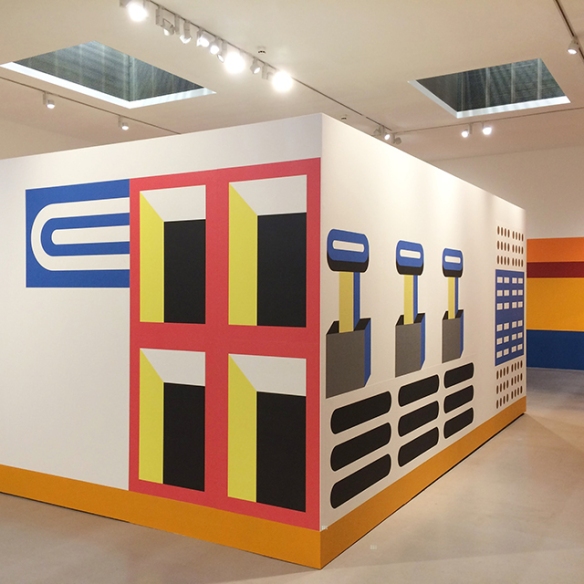
The run north is a long one and features the Zabludowicz collection and the elegant pub-style carpet by Rebecca Ackroyd, before arriving at Camden Arts Centre. Language is a feature of Christian Nyampeta’s show. Some words, he argues, such as philosophy cannot be translated easily into his native tongue of Rwanda. Far from being a deficiency of his country’s languages it is almost the opposite. Western thought has ignored an important concept, which he refers to as “Being”, or more specifically “good will to fellow humans”. In contrast, words from his own culture, he argues, carry these additional connotations as part of their overall meanings. In the other gallery Nathelie Du Pasquier continues her foray into the London consciousness after having recently shown at Pace, and in this gallery she has made a brightly coloured installation suggestive of industrialisation through the tripling of her motifs which is reminiscent of the three phase power supply that remains segregated from generator to power line to factory.
The intermission referred to at the beginning, the long run between west and east, begins with Hampstead Heath. The hard-won altitude gained at Hampstead is quickly surrendered as one approaches the three ponds and with Highgate church now looming above, it is this ascent that will then provide the fantastic views across London before one enters the trees and scrubland of Parkland walk. As mentioned in previous runs, Parkland Walk is a disused railway line and thankfully today it is on a downwards gradient and, with its array of bridges over low roads and ornate arches under the higher ones, one that is remarkably constant in its gradual descent.

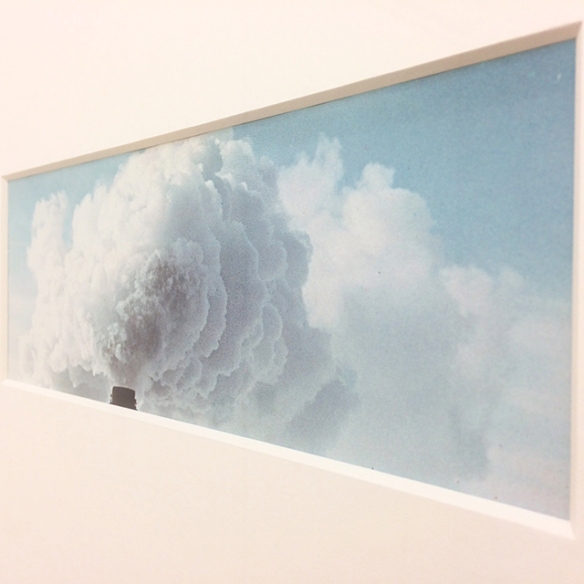
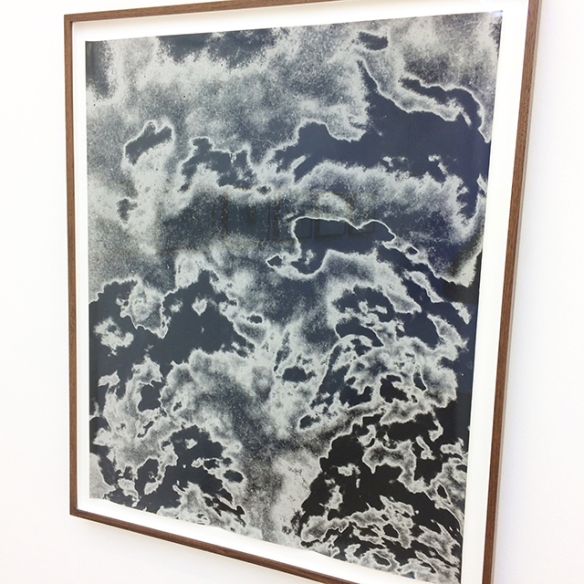
In the east, three artists are showing at The Approach gallery, whilst outside the downstairs pub police-style tape causes momentary alarm as it surrounds the railings of the outer seating space, before revealing its joke on closer inspection, as a Halloween prop and not the site of major incident. Artworks feature motorways and smoke from three of the gallery’s strong list of regulars.

Nearby, the building formally inhabited by Wilkinson gallery has been taken over by Stuart Shave. Josh Kline has cast familiar objects in concrete and then smashed them up slightly, whilst other objects have been cut in half with some extremely effective cutting tool. Having achieved the precision of a smooth cut through the variety of materials making up consumer objects, the plastic of a knob and the steel of a fascia, the artist has then taped together two incongruous halves. A twin of different shape but similar function ensures that this part of the process looks impromptu and scruffy like some final ironic comment about the objects and perhaps also about the process of making art.

871
Dan Colen represented by Gagosian showing at Newport Street Gallery. Beautifully painted and a witty dialogue between cherub and a rather austere looking silver medallion.

872
Rebecca Ackroyd at Zabludowicz Collection with a carpet design that explores Britishness referencing, in particular, the pub carpet.

873
Christian Nyampeta at Camden Arts Centre with an installation and video work that explores the problem of translating western concepts such as philosophy into the language of the Rwandan people.

874
Nathalie Du Pasquier at Camden Arts Centre with bold images using isometric drawing, a graphic technique that doesn’t rely on perspective.

875
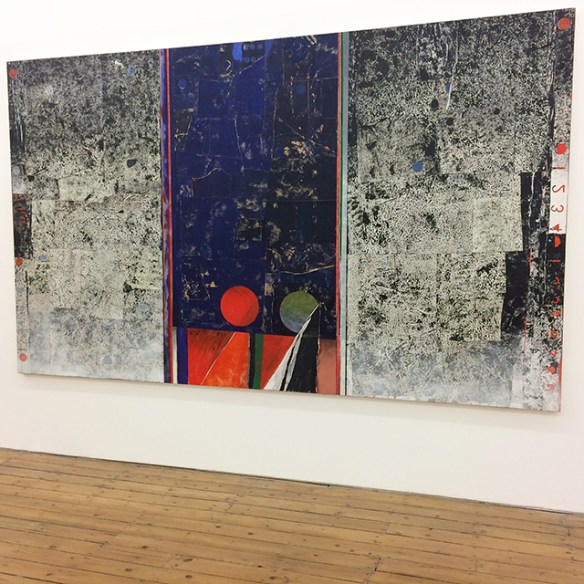
Sam Windett of The Approach with paintings incorporating collage based around the themes of roads and driving.

876
John Stezaker of The Approach with pictures of smoke without its cause, in other words heavily cropped chimneys.

877
Lisa Oppenheim of The Approach with solarised smoke photographs.

878
Josh Kline at Stuart Shave Modern Art with cut up and reassembled objects.

879
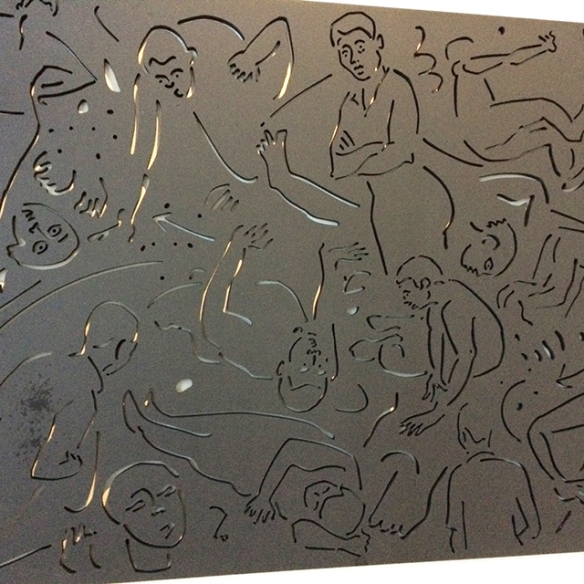
Tim Rollins and KOS of Maureen Paley with drawn-on texts.

Gallery run 20th October

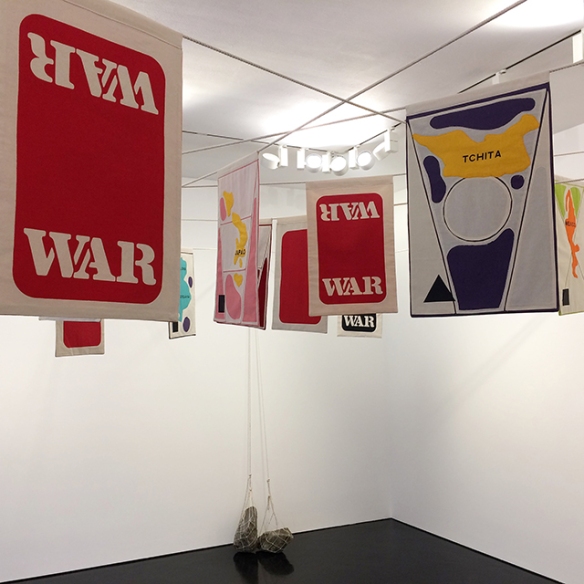
At Stephen Friedman Gallery Rivane Nauenschwander has produced an installation based on the Brazilian version of the board game known in the UK as risk. Flags represent the individual countries that the players would normally roll dice for in their pursuit of world domination. Long all-nighters with friends playing this game have imbued this artwork with a particular aura for me. Round the corner in Grafton Street Sprueth Magers have been doing a refit to their gallery. It looks very slick and the formerly creaking floorboards have now been lovingly preserved and firmly secured. Gary Hume has experimented with gloss paint on paper and the effect is very interesting. The painted surface takes on a mottled form due to the paper support yielding in some way to the gloss, yet it still looks as though it has the solidity of a worked and beaten metal support.

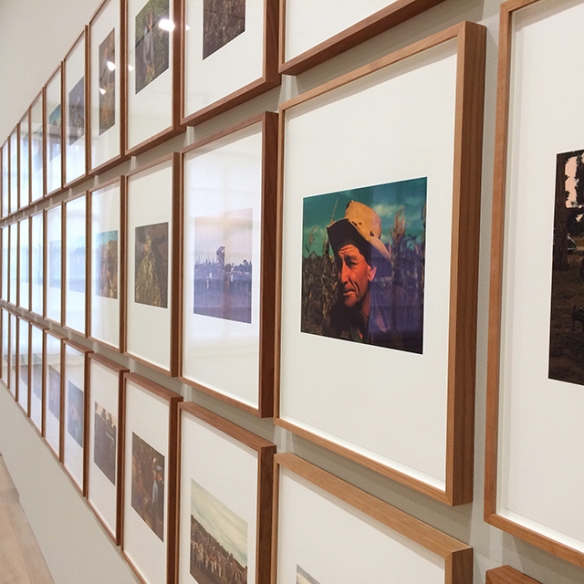
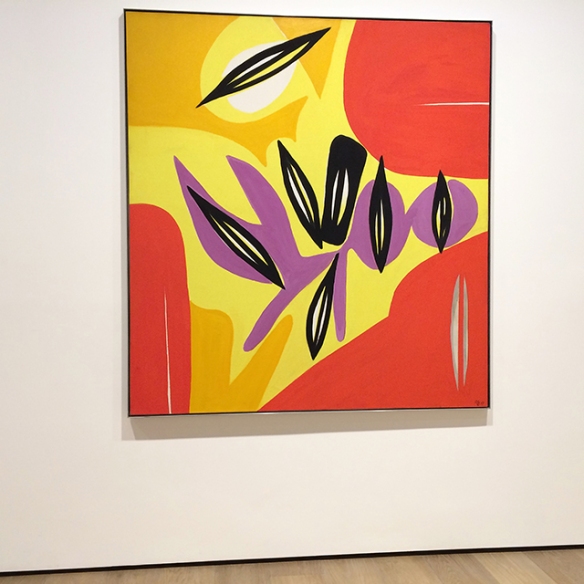
Further down Grafton Street at David Zwirner, Sherrie Levine is displaying work made by re-photographing some iconic images made in a 1940 project to document rural American life during The Great Depression. The display itself is striking with about 50 images hung in a perfect grid on the gallery wall. After visiting this hub of three closely placed galleries the next stop is Grosvenor Hill where Almine Rech and Gagosian have created a new hub comprising two expansive white spaces. The former gallery is showing Ernst Wilhelm Nay. The abstract paintings are reminiscent of seeds and foliage yet they are not restricted to this interpretation. This ambiguity lends them an additional magic which also complements their perfect balance of colour.

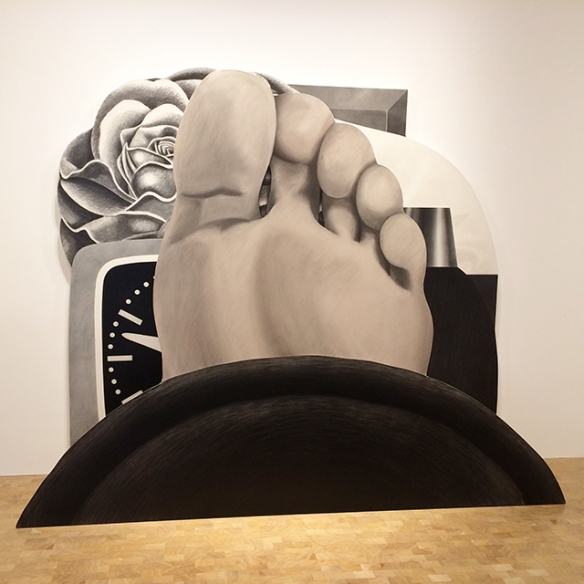
The word is out that Almine Rech and Gagosian have teamed up with the estate of Tom Wesselmann. Both galleries have produced identical press releases describing the artist’s shaped canvases that predominate in his series of bedroom paintings. Various bedside objects such as clocks and designer lamps interweave the limbs, feet and hands that the artist has sketched and then blown up into full size paintings. In the Gagosian on Davies Street a subtle black and white maquette of two painted boards placed in front of one another simulate the two ends of a bed. A large pair of elegant feet obscure the rest of a body whilst the lamp peers out from further behind. This completes the Mayfair region for today and now it is time to embark on the old favourite route along the Regent’s canal whereupon one arrives at the gas storage frameworks that offer a familiar landmark for Hackney.

Two of the new galleries exhibiting at Frieze this year are Campoli Presti and Hales gallery, whilst a new artist has been taken on at Herald Street, called Jessi Reaves. These additions offer the chance to see three new artists in this region of the city which is really the birthing place for new talent and with its exceptionally high rate of Turner Prize nominations is also sustainable in its own right with no need to interact with or be fostered by the Mayfair galleries to the west. Jessi Reaves is an American artist and hence of international importance, who makes sculptures from old furniture. The assistant in the gallery invites me to sit down on the rebuilt comfy chairs and this highlights the critical space that the work operates in, being utilitarian in some respects but stripped of any designer chic. Concluding this exploration after a quick stop at Beigal Bake is a visit to Hales gallery. Since its early days on Deptford High Street as a well respected gallery cafe, it has now become important internationally. Frank Bowling is one of seventeen artists on their books and he is showing colourful abstract paintings incorporating small objects offered up by friends, as well as cutting and sewing, which all contribute to a complex and interesting surface.

861
Rivane Neuenschwander of Stephen Friedman Gallery with an installation based on the board game risk. Each flag represents a risk territory. On the back is written “war”. This would be “risk” in the Uk version.

862
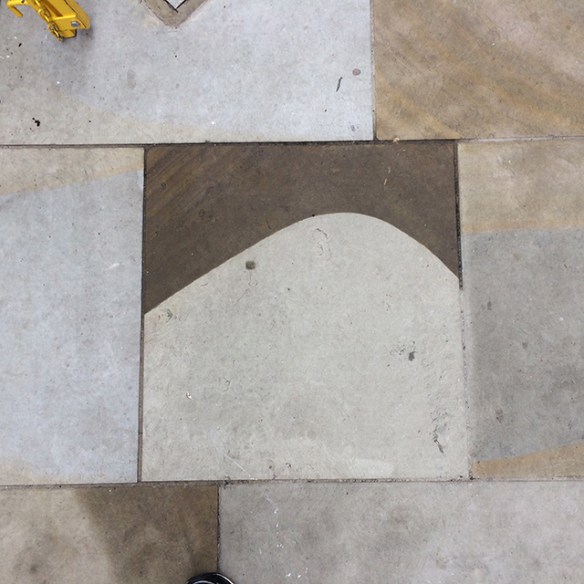
This paving slab on Grafton Street appears to be made up of two parts?

863
The gallery is open again! Gary Hume of Sprueth Magers uses his trademark gloss to produce a mottled finish on paper in his new works.

864
Sherrie Levine has rephotographed and appropriated American Depression photos of farmers by Russell Lee. What was once an attempt to boost morale when they were made in 1940 has now become historical document. Shown at David Zwirner gallery.

865
Ernst Wilhelm Nay at Almine Rech Gallery. Beautiful images with natural motifs but in bright colours.

866
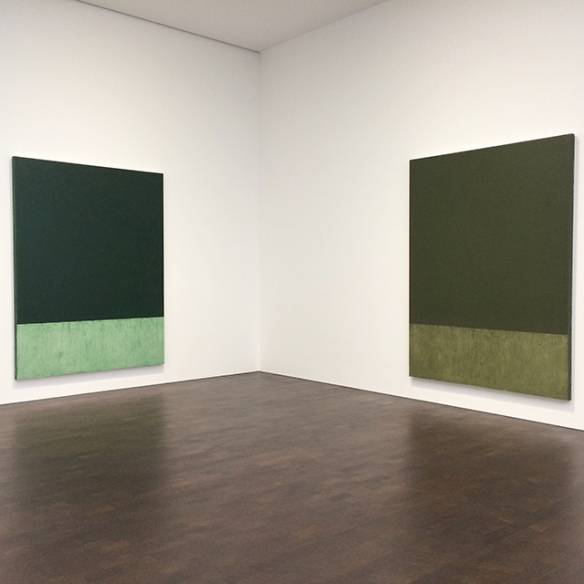
Brice Marden of Gagosian using terre verte, green earth pigment, from several well known paint suppliers, has produced 9 canvases of varying greenness.

867
Tom Wesselmann at Gagosian with Bedroom Paintings.

868
Jessi Reaves of Herald Street with sculpted furniture, cut up and reassembled.

869
Frank Bowling of Hales Gallery with abstract compositions on stitched canvases.

Gallery run 12th October

One of the most enjoyable runs is along the Regent’s Canal from Lisson Gallery to Wharf Road, where Victoria Miro and Parasol Unit are situated. Having been to neither gallery for a while there are new shows to see at each and with the addition of an exceptionally fair autumn day the planets are aligned for a good run. At Lisson Gallery, Allora and Calzadilla have installed a display that very obliquely criticises America’s policy towards Puerto Rico and other affiliated states. These states don’t get a star on the US flag and furthermore, according to the artists, suffer from the ambiguity of their legal status of being “Foreign in a Domestic Sense”. They are foreign in some respects and domestic in others but in a way that gives them generally a bad deal, as the critique continues. How could this critique be presented as an artwork?, one might wonder. Partly through drawing attention to the phrase above in its use as the show title and partly also through arguing that the work itself by a sort of mimetic response, embodies contradictory aspects in its own form. On display is a transformer plugged into a domestic power socket making a surprisingly large humming sound off what is presumably a 13 amp plug. With various bits of foliage and earth surrounding it, the electrical equipment does indeed seem to deliver this contradictory response to the viewer that the artists had hoped for. The artwork is actually rather scary to get close up to for the photograph.

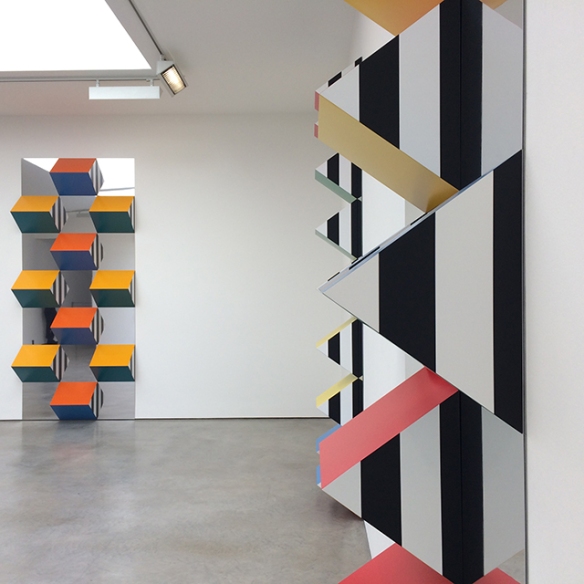
At the other gallery Daniel Buren has installed beautifully finished powder-coated, coloured modules against a mirror background. This encourages the simple conceit on my part of trying to pick up reflections from across the gallery and uniting the different modules in single camera shots. Buren’s characteristic 8.7cm vertical stripes unite all the modules together and this is a geometric feature which the press release diligently draws attention to.

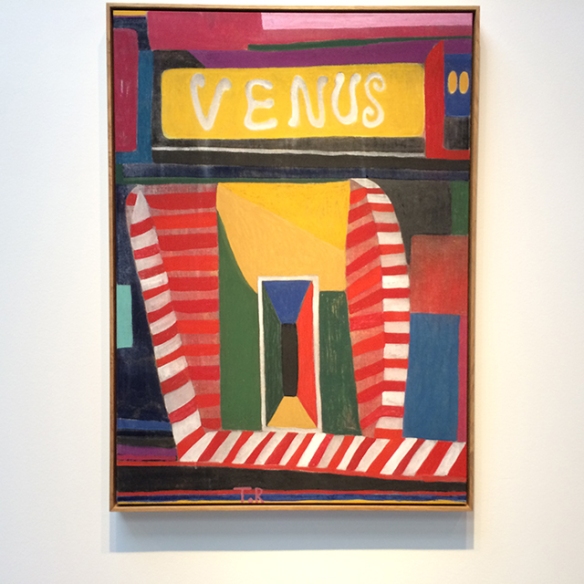
The canal is looking good today adorned by the sparkling sun and the towpath is full of walkers and cyclists. Though the canal is not a short cut, it allows the mind to switch off and soon enough one arrives at Wharf Road, 5 miles away. Tal R is showing his sex shop paintings which are a lot less explicit than they sound. Indeed it is the very barrier of the front door and plain facade of the shop that the artist likens to a physical barrier of the painted canvas. The critique continues that the canvas obscures various desires forever hinted at but unrealised through the medium of paint. The images are painted from photographs but rather than this being a negative feature in the sense that the images are only copies, the photographs add a performative aspect to the artwork. For these photographs are collected randomly by the artist’s friends and thereby remove some sense of the artist’s own taste and instead allow the subject matter to be presented as a simple phenomenon.

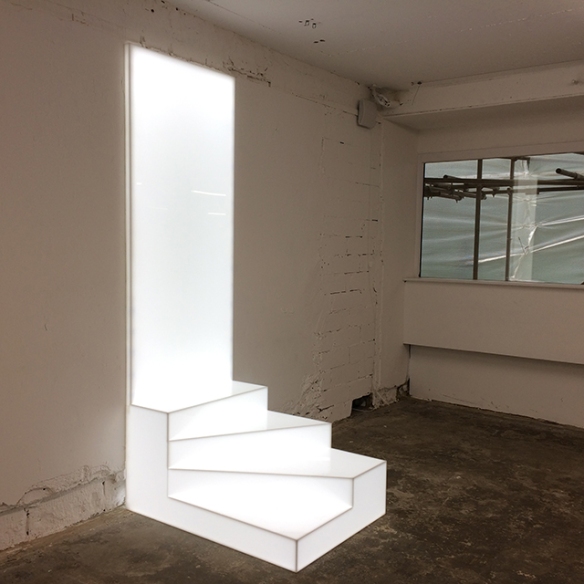
Having also seen some more great artwork at Parasol unit, the last destination is The Strand where Lisson Gallery have taken over a building. The building is scheduled for demolition and has temporarily assumed the name of Store Studios. Here the Lisson artists have executed some of their installations in this new setting and of particular note is Ryan Gander’s sculpture depicting glowing steps ascending to a rectangular doorway, which is actually a sheet of back-lit plexiglass. The effect is to suggest some transcendental ascent to those climbing those steps (but as they number only three and are built of plexiglass too, cannot be walked on) set within the shabby walls of the condemned building. With the index of Lisson artists largely addressed in this show and the earlier works from the morning further drawing from that index, the day has finished with a decidedly minimalist Lisson-like feel.

851
Daniel Buren of Lisson Gallery with wall mounted pieces based on his characteristic 8.7cm wide black and white stripes.

852
Allora and Calzadilla of Lisson Gallery. Foreign in a Domestic Sense is a legal American phrase which the artists feel is unfair to certain of its allies.

853
Regent’s Canal.

854
Tal R of Victoria Miro with his new series of paintings based on photos of sex shops, many of which were sent to him from around the world.

855
Martin Puryear at Parasol Unit with beautifully crafted sculptures.

856
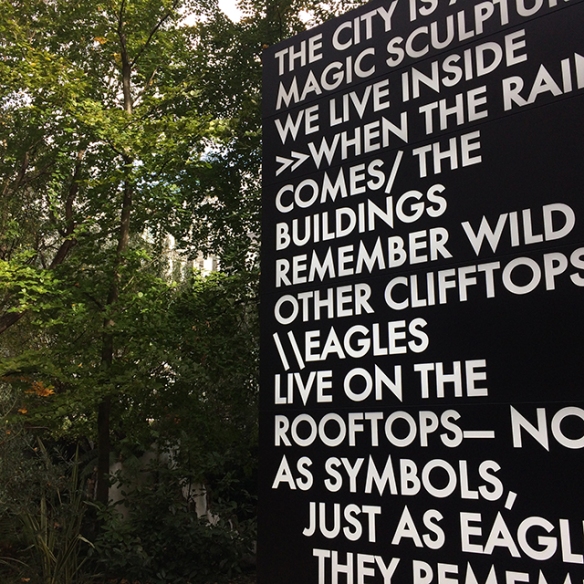
Robert Montgomery at the Parasol Unit with a large outdoor text piece.

857
Idris Kahn of Victoria Miro with delicate text-based paintings.

858
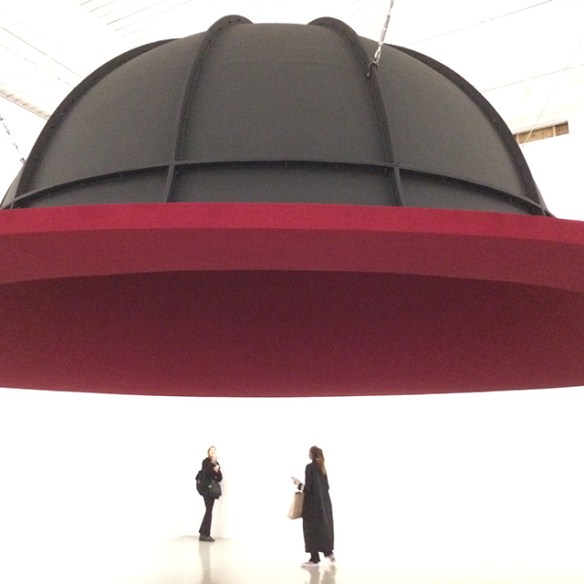
Anish Kapoor of Lisson Gallery showing at Store Studios on The Strand.

859
Ryan Gander of Lisson Gallery at Store Studios on The Strand.

Frieze week 5th October

It is Frieze week and the galleries are all together under the Regent’s Park awning. Consequently there is little opportunity for a run. However, earlier this week I am given the opportunity to run up to Alan Cristea Gallery and review the new Michael Craig Martin exhibition of prints. Prints are the speciality of this gallery. To one side of the gallery, the newest work uses an altogether new method of duplication using a laser cutting process to remove a thin black surface and reveal portions of the white under-layer. The bonus of this process is the durability of the surface and these works look striking without even needing a sheet of protecting glass.

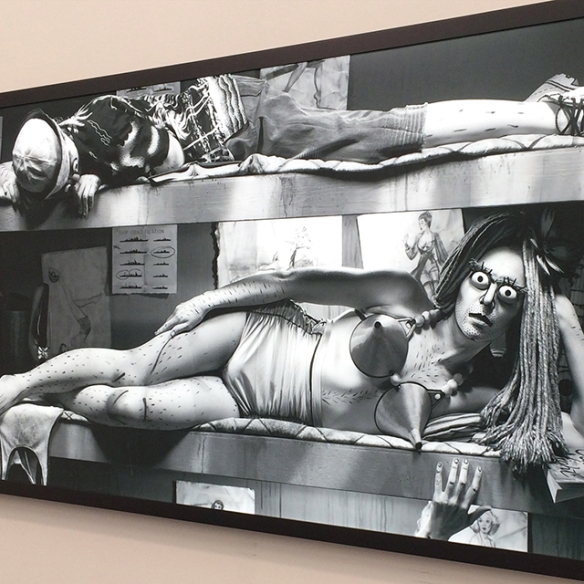
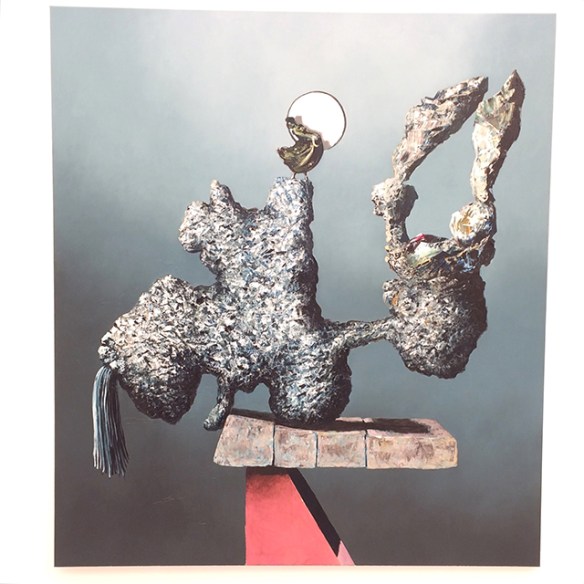
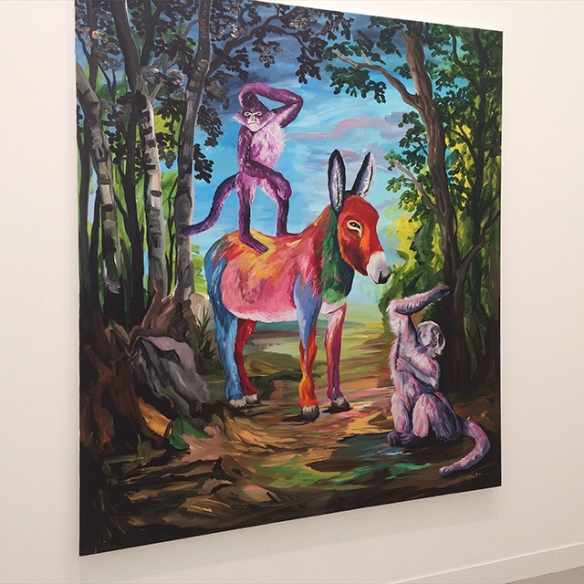
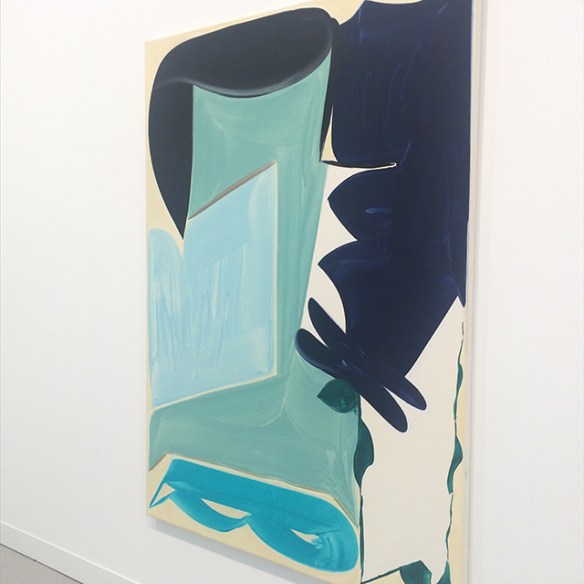
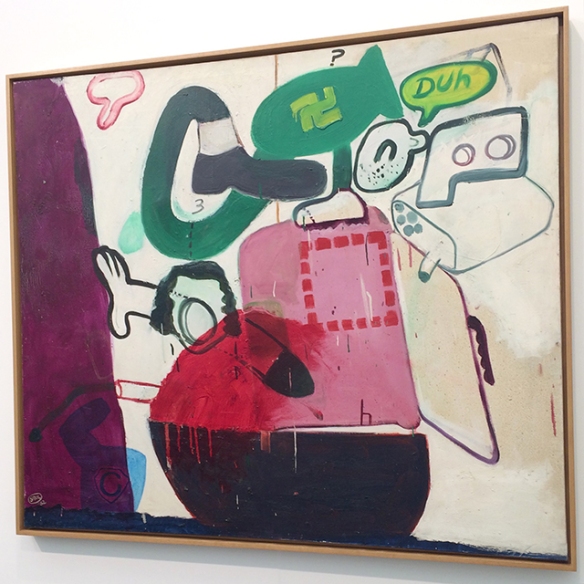
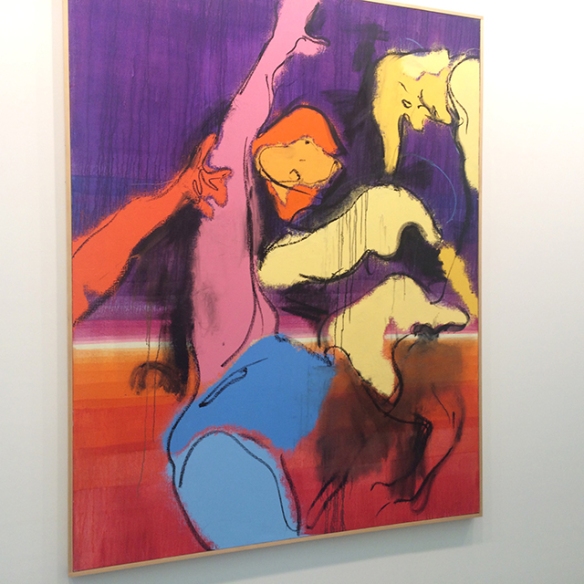
Two days later it is my chance to visit Frieze. The stand out works include some great ones by Ivan Seal, Mary Reid Kelley, Djordje Ozbolt, Patricia Treib, Sheila Hicks and Daniel Richter. A recent addition to Michael Werner Gallery called Peter Saul catches my eye in particular. It seems popular too on the Instagram feed with the most likes and as I look at the image it leaves this intense desire to produce a work of my own in a similar style. This of course will never happen. The work is great though, being a sort of dismantled figure with recognisable foot and hand emerging from some central tank-like container.

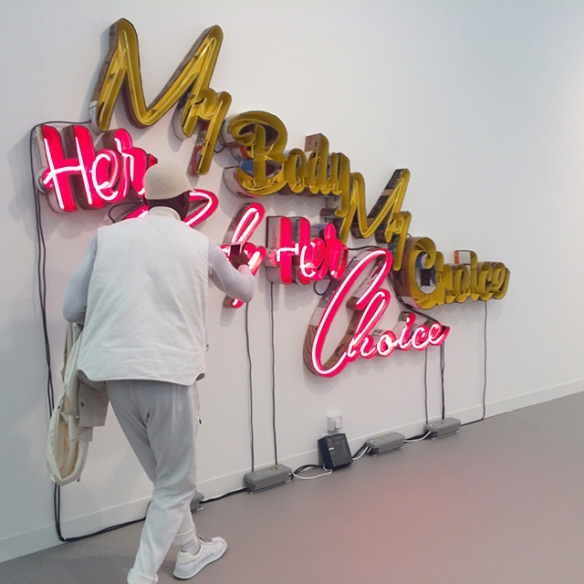
Lastly, a neon piece by Andrea Bowers is flashing away at Andrew Kreps Gallery, and since this is Frieze week, New York lies only a few seconds from London. The concourse between the neighbouring cubicles replaces the expanse of the Atlantic Ocean. A cardboard cowling surrounds the neon letters and frames their pithy slogan, but also lends to their slick form an impromptu feeling, due in part to bits of random image left on the cardboard surface. This is almost the end of Frieze experience for me, but the same evening there is a bonus of seeing a talk by the Slade professor Andrew Stahl. A mutual friend has invited us to a rather exotic venue in Mayfair, home of the Woman’s University Club, and the evening assumes a slower and more relaxed rhythm.

841
Michael Craig Martin at Alan Cristea Gallery with laser cut plastic as a medium for his new drawings.

842
Sheila Hicks of Alison Jacques Gallery at Frieze 2017.

843
Mary Reid Kelley of Pilar Corrias at Frieze 2017. Images and props from a recent film are artworks in themselves.

844
Ivan Seal of Carl Freedman Gallery at Frieze 2017.

845
Djordje Ozbolt with Herald Street at Frieze 2017.

846
Patricia Treib of Kate Macgarry at Frieze 2017.

847
Peter Saul of Michael Werner at Frieze 2017.

848
Daniel Richter with Galerie Thaddaeus Ropac at Frieze 2017.

849
Andrea Bowers at Andrew Kreps Gallery.

Gallery run 28th September

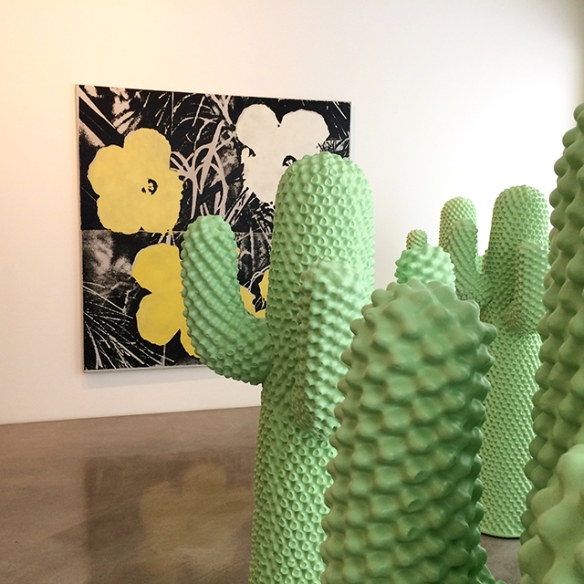
Having been invited to the lunchtime press opening at Ordovas gallery, the first stop today is at a sports shop for new trainers. A couple of invites came through in the last week and it would be nice to look smart. At the gallery an installation of cacti by luxury Italian furniture company Gufram has been set up. Around the walls is situated pop art and an Andy Warhol piece seems to fit very well into the cartoon-like space created by the cacti.

Across the street, which is Savile Row, stands the two Hauser and Wirth galleries. To the left is an installation by Marcel Broodthaers. Palms, a luxury product back in the 70’s, stand alongside some intentionally tired-looking museum display cases. This creates a pastiche of the traditional museum.

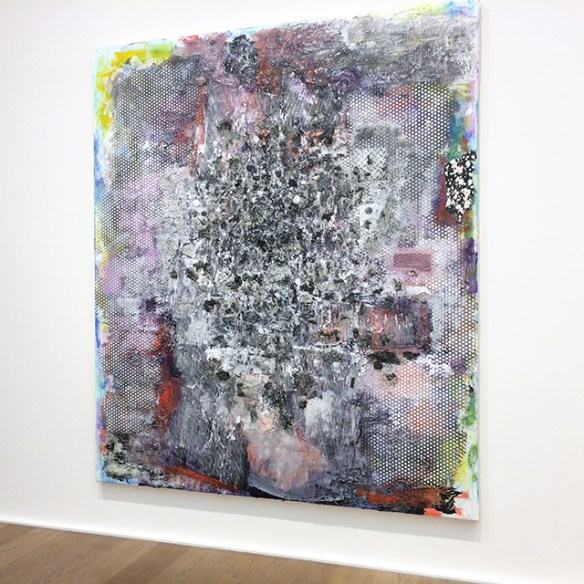
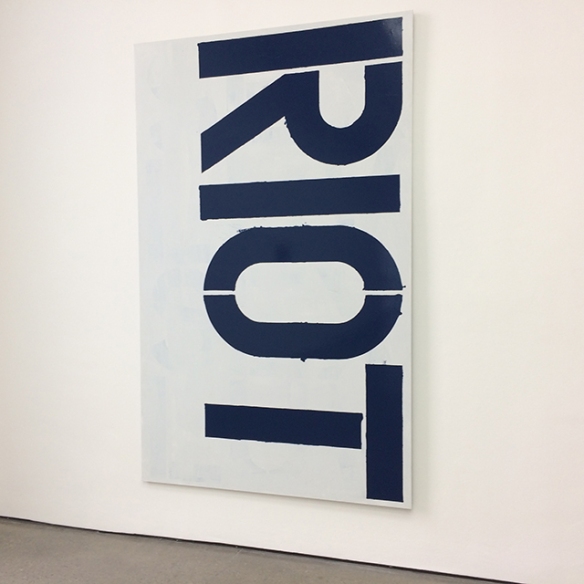
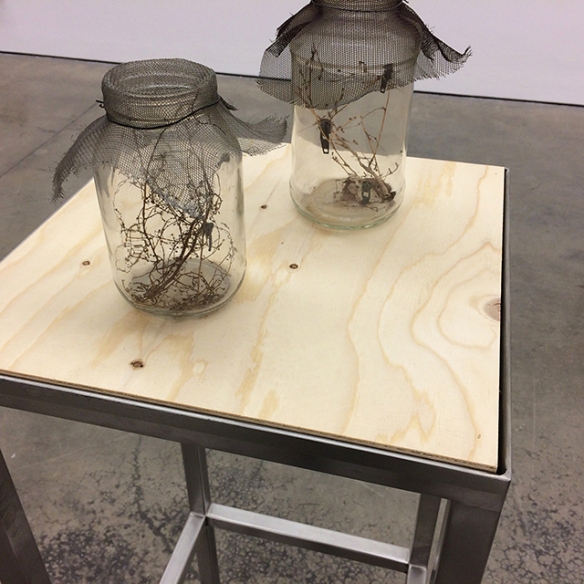
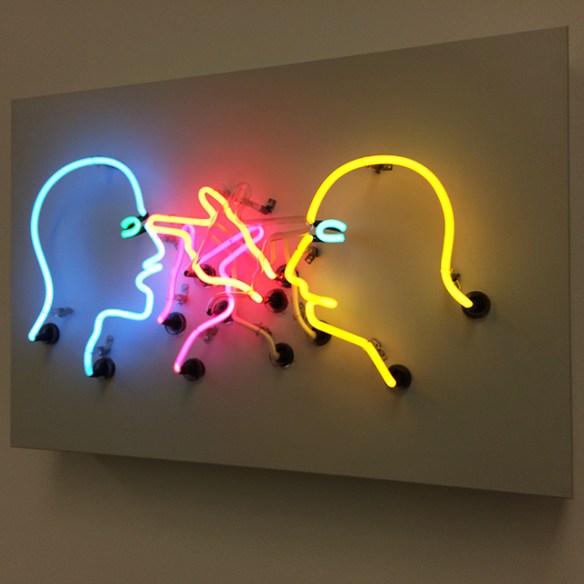
In the right hand gallery are paintings by Jack Whitten who has applied a variety of meshes and raking tools to create highly complex and varied painted surfaces. Then it is south to White Cube where America’s pop art tradition has been brought into a critical discourse by the varied artworks on display. Christoher Wool’s Riot slogan and David Hammon’s fly zippers trapped in two jars have a delightful lightness of touch. Meanwhile in this show Bruce Nauman has a neon piece depicting two people poking the other in the eye.

Further down Duke Street St. James’, Thomas Dane Gallery is playing host to Kelley Walker. This influential artist has taken branded objects, such as those by Calvin Klein, and turned them into exotic artworks. This is the first day of the show and a small group including possibly the owner are discussing the works in the gallery.

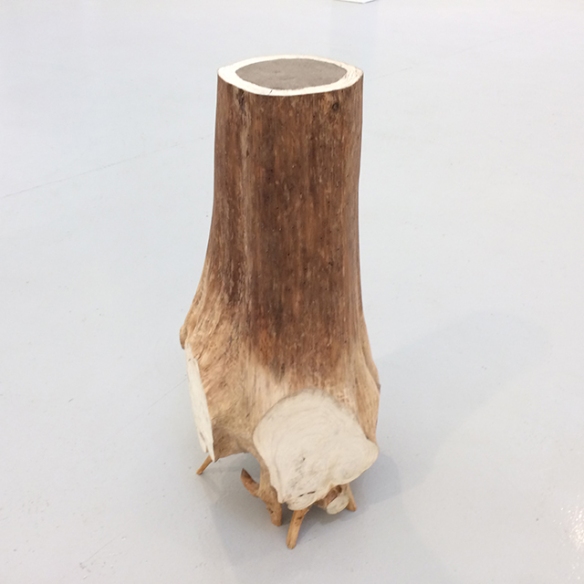
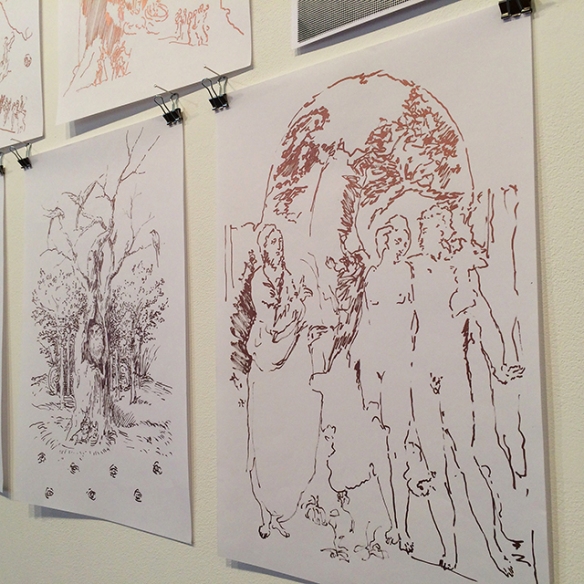
Then it is time to head south and the arrival in Kennington at Greengrassi and Corvi Mora allows me to visit the two artists being shown by these twinned galleries. The assistants at the front desk greet me and check the gallery lights are on. Juha Pekka Matias Laakkonen has developed interesting narratives from seemingly mundane objects. A tree stump has had a set of processes applied to it as though the artist were following an algorithm, but the effect is beautifully poetic and though his objects on display are small, they seem to fill the gallery with their presence. Upstairs it is the turn of Greengrassi to exhibit in the smaller space. Stefano Arienti appears to be motivated by the giants of art history spawning a set of drawings and photocopies that reference the works of Bosch and El Greco.

831
Andy Warhol presented in an imaginative installation, using fabricated cacti designed in the early 70’s by Gufram. On display at Ordovas.

832
Marcel Broodthaers at Hauser and Wirth with an installation based deliberately on an old-fashioned museum style.

833
Jack Whitten at Hauser and Wirth with abstract paintings.

834
Christopher Wool at White Cube.

835
David Hammons of White Cube in a witty piece with fly zippers trapped in jars.

836
Bruce Nauman at White Cube.

837
Kelley Walker of Thomas Dane Gallery has turned advertising images into artworks.

838
Juha Pekka Matias Laakkonen of Corvi Mora with processed objects. This tree stump was left after the tree collapsed. Then it was dug up, the roots burned and finally the stump was filled in with the resulting ashes.

839
Stefano Arienti of Greengrassi with delicate drawings and a few photocopies.

Gallery run 14th September

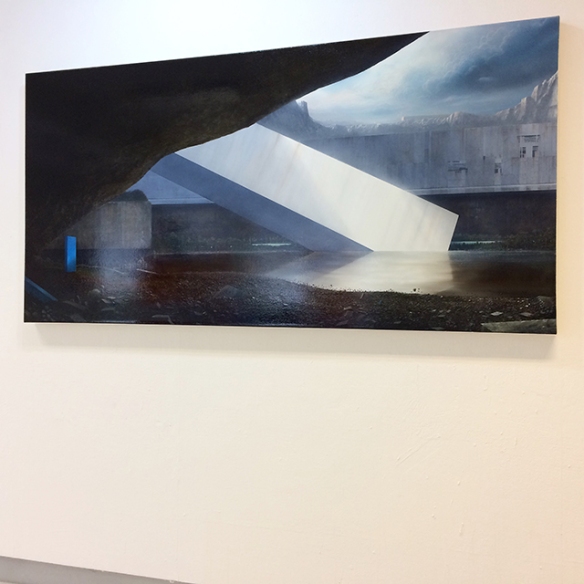
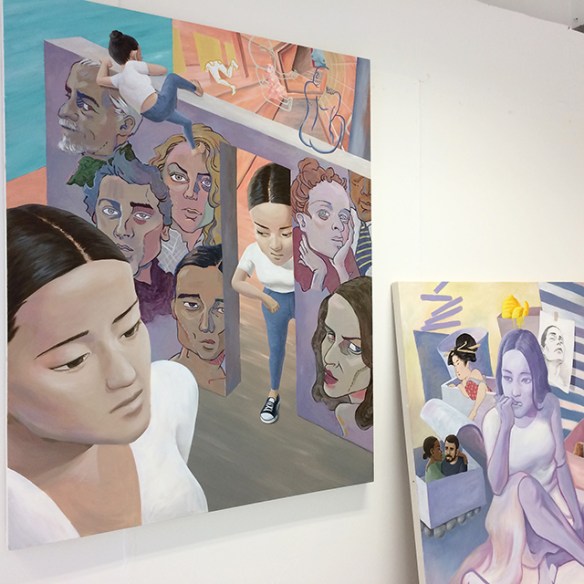
The day starts with a diversion to Clapham Junction. My partner is on a business trip abroad and has forgotten her phone. Having made the rendezvous and said a second farewell, it is only a short distance to Chelsea College. The college is located near Tate Britain and is hosting an MA fine art student show, the last of the season. Two painters on display are of particular note. Naoya Inose has produced fantastical landscapes incorporating architectural structures with enormous walls, bathed in the glow of a low sun which has simultaneously illuminated vast ranges of clouds. In contrast Mikolaos Panagiotopoulos has created a much more intimate space populated with variously wrought figures that are lifelike though suggesting in places a more cartoon-like idiom.

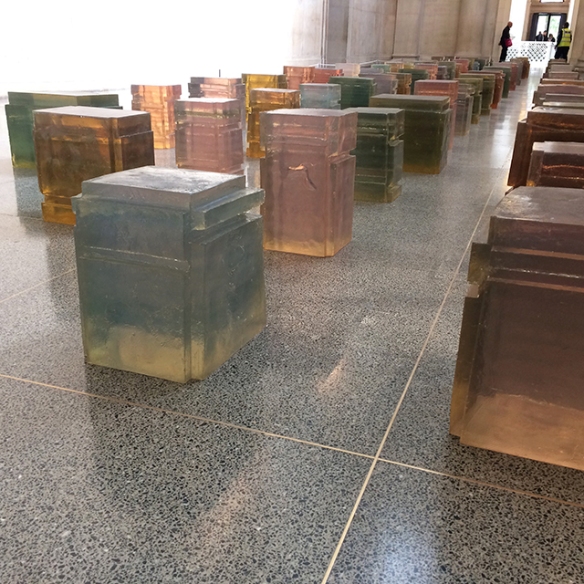
Next door the Tate has a grand retrospective of Rachel Whiteread and although it is a pay show, a large display has been installed in the Duveen Galleries, the enormous central space reserved primarily for sculpture. The pastel lozenges, which the sculptor has cast from coloured resin, bare the imprints of legs and chair bottoms and suggest that these are solid embodiments of the empty spaces beneath seats. A moment of reflection on the nature of chairs follows before noticing too, the glow of light that is trapped and preserved in the resin forms, the source being the sun of course, which is wending its way round the skylights above the gallery.

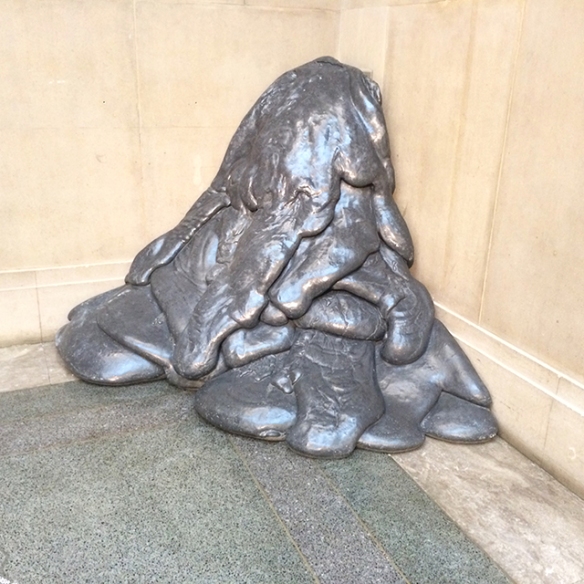
Close by in this central space, Lynda Benglis has produced what looks like a pile of molten metal cast into a generic corner. This pile finds its particular fit amongst the London stone of Tate Britain flanked by occasional classical columns.

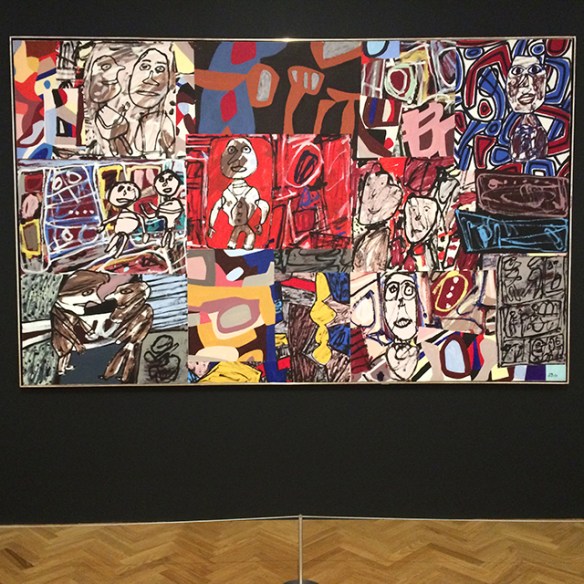
Then it is a short jog through St James’ Park to Pace Gallery where Jean Debuffet’s late collage works are on display from a private collection. They demonstrate a striking use of juxtaposition as hundreds of drawings appear to have sought each other out as though by a natural force and collected into several perfectly ordered groups. Each framed cluster is rich in narrative through its varied fragments, but yet is unified through similarities of colour, theme and other parameters far too subtle to even put into words.

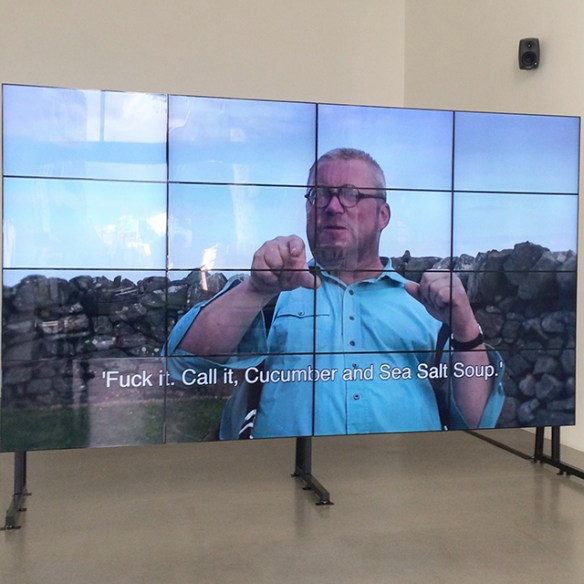
Finally at Sadie Coles HQ, TJ Wilcox has produced three films using an interview style done with great sensitivity. The restauranteur Fergus Henderson describes the joys of food with engaging anecdotes and slowly one becomes aware too, through the direct and honest replies, about the interviewee’s illness and treatment for Parkinson’s disease. Though the speech is sometimes hard to follow, necessitating subtitles, the interview is full of life. I stand there for a full twenty minutes simply enjoying the story, the images and the slow revelation of someone’s fascinating life.

821
Naoya Inose at Chelsea MA Fine Art, with great landscapes.

822
Mikolaos Panagiotopoulos at Chelsea MA Fine Art with elegantly combined images of figures.

823
Rachel Whiteread of Gagosian Gallery on show at Tate Britain.

824
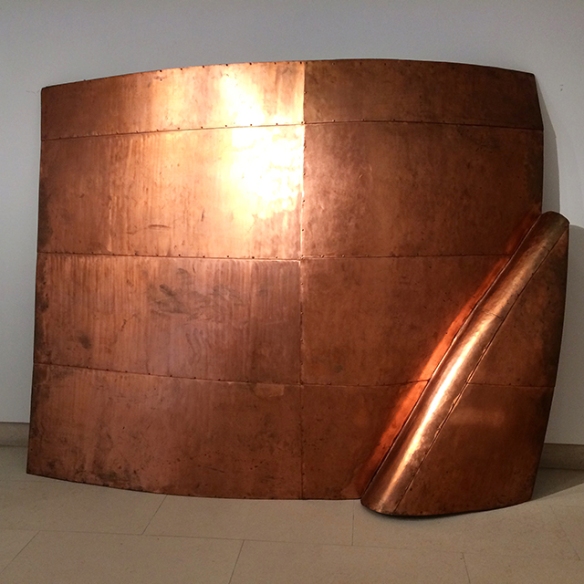
Lynda Benglis of Thomas Dane Gallery with a piece on show at Tate Britain.

825
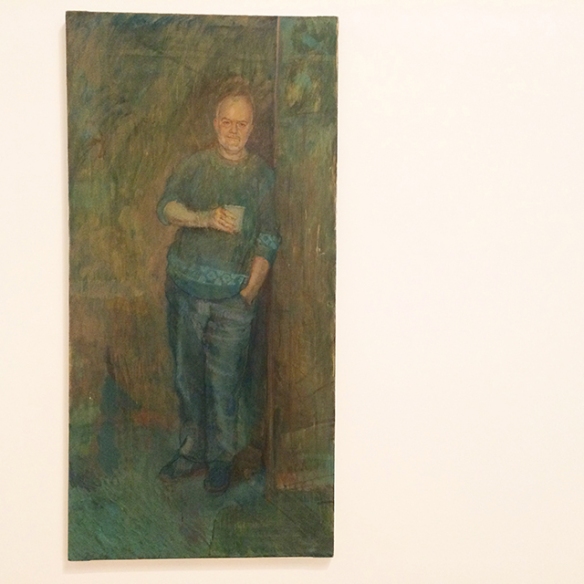
Michael Fullerton of Carl Freedman Gallery with a portrait of John Peel in Tate Britain.

826
Jean Dubuffet at Pace London with images built up from drawings collages onto the canvas.

827
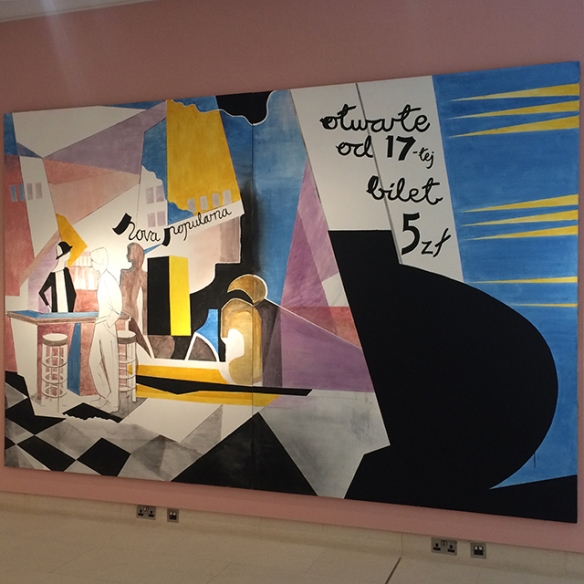
Lucy McKenzie and Paulina Olowska with a striking piece up for auction.

828
Danh Vo of Marian Goodman Gallery with a piece up for auction.

829
TJ Wilcox at Sadie Coles HQ interviewing charismatic restaurateur Fergus Henderson. There was too much salt in a friend’s batch of cucumber soup.

Gallery run 8th September

Today is wet and with the forecast suggesting continuous rain all day apart from a two hour window in the late morning, it is fortunate that all the galleries lie close together in the West End. The Photographer’s Museum is free before 12 and this morning slot also fits well with the gap in clouds overhead. Gregory Crewdson is showing photographs in which a small town and surrounding forrest have played host to several tableaux created by the artist and his team of assistants. Human figures are captured in the images perfectly lit behind windows or amongst landscapes. The effect is to reveal simultaneously both the details of a facial feature and those of a receding landscape. Technically this probably means an astonishingly deep depth of field and what the blurb described as a film crew whose size is normally associated with a movie.

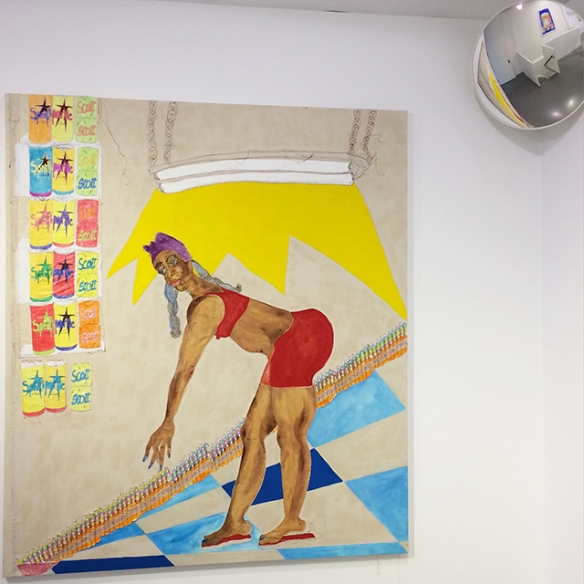
Having marvelled at these works the next destination is Pilar Corrias Gallery. Tshcabalala Self has themed her first show here around the Bodega, the US equivalent of the corner shop. Lots of bottles of pop line the shelves. They seem to stand as a sort of cypher for the artist’s own memories of these shops. In addition to paint, the images use collage and stitched fabric. Even the gallery itself plays a role in the artwork. Three neon signs hang in the window and anti-theft mirrors are installed in each corner of the gallery, like the type the shop keeper glances up at from behind the till.

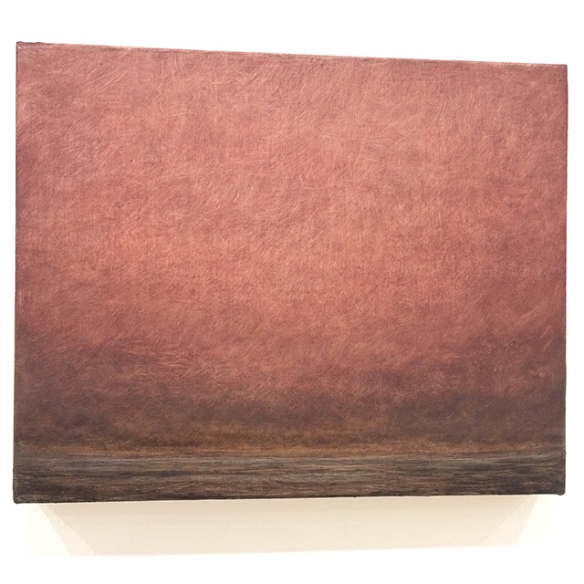
The rain has now started and after arriving at David Zwirner Gallery it is necessary to dry off in a porch opposite for a few minutes to remove any obvious signs of a soaking. Downstairs Lucas Arruda has displayed delicate landscapes and upstairs Suzan Frecon is displaying the studies for large abstract paintings she would go on to produce, though they themselves are not on display here.

Finally there are two further excursions from under the rain protection of overhanging facades. First at Simon Lee Gallery, Jeff Elrod has exhibited paintings composed chiefly of spray paint. The effect is to create an abstract surface and is exemplified by a fantastic large scale work upstairs that resists any attempt for the eyes to focus upon it. In that sense the painting offers an experience to the viewer that is almost physical. The last excursion, which is to Thomas Dane Gallery reveals an interesting twist to the standard summer group show format. Here the works are given 9 hours of individual air time in the empty gallery before returning to the packing cases, which themselves are all on display. Eventually, though, a sort of climax is scheduled to take place wherein all the individually displayed works will go up in the gallery at the same time. As the curator explains, this should have an interesting effect as each piece re-appropriates its piece of wall in a packed display, perhaps displacing others sideways in the process.

Now with the weather unexpectedly clearing up and only a short distance covered up to this point, I head west to build up the miles and attempt to convert these fragmented visits to the galleries into something more resembling an actual gallery run.

811
Spot the loo roll!
Gregory Crewdson at The Photographers Gallery with a body of work depicting life in an American town and surrounding forrest. The photos are carefully staged tableaux.

812
Tschabalala Self of Pilar Corrias with paintings of a type of corner shop called a #Bodega. Spot the anti theft mirror you would find in the corner shop.

813
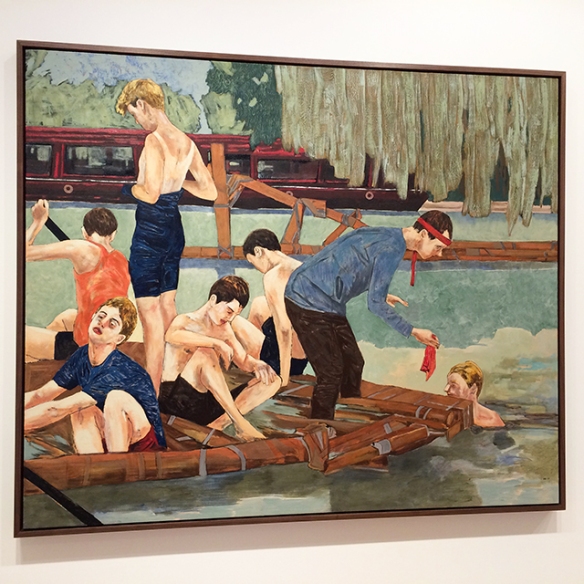
Hernan Bas at Victoria Miro Gallery with paintings of revellers and rebels in Cambridge.

814
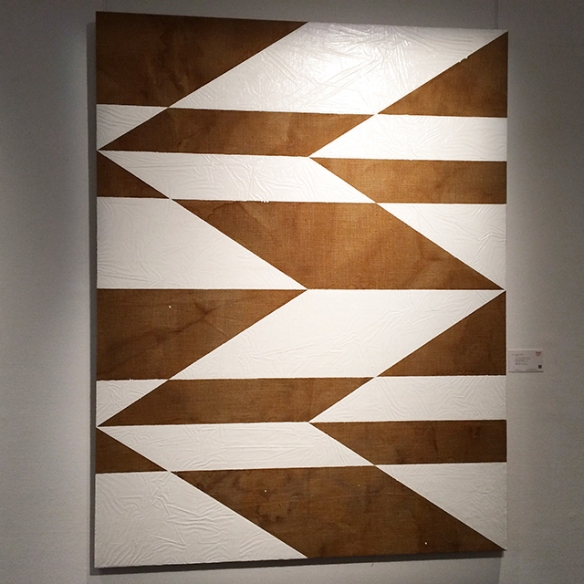
Mark Hagen uses a gloss white surface on a canvas-like support in this composition shown at Sotheby’s St George St.

815
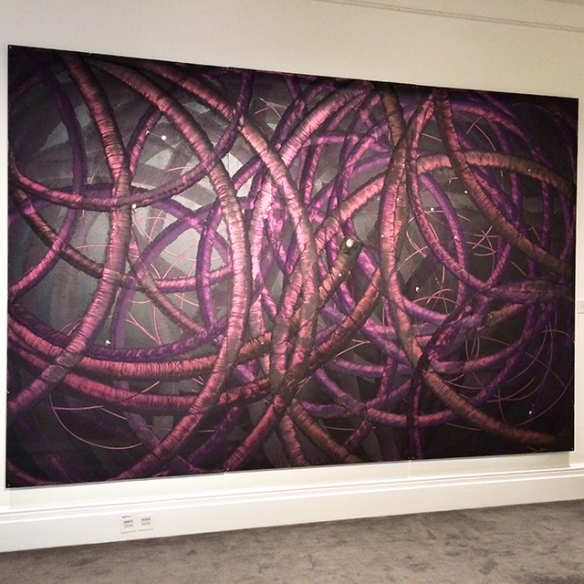
Aaron Young at Sotheby’s.

816
Lucas Arruda at David Zwirner with delicate landscape. They have immaculate matt surfaces, revealed by the complete lack of glare when photographed.

817
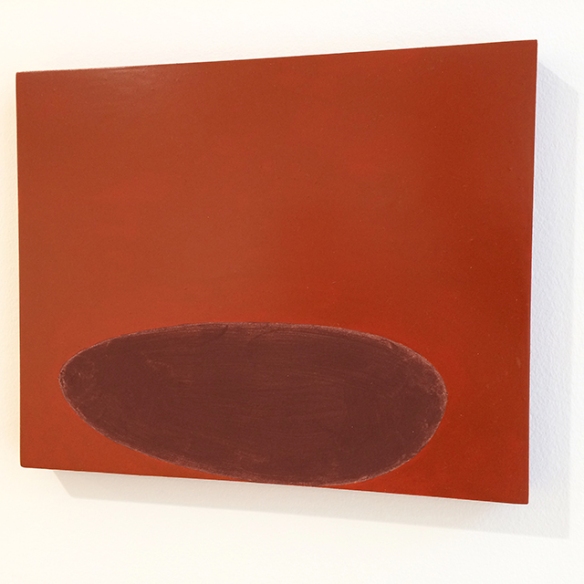
Suzan Frecon at David Zwirner with delicate studies for larger abstract pieces on show in New York.

818
Jeff Elrod of Simon Lee Gallery with paintings using spray paint.

819
Lari Pittman at Thomas Dane Gallery waiting to be displayed. The gallery displays each work for just 9 hours in this group show. Later on in September all the works go on display together.